
Use the market itself to find a fair price, remove the vig, and bet the bookmaker prices that beat it.
Watch the Top-Down EV video


Positive EV
Not All Expected Value (EV) Is Created Equal: A Look Into How To Evaluate EV Bets
Most bettors chase big edges, but few understand how odds shape real outcomes. Learn why the same EV can produce wildly different results, how variance impacts profit, and the smarter way to grow your bankroll consistently.

You have decided you want to get into the world of +EV bets. Great. This is the way!
But not all expected value should be viewed the same. EV betting is a volume game. So before you jump into putting your entire bankroll on EV bets, it is important you understand some of the nuances of EV betting.
What is EV?
Expected value (EV) is the difference between what a bookmaker is offering you and what the bet is actually worth. If a bookmaker prices a selection at $3.00, but the true probability suggests fair odds of $2.50, you’re getting more than the bet is worth, that’s a positive EV bet. The “edge” in that case is about 20%: you’re being paid $3.00 for something that should cost $2.50.
In BetSniper, we have two major strategies we use.
Positive EV betting: uses the aggregate market average as the benchmark
Benchmark EV betting: choose a singular bookie benchmark, or construct your own custom weighted benchmark
It’s worth noting that this is a good but not perfect measure of true EV. The benchmark itself has a margin built in and can occasionally be wrong. But over a large sample, bets that consistently beat the benchmark is profitable. It’s the most practical and reliable method available to everyday punters, and it’s the foundation of everything that follows in this article.
This is often referred to as a top-down betting strategy (as opposed to a bottoms-up strategy which requires you to originate prices which takes a lot of resources and mental effort).
What does 5% EV actually mean?
Let’s start with what a 5% edge actually means in practice. If you place a bet at $3.00 odds with a 5% edge, it means the true fair odds on that selection are around $2.86. The bookmaker is paying you more than the bet is worth. For every $100 you stake on bets like this, you’d expect to make $5 in profit over the long run. That’s your 5%, it’s the gap between what you’re being paid and what the bet is truly worth. This does not mean you always win. But if you placed this bet in infinity you would expect to have a 5% return.
Most punters treat EV like a universal measuring stick. A 5% edge is a 5% edge, right? Whether you’re backing a $2.00 favourite or a $6.00 longshot, that 5% should mean the same thing.
It doesn’t.
EV tells you your theoretical edge on a single bet. But it tells you almost nothing about how your bankroll will actually behave over the next 100, 500, or 1,000 bets. Two punters can both have a genuine 5% edge, both place 500 bets, both use proper staking, and end up in completely different financial positions. One cruises to a tidy profit. The other is underwater and questioning everything.
If you want to learn about staking check out our staking guide
The difference isn’t the edge. It’s the odds. And the mechanism that connects them is called variance.
Same Edge, Wildly Different Outcomes
The best way to understand this is to use some numbers.
Here’s what actually happens when you take a 5% edge and apply it across different odds levels. Same edge, same number of bets, same $10,000 starting bankroll. 500 bets each. We’ll compare two staking approaches: quarter Kelly (which adjusts your stake based on odds and edge) and a simple flat 1% of your starting bankroll ($100 per bet).
Odds | Win Rate | 1/4 Kelly stake | Median Profit | Chance of loss | Top 5% results |
|---|---|---|---|---|---|
2.00 | 52.5% | 1.3% | +$3,000 | 17% | +$10,900 |
3.00 | 35.0% | 0.6% | +$1,460 | 25% | +$6,000 |
4.00 | 26.3% | 0.4% | +$900 | 28% | +$4,500 |
6.00 | 17.5% | 0.3% | +$480 | 32% | +$3,100 |
8.00 | 13.1% | 0.2% | +$300 | 35% | +$2,400 |
Look at the median profit column. At $2.00 odds, the typical punter walks away with around $3,000 profit. At $8.00 odds with the exact same 5% edge, the typical punter makes about $450 after 500 bets. That’s nearly a 7x difference in real-world profit from the same theoretical edge.
The Median Is Where You Want To Look At
The median profit is what the typical punter actually experiences, it’s the midpoint of all possible outcomes. Half do better, half do worse. It’s the most honest number in betting.
So why does the median collapse at higher odds? Because short odds bets are dramatically more capital efficient. They let you put more of your bankroll to work on every bet.
Because of how staking works. Quarter Kelly sizes your stake based on your edge and the odds. When odds are short, your edge translates into a larger stake relative to your bankroll. At $2.00 odds, quarter Kelly tells you to stake about 1.3% of your bankroll per bet. At $8.00, it drops to just 0.2%.
If you were to flat stake your bets all the way up to higher odds, your risk of blowing out increases dramatically.
Your 5% edge is doing the same proportional work, but it’s working on a much smaller amount of money. Short odds let you deploy more capital per bet with the same level of risk.
Think of it like interest on a savings account. 5% interest on $10,000 earns you $500. 5% interest on $1,000 earns you $50. Same rate, different base, different outcome. Kelly staking forces you to shrink that base at higher odds because the risk of a long losing streak is too dangerous otherwise.
The result is that the same EV percentage becomes dramatically less valuable as odds increase.
The most under-looked variable in EV betting: your bankroll growth rate
What actually matters is not your EV on any individual bet, but how fast your bankroll compounds over time. This is your growth rate.
A bet with 5% EV at $2.00 odds and a bet with 5% EV at $8.00 odds have the same expected return per dollar staked. But the $2.00 bet grows your bankroll faster because you can comfortably bet more on this bet.
The idea of the Kelly Criterion is that it maximises your long-term bankroll growth.
What about if I get more edge?
Often lots of punters will see the big edges on BetSniper and get a bit carried away without properly understanding the risk profile. You can see that a lot of the bets with the highest EV on the positive EV screen tend to have much higher odds.
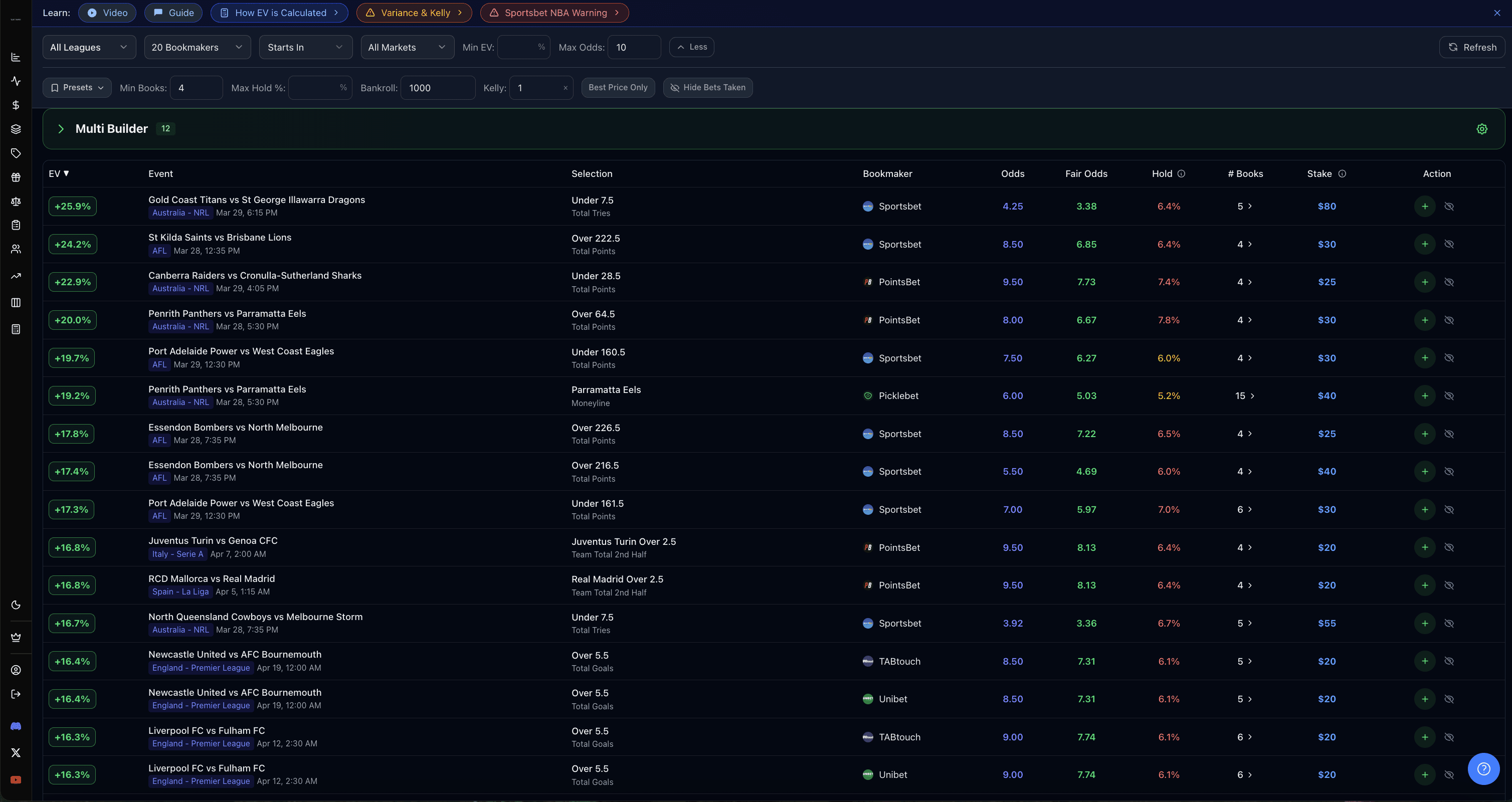
These bets are fine to play, but it is important you understand their risk profile.
Let’s run the same example as above, except this time we will assume a 10% return.
Odds | Win Rate | 1/4 Kelly stake | Median Profit | Chance of loss | Top 5% results |
|---|---|---|---|---|---|
2.00 | 55.0% | 2.5% | +$19,900 | 3% | +$63,500 |
3.00 | 36.7% | 1.3% | +$7,000 | 9% | +$24,500 |
4.00 | 27.5% | 0.8% | +$4,600 | 13% | +$14,800 |
6.00 | 18.3% | 0.5% | +$2,500 | 21% | +$9,000 |
8.00 | 13.8% | 0.4% | +$1,800 | 25% | +$7,000 |
Look at 10% EV at $6.00 odds: a median profit of +$2,500 and a 21% chance of loss. Compare that to 5% EV at $2.00 odds: a median profit of +$3,000 and a 17% chance of loss.
A punter with double the edge at $6.00 odds still makes less money and has a higher chance of losing than someone with half the edge at $2.00 odds.
At $8.00 odds with 10% EV, the median profit is +$1,800 with a 25% chance of loss. One in four punters still lose money after 500 bets, despite having a 10% edge on every single one.
The maths is brutal and unforgiving. Variance doesn’t care how big your edge is. At long odds, it will eat into your results regardless.
How much edge do you need to make betting at higher odds worth it?
If a punter with a 5% edge at $2.00 odds expects a median profit of ~$3,000 over 500 bets, what edge would you need at higher odds to match that same result?
Odds | Required edge | Median profit | Chance of Loss |
|---|---|---|---|
2.00 | 5.0% | $3,000 | 17% |
3.00 | 7.0% | $3,000 | 17% |
4.00 | 9.0% | $3,300 | 16% |
6.00 | 11.5% | $3,400 | 17% |
8.00 | 13.8% | $3,300 | 17% |
To get the same median result betting at $8.00 odds that you’d get at $2.00 odds, you need nearly three times the edge. A 5% advantage at $2.00 is equivalent in practical terms to needing a 13.5% advantage at $8.00.
What does this mean for punters?
If you’re starting out, the temptation can sometimes to be to chase the largest EV percentages. A +15% EV bet looks a lot sexier than a +4% one. But now you know: that +4% edge at $2.00 odds will likely grow your bankroll faster and more reliably than even a +10% edge at $6.00.
This isn’t about avoiding long odds bets forever. It’s about understanding what you’re signing up for. Short odds with moderate EV is the most forgiving way to learn. You get quick feedback, manageable swings, and your results start to reflect your edge in a reasonable timeframe. Once you’ve proven the process works and built both your bankroll and your confidence, you can start layering in higher-odds plays, with full awareness of what the variance looks like.
There’s also a massive psychological element that doesn’t show up in any spreadsheet. At $2.00 odds, you’re winning roughly every second bet. A bad run might be four or five losses in a row. You can see the wins coming regularly enough to trust the process. At $6.00 odds, you’re losing five out of every six bets. You will go on runs of 15, 20, even 25 straight losses and that’s with a genuine edge. Intellectually, you might understand that the maths is on your side. Emotionally, after watching your bankroll bleed red for three weeks straight, most people break. They second-guess the strategy, abandon the staking plan, or quit entirely. The edge was real the whole time, but the variance killed their conviction before the results could materialise.
Here’s the practical gameplan:
Start with shorter odds. Filter by max odds of $2.50 to $3.00. You’ll find plenty of +EV bets in this range across AFL, NRL, NBA, and racing markets. The edges might be 2–8%, but that’s more than enough to build with.
Use proper staking. Quarter Kelly is the gold standard, but if you’re sticking to shorter odds, flat staking at 1–2% of your bankroll per bet is perfectly reasonable. At $2.00 odds, quarter Kelly works out to about 1.3% anyway, so you’re in the same ballpark. Where flat staking becomes dangerous is at longer odds, where you can rack up 15–20 losses in a row and blow through a huge chunk of your bankroll before a single win lands.
Track everything. After 200+ bets at short odds, you’ll start to see your edge materialise in your actual P&L. That confidence, earned through real results, is worth more than any single high-EV play. You can track all your plays in BetSniper with the Bet Tracker which tracks your EV and will auto result at the end of the day.
Expand gradually. Once you’ve built a buffer, start adding $3.00–$5.00 odds bets into the mix. Your bankroll will be large enough to absorb the higher variance, and you’ll have the mental resilience to ride out the inevitable swings.
We can predict our expected returns with EV betting. But we must have an understanding and an appreciation for variance and the cost it has. When you are comparing edges, the size of the odds fundamentally matter.
Positive EV is a Top-Down EV Method
Positive EV is one of BetSniper’s top-down EV methods. Instead of building a betting opinion from scratch, top-down EV starts with the market, compares prices across bookmakers, and highlights opportunities where the available price is better than the fair price.
Explore the Top-Down EV tool to compare Positive EV with Benchmark EV, Line Out EV and Pick’Em EV in one place.




Learn how to become a profitable punter with our guide
We have put 20+ years of betting knowledge into one guide to help you become a better punter as well as share why each BetSniper tool exists, how to use it and the best strategies you can implement today with the BetSniper tools!

Co-founder
I've been betting seriously for over a decade, ever since I realised you can actually make money from sports betting. I studied Economics and Finance at the University of Melbourne and funded my entire time there through betting. Over the years I've become obsessed with building tools and taking a mathematical, strategic approach to the markets. I've poured that experience into building BetSniper - the ultimate companion tool for the smart punter. I now spend my time educating others on how to think about betting strategically, discovering new strategies and ultimately making as much money as possible from sports betting.


Get access to cutting-edge technology as well as a helpful community to help you start making smart decisions when you are betting.


