


Education
What Is a Multi Bet? A Complete Guide for Australian Punters
Learn what a multi bet is, how parlay betting works in Australia, and how to build smarter multis across AFL, NRL, NBA, and more.

What Is a Multi Bet?
A multi bet combines two or more individual selections into a single wager. The odds of each leg multiply together, producing a much higher potential return than any single bet could offer, and every leg must win for it to pay out. One loss anywhere on the ticket and the whole bet goes with it.
The strategy is also called a parlay, accumulator, or all-up -- but in Australia, "multi" is by far the most common term you'll hear.
Multi betting is worth understanding because it
turns a modest stake into a significantly larger potential payout
works across almost every sport, league, and market type available in Australia
forms the foundation of popular bet types like the Same Game Multi, which has become one of the most widely used products at Australian bookmakers
How Does Multi Betting Work?
The mechanics are straightforward. You pick two or more outcomes across different events, add them to your bet slip, and the bookmaker multiplies the odds of each selection together to produce your combined multi odds. Place your stake on those combined odds, and if every single leg wins, you collect.
Here’s the formula for a multi bet:
Leg 1 Odds x Legs 2 Odds x Leg 3 Odds (and so on)
And this is how your returns are calculated:
Stake x Combined Multi Odds
Stake × Combined Multi Odds |
Here's how the numbers look in practice:
Say you're building a three-leg AFL multi using the best available prices on Betsniper's odds screen.
Fremantle Dockers to win: 1.33 with Neds
Hawthorn Hawks to win: 1.80 with Ladbrokes
Gold Coast Suns to win: 2.09 with Dabble
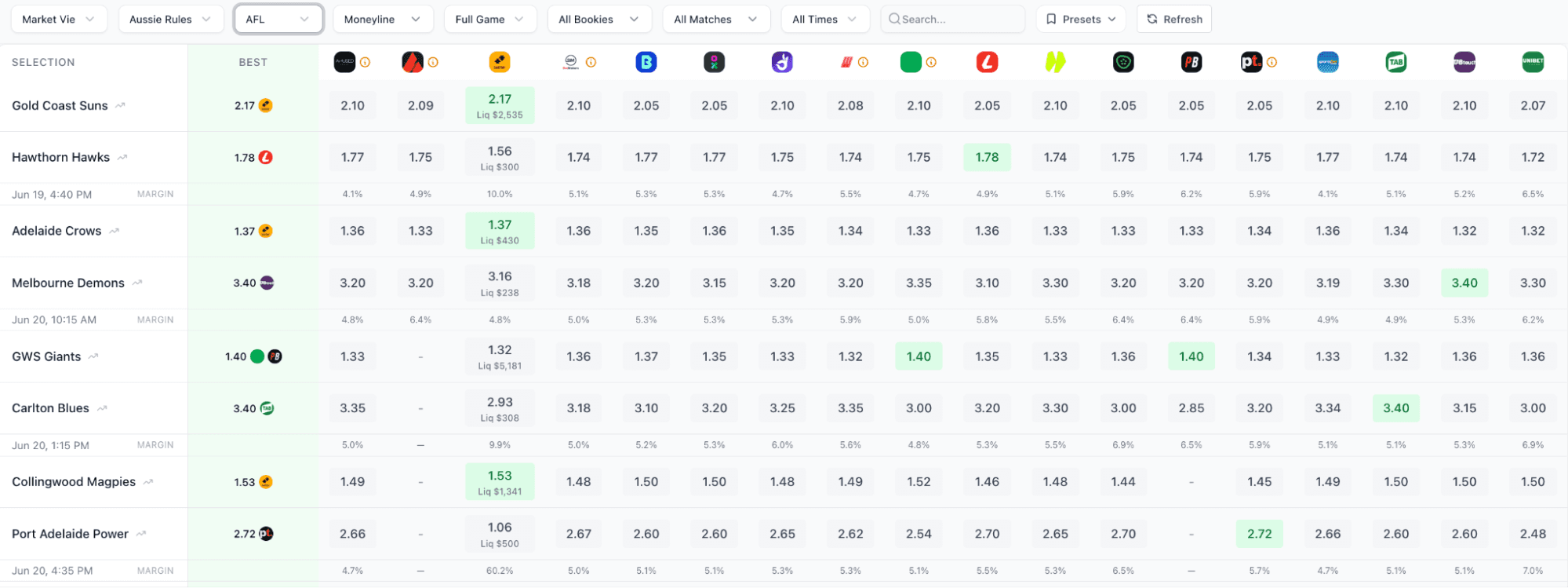
Your combined multi odds:
1.33 × 1.80 × 2.09 = 5.00 |
On a $20 stake, that's a potential return of $100 -- an $80 profit.
If you'd placed $20 on each of those three games as individual singles and won all three, you'd collect roughly $43 in profit total. The multi more than doubles that from the same three picks.
But the flip side is just as stark. If the Suns lose despite Fremantle and Hawthorn both winning, your multi returns nothing. That $20 is gone, whereas two of your three singles would have still paid out.
Why the bookmaker's margin compounds in a multi
Every leg you add to a multi carries the bookmaker's built-in margin. On a single bet with a 5% margin, the house has a 5% edge. Stack four legs together, each with a 5% margin, and the effective margin compounds across the whole bet -- the longer the multi, the more that works against you mathematically.
This is why the best multi bettors are extremely selective about which legs they include and where they source the odds. Stacking legs for the sake of bigger numbers is exactly how the compounded margin does its damage.
Multi Bet Examples
Here's how multi betting plays out in practice across a few common scenarios.
1. A standard cross-sport multi
This is the most common type. You pick winners across different codes on the same day and let the multiplied odds do the work.
Say it's a Thursday evening with both AFL and NRL games on the card.
You check Betsniper's odds screen and pick the best available price on three selections:
Fremantle Dockers at 1.35 with Tab
Hawthorn Hawks at 1.80 with Ladbrokes
The Dolphins at 1.45 with Neds
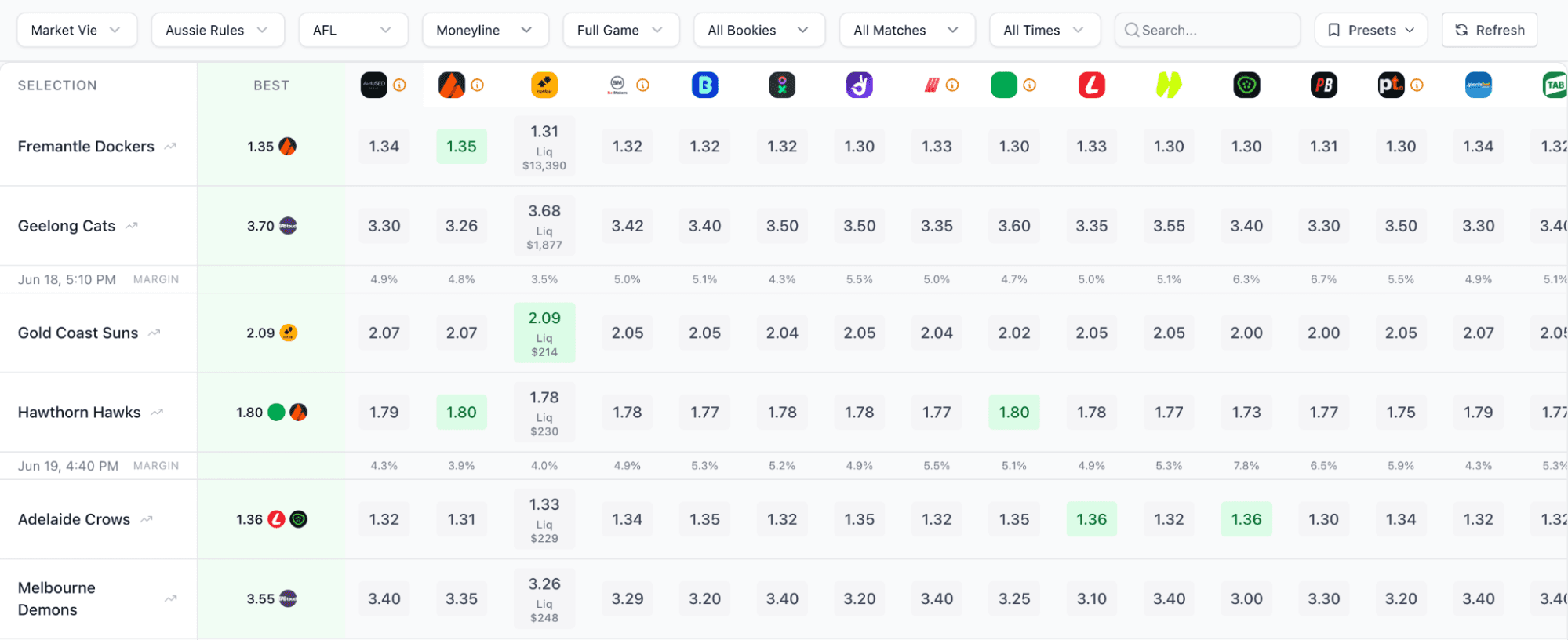
You plug all three into Betsniper's Multi Calculator with a $50 stake for a combined odds of:
1.35 × 1.80 × 1.45 = 3.52 |
A $50 stake returns $176.18 if all three win -- a $126.18 profit.
Place those same three as individual singles at $50 each and winning all three returns roughly $78 in profit total across $150 staked.
As you can see, the multi delivers meaningfully more from a smaller outlay.
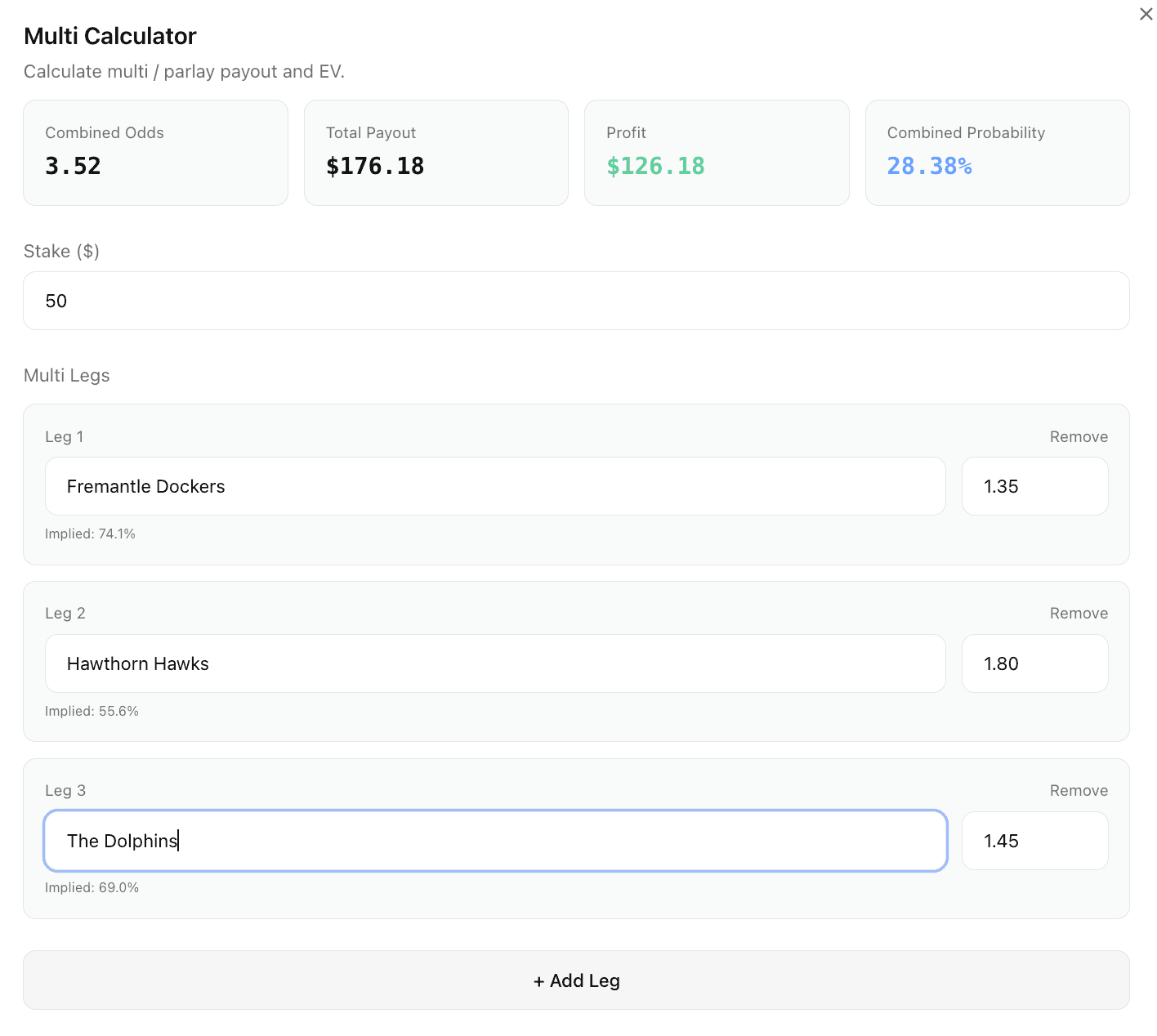
If the Dolphins lose despite the other two legs winning, the whole multi is gone. This is the trade -- higher ceiling, no partial return.
2.Combining a short-priced favourite with player props
A short moneyline favourite on its own is rarely worth betting in isolation -- backing Penrith Panthers at 1.27 returns almost nothing for the risk of a single upset. The instinct to add one as a "safe" anchor leg in a multi is common, but it only makes sense if that leg carries positive expected value. A favourite priced at 1.27 with a true probability closer to 1.35 doesn't anchor anything and just adds a losing leg at compressed odds.
Where this strategy has merit is across separate matches, combining multiple positive EV selections from different games. Each leg needs to stand on its own analytical case:
A well-researched disposal prop from one game
A total tries line from another
A moneyline where the favourite is genuinely underpriced…
…combined across matches, these can build meaningful multi odds without the correlation issues that come with stacking legs from the same game.
Same-match combinations involving props from a single game fall under Same Game Multis, which bookmakers price differently to account for correlation between legs -- and that adjustment is rarely in the punter's favour.
3. A multi that builds from line movement
Start with a single bet that you think has real potential, then build outward from there.
For instance, let’s say you’re looking at Betsniper’s NRL odds screen and notice the Wests Tigers are priced at 3.00 with one bookmaker -- the best price in the market by a meaningful margin, with most books sitting between 2.84 and 2.95.
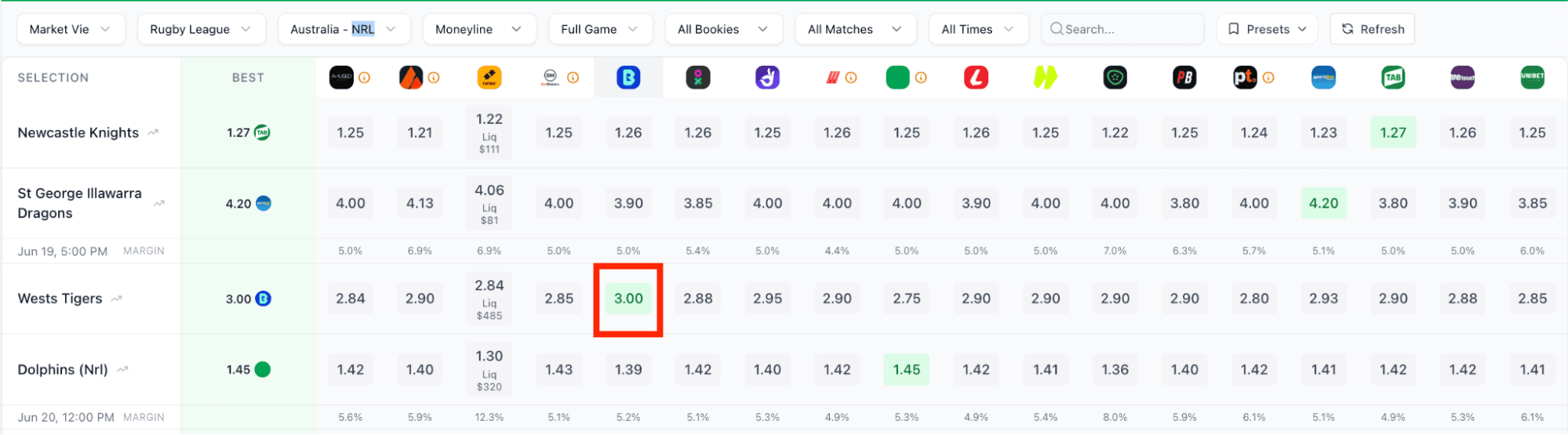
Your research -- recent form, injury news, travel schedule -- suggests the Tigers have a real shot that the 3.00 price doesn't fully account for. That's the anchor leg.
From there, rather than betting the Tigers as a single and moving on, you identify a second underdog from a separate match that you've assessed similarly, and combine both into a two-leg multi at the bookmaker offering the best price on each.
Use the Betsniper's Multi Calculator to get an idea of the combined odds and return before you commit.
This approach works best when the market move confirms an opinion you already held. If you're adding legs simply because the original bet is in a good position and you want to squeeze more out of it, you're usually introducing risk rather than value.
Does Multi Betting Actually Work as a Strategy?
Multi betting works -- but only with the right approach behind it.
Most multi bettors lose over time because the bookmaker's margin compounds with every leg added. Stack five legs with a 5% margin each and the effective edge against you is substantial before the first game kicks off.
That's the part the big combined odds number obscures. Every leg on a multi ticket should clear the same bar as a standalone single: does the price represent value against the true probability, and is it the best available price across the market? If both answers aren't yes, the leg doesn't belong on the ticket.
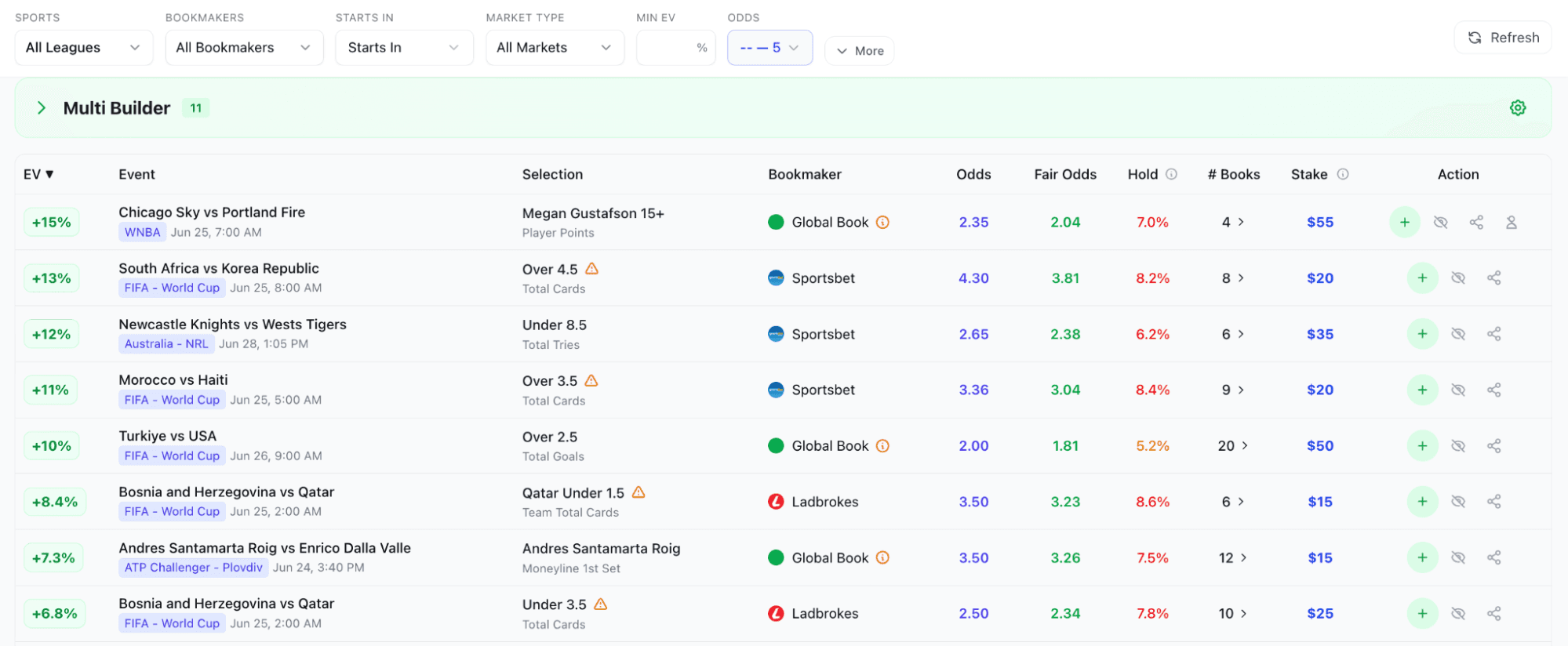
Betsniper's Positive EV tool does that scanning for you -- flagging prices across 18+ Australian bookmakers that sit above what the broader market implies. Use it to filter your legs before you build.
What Are the Best Sports for Multi Betting in Australia?
The sports with the deepest markets, most reliable data, and most consistent pricing gaps across bookmakers give you the best multi betting foundation.
AFL and NRL dominate Australian multi betting by volume. The sheer number of weekly games across 18+ rounds, combined with the depth of markets on offer -- head-to-head, line, player props, same game multis -- makes both codes a natural playground for multi bettors. The volume of competing bookmakers also means price differences appear regularly, especially earlier in the week before sharp money aligns the market.
NBA runs year-round on Australian platforms and generates consistent overnight action across time zones. With 82 regular season games per team, the volume of available legs is enormous. It's also one of the sports where player prop markets -- rebounds, assists, points -- tend to stay softer for longer than the head-to-head line, giving multi builders more options to find value legs.
Soccer (A-League, EPL, Champions League) is popular for multi betting, though the three-way market (home, draw, away) makes selections genuinely harder to analyse than a two-outcome event. Still, the depth of competition and year-round availability keeps it a firm favourite for Australian multi bettors.
Tennis is one of the cleanest sports for multi building. Two players, one winner, no draw. ATP, WTA, and the four Grand Slams keep the calendar full year-round, and the head-to-head format means your multi analysis is simpler than in team sports where lineup changes, injuries, and rotations can shift the market overnight.
Horse racing has a long tradition of multi betting in Australia, often through the "all up" format where winnings from one race roll directly into the next selection. The volatility of racing markets also means prices move quickly and significant gaps can appear across bookmakers, particularly in the minutes before a race.
How to Build Better Multi Bets in Australia
Finding genuinely good multi bets is harder than it looks. Here are the most effective methods for improving what goes into your ticket.
1. Start with an odds comparison screen
Before adding any leg, confirm you have the best available price. On a single bet the difference between 1.80 and 1.90 is marginal. It isn’t when the odds are multiplied across five legs.
Betsniper's Odds Screen pulls live prices from 18+ Australian bookmakers simultaneously, so you can see at a glance which book is offering the highest return on each potential leg before you build the ticket.
2. Run each leg through a positive EV filter
The biggest mistake multi bettors make is adding legs because they feel confident, not because the price is right. A leg where the bookmaker's odds are below what the broader market implies is a negative EV selection -- adding it to your multi hurts the expected return of the whole ticket regardless of how likely you think that team is to win.
Betsniper's Positive EV tool benchmarks each market against Pinnacle, the sharpest bookmaker in the world and the closest thing betting has to a true price, to identify where an Australian bookmaker is offering more than the market implies. Using only positive EV selections as your multi legs is one of the clearest ways to build a more disciplined multi betting approach over time.
3. Keep your legs to a manageable number
Longer isn't better. A two- or three-leg multi built from genuinely valued selections will outperform a seven-leg ticket padded with confidence picks over the long run. Every leg you add -- even a short-priced one -- multiplies the variance of the ticket. A five-leg multi where each leg wins 70% of the time still loses more than half the time. The combined odds number grows with each addition, but so does the probability of a single leg collapsing the whole ticket. Discipline about what goes in matters more than the size of the payout.
4. Focus on less-traded markets and early lines
AFL and NRL head-to-head markets are corrected quickly because they attract enormous betting volume. Player props and lower-division soccer tend to stay mispriced longer -- these are the markets where a leg with genuine positive value is more likely to exist and more likely to still be there when you go to place it.
5. Track your multi results over time
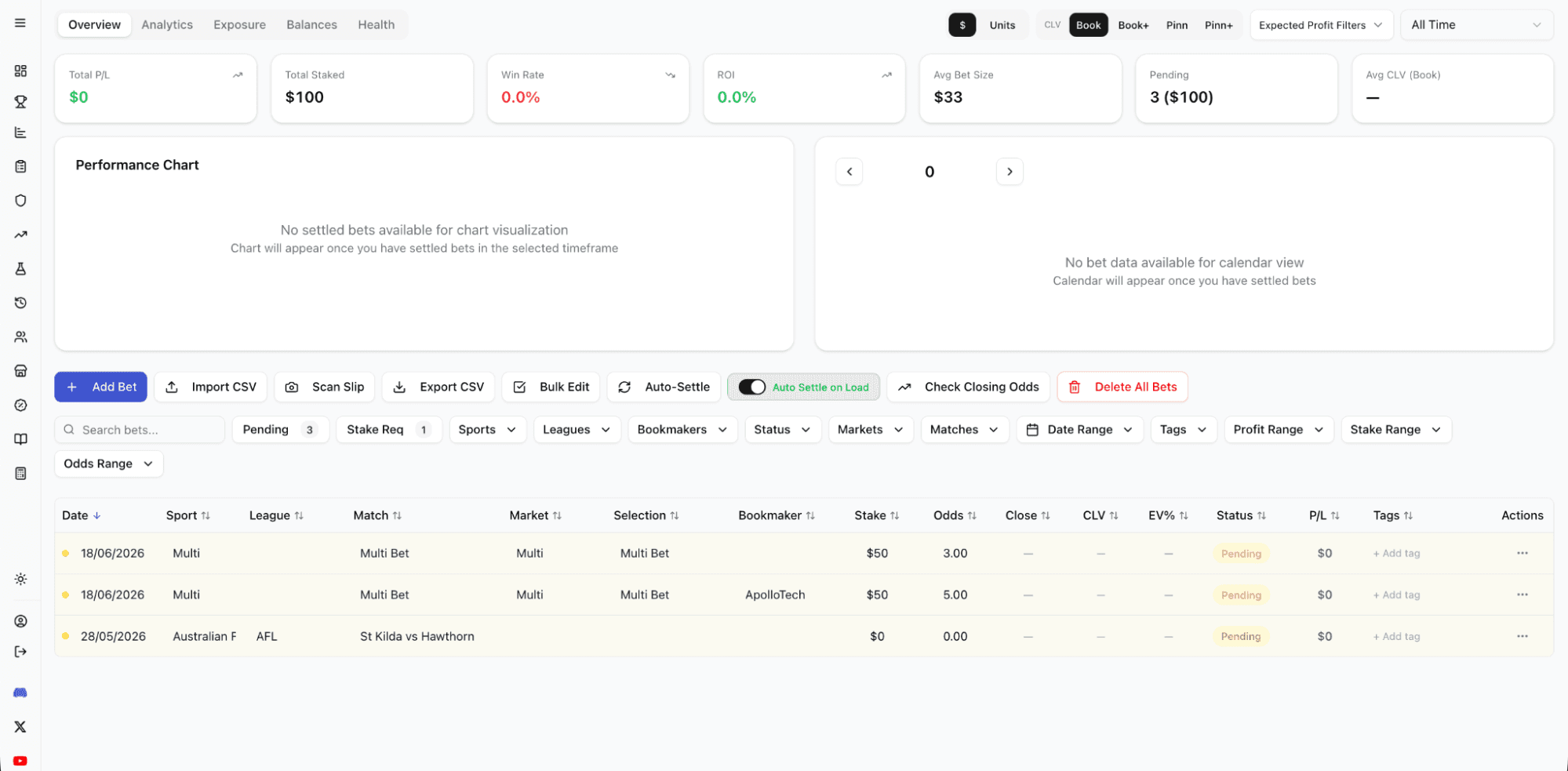
Without a record of what you've bet, which legs have won and which have lost, and what your overall return on multi betting has been, you have no basis for improving. It's easy to remember the times a multi paid out and forget the cumulative cost of all the losing tickets.
Betsniper's Bet Tracker lets you log every bet -- including each leg of a multi -- and review your performance over time. Seeing which legs consistently win and which consistently drain value from your tickets is the feedback that actually sharpens your multi strategy.
Types of Multi Bets in Australia
Not all multis work the same way, and understanding the variations is useful before you start building tickets.
Standard multi (win multi): The most common format. Every leg must win. Two selections is called a double, three is a treble, and from four upward you'll often just hear "four-leg multi," "five-leg multi," and so on. Most Australian bookmakers allow multis of up to 20 or 25 legs.
Same Game Multi (SGM): All legs come from a single event. Popular for AFL, NRL, and NBA. Odds are adjusted by the bookmaker to account for the correlation between legs, meaning they're not calculated by simple multiplication.
Boxed multi (round robin): This format allows some legs to lose and still return a profit. A "three from four" boxed multi, for example, places every possible three-leg combination from your four selections, meaning one losing leg doesn't kill the entire bet. The downside is the cost -- you're effectively placing multiple tickets at once, so your total outlay is multiplied.
Racing all-up: Common in horse racing. Your winnings from the first leg roll directly into the next selection as the stake. If the first leg loses, the bet ends. If it wins, the full return becomes the stake on the next leg.
Is Multi Betting Legal in Australia?
Yes. Multi betting is completely legal in Australia. The Interactive Gambling Act 2001 permits online sports betting through any bookmaker licensed by Australian state or territory authorities -- and every major Australian bookmaker is fully compliant when offering pre-match multi products across sports and racing.
The one restriction worth knowing is in-play. Pre-match multi legs placed online before an event starts are legal. Once the event is live, online in-play wagering on Australian-licensed platforms is not permitted under the Act. Phone betting remains available for in-play markets through licensed bookmakers, but that falls outside standard pre-match multi betting.
Common Multi Betting Mistakes
Most multi bettors make the same mistakes. Here's what to avoid:
Padding the ticket to inflate the odds: Adding an extra leg because the combined price looks more exciting is the most common and most costly mistake in multi betting. Every added leg is another compounded layer of bookmaker margin -- and another way for the whole ticket to fall over.
Chasing losses with longer multis: Moving to bigger, longer tickets after a losing run to "get it back in one hit" rarely works.
Not shopping for the best price on each leg: Using the same bookmaker for every leg of a multi is expensive. A single leg priced 10% higher at a different bookmaker changes your combined multi odds on a five-leg ticket significantly. Check prices before you commit.
Not tracking results: Without records, you can't know whether your multi strategy is actually generating returns or just producing the occasional large win between many losing tickets. The big collect from a seven-leg multi feels significant, but it may not cover the accumulated losses from all the tickets that nearly got there.
Letting promotions drive your selections: Multi Builder tools, same game multi boosts, and multi insurance offers are some of the most heavily marketed products in Australian sports betting. A boosted price on one leg can make the combined odds look attractive while the rest of the ticket carries no real value. Each leg needs to stand on its own merits before a promotion enters the equation.
Bottom Line
Multi betting is the easiest way to turn a small stake into a significantly larger payout. The problem is that most punters build their multis the wrong way.
Betsniper gives Australian punters the tools to close that gap -- from a live odds screen that shows the best available price on every leg across 18+ bookmakers, to a Positive EV finder that flags when a selection is genuinely mispriced in your favour, to a Bet Tracker that tells you honestly whether your multi strategy is working over time.
If you're going to stack legs, you may as well make sure each one is pulling its weight.




Learn how to become a profitable punter with our guide
We have put 20+ years of betting knowledge into one guide to help you become a better punter as well as share why each Betsniper tool exists, how to use it and the best strategies you can implement today with the Betsiper tools!

Co-founder
I've been betting seriously for over a decade, ever since I realised you can actually make money from sports betting. I studied Economics and Finance at the University of Melbourne and funded my entire time there through betting. Over the years I've become obsessed with building tools and taking a mathematical, strategic approach to the markets. I've poured that experience into building Betsniper - the ultimate companion tool for the smart punter. I now spend my time educating others on how to think about betting strategically, discovering new strategies and ultimately making as much money as possible from sports betting.


Get access to cutting-edge technology as well as a helpful community to help you start making smart decisions when you are betting.


