
FEATURES
My Bets
Top-Down EV
Hedging Tools
Punting Tools
Odds Tools
Racing
Community
Sharp Money Tools
Other
TOP-DOWN EV
Use the market itself to find a fair price, remove the vig, and bet the bookmaker prices that beat it.
Watch the Top-Down EV videoTop-Down EVEvery bookie price that beats a fair, de-vigged market pricePositive EVReal-time scan for bets priced above the sharp market's fair valueBenchmark EVCompare each bookie's price against one sharp reference bookPinnacle EVDe-vig Pinnacle, the world's sharpest book, and flag bookies that beat itPick'Em EVFind positive EV legs for your Dabble Pick'Ems
FEATURES
My Bets
Top-Down EV
Hedging Tools
Punting Tools
Odds Tools
Racing
Community
Sharp Money Tools
Other
TOP-DOWN EV
Use the market itself to find a fair price, remove the vig, and bet the bookmaker prices that beat it.
Watch the Top-Down EV videoTop-Down EVEvery bookie price that beats a fair, de-vigged market pricePositive EVReal-time scan for bets priced above the sharp market's fair valueBenchmark EVCompare each bookie's price against one sharp reference bookPinnacle EVDe-vig Pinnacle, the world's sharpest book, and flag bookies that beat itPick'Em EVFind positive EV legs for your Dabble Pick'Ems
Getting Started With BetSniper
This guide goes over all the tools and some betting basics. Depending on your level of experience and expertise you may not need to reach every section.
What is BetSniper?
Welcome! BetSniper is the ultimate tool for the smart punter to use data and mathematical strategies to get an edge over the bookmaker.
We have been betting for 10+ years, and it’s the tool we always wish existed in Australia. Check out our full story here.
BetSniper is an information product. We pull real-time betting data from every major Australian bookie, run it through our algorithms, and surface it in dashboards that show you where prices are moving and where the edges are.
These are not tips. What we do is show you exactly how professional punters bet and we teach you how to make smarter betting decisions where the edge is in your favour.
Built for: Punters who want a systematic, data-driven edge
Not built for: Anyone looking for tips, locks, or “guaranteed winners.” If that’s what you want, you’re in the wrong place (and truthfully, these never exist)
Claim your free trial
You can sign up to BetSniper here. A free account gives you limited access to some of our tools, which is enough to get a feel for the platform.
For full access, we offer a 7-day free trial for first-time users. You’ll need to add your card details to start, but you can cancel anytime during the trial and still keep access for the full 7 days.
Coming soon
Want to make 100 units every month?
This guide covers all the main strategies and the basics to get you started. But if you are serious about going to the next level, we are also building the Sniper Academy. This will be a tight community with hands-on coaching, detailed guides and instructional videos, advanced analytics, and the deeper tips and strategies we use ourselves to win consistently.
Over the last few years we've profited $100,000+ from BetSniper ourselves, and helped hundreds of other punters bank $10,000+ a year.
Detailed video lessons
Every strategy taught step by step
Live walkthroughs
Real bets analysed in real time
Advanced strategies
The plays we don't share publicly
More data and tools
Beyond what standard members get
Private community
Other serious punters to learn with
Direct founder access
For questions and strategy reviews
Whether you're starting from zero or already turning a profit, the Academy is built to cut years off your learning curve.
We're putting it together now and want to make sure it solves the problems serious punters actually have. Register your interest and you'll be the first to know when it opens.
Join the Discord
Once your trial is active, head over to our Discord and verify yourself. This is where the BetSniper community lives, ask other members what strategies are working for them, follow the day-to-day discussion on bets and edges, and learn from punters who’ve been doing this for a while.
Verifying yourself unlocks our premium-only channels, including the alert channels. Instructions are in the #verify-yourself channel and takes only 30 seconds to complete.
PS: users on free trial can verify themselves and get access to premium-only channels.
Introduction to Betting Basics
Before you start using BetSniper, it’s worth understanding how betting markets actually work. Most punters lose money not because they’re unlucky, but because they don’t understand the maths working against them. This section will get you up to speed.
Bookmakers
Every bookmaker sets their own odds, independently. This is based on their own traders, models, and risk appetites.
A few things worth knowing:
Some books offer way more markets than others. larger bookmakers tend to have the deepest market coverage (player props, exotic markets, niche sports). Where smaller books often only price head-to-heads, lines, and totals.
Bookmakers are considered either sharp or soft. Sharp books (like Pinnacle) price tightly with low margin and welcome winners, their lines reflect the true probability of an outcome. Soft books (most Aussie bookies e.g. Sportsbet, Ladbrokes, Neds, TAB, Betr price loosely with higher vig and limit winning accounts.
You need accounts at multiple books. You can only act on an edge if you have an account at the book offering it. If you want to make money from sports betting, you need to have accounts open at all the bookmakers
There are over 100+ bookmakers in Australia. We have compiled the full bookmaker list as well as available deposit offers.
Note: there are 100+ bookmakers in Australia, however a lot of them get their odds from the same provider. You can see our bookmaker list to understand all the unique bookmakers in the market as well as the bookmaker that share their odds from one provider (we refer to these bookmakers as clones).
What are betting limits?
You can't just bet whatever you want, whenever you want.
Every market has a maximum stake the book will accept, and it varies wildly:
Major markets (AFL/NRL head-to-heads) might let you bet thousands
Player props and niche markets often cap at $500
Sharp markets and live betting are usually the tightest
On top of market limits, books will also limit your account personally if they decide you're winning too much or betting too sharply. This is called being "stake-limited" or "factored down." A bet that used to take $500 might suddenly only take $5.
It is important you have a basic understanding of betting limits before you start. We have put together a guide where we go over everything you need to know about betting limits.
Why do 99% of punters lose?
Punters lose because it’s odds are engineered so that before you even place a bet the edge is with the bookmaker. The system is built so regular people can’t win:
1. They take negative EV bets. Every bet a recreational punter places at standard bookie odds is, on average, a losing bet, because the vig is built in, no matter how confident your mate is at the pub.
2. They bet multis. Multis are the bookies’ favourite product, and for good reason. Every leg you add multiplies the vig or the edge for the bookmaker. Assume the average vig of 7%. Remember that means on average you will lose 7% on every bet. When you play a multi, you are multiplying the vig together. For a multi, your expected loss will be:
2 legs: 1.07² = 1.1449 → 14.5% vig
3 legs: 1.07³ = 1.2250 → 22.5% vig
4 legs: 1.07⁴ = 1.3108 → 31.1% vig
5 legs: 1.07⁵ = 1.4026 → 40.3% vig
How is anyone supposed to win, when the odds are so much in favour of the bookmaker.
3. They take one-sided markets. Markets like “Will [Player] score a try in the first 10 minutes?” can carry unlimited vig. Because the bookmaker does not post the otherside of the market, they are able to offer punters really bad odds.
4. They have no way to identify edges. This is the big one. The average punter sees a market on a betting app and has no idea whether the odds are sharp or soft, whether there’s value or vig, or how this book compares to the rest of the market. Without a tool that aggregates every bookie’s prices in real time, identifying an edge is essentially impossible.
That last point is the whole reason BetSniper exists. We take the data the books would rather you didn’t see, every price, across every book, updated live, and turn it into a clear signal.
Setting up accounts
To get started with BetSniper, the first step is to actually set up your betting accounts.
When you set up your account, make sure to take advantage of the sign-up offer bookies have. Bookmakers no longer can publicly advertise these bonuses but can offer them to you once you are an existing customer.
Most bookmakers have a bonus immediately on sign-up, or will offer it to you in the first week or so. You can also always call up and see if they would be willing to give you one as well. But even if you don’t want to deposit right away, it is a good idea to set up the account as they will eventually send you a sign-up offer.
There are so many bookmakers in Australia. We have a complete list on all bookmakers in Australia as well as which ones are offering deposit bonuses.
To maximise your winnings from punting, you need to have money spread across multiple accounts so that you can always get the best price.
Once you put money into a betting account, there are usually turnover requirements. This is normally turning over your deposit once over. Once you read through the rest of this guide, this will be very easy to do and should not be anything you need to worry about.
Converting bonus bets
This is the first skill you need to learn to be become a profitable punter.
If you do get bonus bets, you can quickly turn that into cash. The catch with bonus bets is that you don’t get your stake back if the bet wins, you only collect the profit. A $100 bonus bet on $2.00 odds returns $100, not $200.
That makes bonus bets feel less valuable than cash, but there’s a way to convert them into guaranteed profit: bet both sides of the same market. Use the bonus bet on one side, and place a cash bet on the other side at a different bookie. No matter which outcome wins, you lock in a known profit. We should aim for at least 70%+ conversion and in most instances an find an 80%+ conversion if we are patient.
The BetSniper Bonus Bet Converter does the maths for you. Pick the bookie holding your bonus, and we’ll surface every market across our 50+ bookies where you can convert it. Enter your bonus bet amount, and we’ll calculate exactly how much to stake on the other side, what you’ll profit, and which bookie to place it at.
So we place a $50 bonus bet on St George -3.5 at 5.20 odds. At the same time we place a bet on Ladbrokes on Cronulla +3.5 at 1.25.
We have now covered all options and no matter what happens, we will get a profit of $42.
Let's look at an example:


What are odds?
Probably the most important concept to understand in betting, but most people even punters who bet everyday, would not be able to explain it to you. So here is what you need to know:
Odds are just probabilities, dressed up in decimal form.
If a bookie offers $2.00 on a team, they're saying "we think this team has roughly a 50% chance of winning." The maths is straightforward: implied probability = 1 ÷ decimal odds.
A few quick examples:
$1.50 → 66.7% implied probability
$2.00 → 50% implied probability
$3.00 → 33.3% implied probability
$5.00 → 20% implied probability
When you place a bet, you're really making a claim that the true probability is higher than what the odds imply. If a bookie is offering $2.20 (45.5% implied) on something you think is genuinely a 50% shot, you've got an edge.
What is vig/juice/margin?
This is the most important concept to understand about betting markets. It explains how bookmakers are billion dollar corporations.
The price you get from a bookmaker does not reflect the true probability. They will always have their price underneath the true probability. That is how they make money.
If a bookie offered "fair" odds on both sides of a coin flip, they'd price both sides at $2.00. Each side has a 50% chance, the implied probabilities add up to exactly 100%, and over time the bookie would break even. No profit.
So they don't do that. Instead, they price both sides at something like $1.91 / $1.91. Now the implied probabilities are 52.4% on each side, adding up to 104.8%. That extra 4.8% is the vig (also called juice, margin, or overround). It's the bookmaker's built-in edge, baked into every market they price. Another way to interpret this number is that by placing this bet, in the long-run you can expect to lost 4.8%.
The vig that bookmakers offer varies greatly depending on the market as well as the bookmaker. The vig on head to head markets ranges from 3-5% whereas the vig on player props usually is 6-8%. For some niche markets or markets with more than one selection the vig is often >10%.
To calculate the vig in a market you add up the implied probabilities of every outcome in a market. If they total more than 100%, the difference is the vig.
You can use our fair odds calculator to calculate how much edge the bookmaker has on markets
Coming soon
Want to make 100 units every month?
This guide covers all the main strategies and the basics to get you started. But if you are serious about going to the next level, we are also building the Sniper Academy. This will be a tight community with hands-on coaching, detailed guides and instructional videos, advanced analytics, and the deeper tips and strategies we use ourselves to win consistently.
Over the last few years we've profited $100,000+ from BetSniper ourselves, and helped hundreds of other punters bank $10,000+ a year.
Detailed video lessons
Every strategy taught step by step
Live walkthroughs
Real bets analysed in real time
Advanced strategies
The plays we don't share publicly
More data and tools
Beyond what standard members get
Private community
Other serious punters to learn with
Direct founder access
For questions and strategy reviews
Whether you're starting from zero or already turning a profit, the Academy is built to cut years off your learning curve.
We're putting it together now and want to make sure it solves the problems serious punters actually have. Register your interest and you'll be the first to know when it opens.
The Guide To Become A Profitable Punter
There's no single way to beat the bookies. There are several, and they all work, but they suit different types of punters.
What every winning strategy has in common is maths. You're not picking winners on gut feel or chasing tips. You're finding situations where the odds are wrong, and you're placing enough of those bets over a long time horizon so that variance smooths out and your edge shows up in your bottom line.
BetSniper is built around three core approaches:
Top-down betting
Bottom-up betting
Hedging/arbitrage.
Most successful punters end up using a mix of all three, but it's worth understanding each one on its own before you blend them.
Pick your betting style
Before we get into the tools, it's worth being honest about which approach suits you. Each one has a different trade-off between effort, variance, and ceiling.
We have tools built for all of these different strategies. We advise you to first start off with one strategy and learn the tools and strategies for that before trying another one.
In the following sections, we will go through all the tools for each strategy and explain how to best use them.
| Approach | Best for | Effort | Variance | Profit |
|---|---|---|---|---|
| Top-down | Recommended — Punters who want the platform to find bets for them | Low | Medium | High |
| Bottom-up | Punters who enjoy research and want their own edges | High | Medium | High |
| Hedging / Arbitrage | Punters who want low-risk, consistent returns | Low | Low | Low-medium |
Words of advice from 10+ years professional betting
We have been betting professionally for over a decade. In that time we’ve learned a lot about winning and even more about losing. If I knew everything I knew now when I started, I would have saved myself a lot of pain and suffering.
That is completely expected when you are doing something that inherently is risky. The purpose of this guide is to share with you all of the lessons we have learnt and fast track your experience so you can be making money with betting as soon as possible.
If you are interested in becoming a profitable better and using BetSniper, it’s really important you read this guide. If you wing it, you will lose. If you take the time to read this properly, you’ll come away with everything you need to start beating the bookies yourself.
We will save you a lot of money, time, and heartache along the way.
Enjoy.

Tracking your live bets
If you're running any BetSniper strategy seriously, you'll quickly find yourself with dozens of bets live at any given time. Trying to track all of that mentally is impossible.
We've built a live tracker to solve exactly this. It pulls in every open bet you have across the platform and shows you, in real time, how each one is tracking and what your expected return is right now.
Instead of waiting for results to come in and adding up the damage at the end of the night, you see:
Every open bet in a single view, regardless of sport, bookie, or strategy
Live status of each leg as games play out (winning, losing, on track for a middle, etc.)
Updated return predictions for each bet based on what's happening live — so a Pick'Em with three legs cashing and two still in play shows you exactly how much it's currently worth
Aggregate live P/L across your whole portfolio, so you know whether the day is shaping up green or red without having to do the maths yourself

Coming soon
Want to make 100 units every month?
This guide covers all the main strategies and the basics to get you started. But if you are serious about going to the next level, we are also building the Sniper Academy. This will be a tight community with hands-on coaching, detailed guides and instructional videos, advanced analytics, and the deeper tips and strategies we use ourselves to win consistently.
Over the last few years we've profited $100,000+ from BetSniper ourselves, and helped hundreds of other punters bank $10,000+ a year.
Detailed video lessons
Every strategy taught step by step
Live walkthroughs
Real bets analysed in real time
Advanced strategies
The plays we don't share publicly
More data and tools
Beyond what standard members get
Private community
Other serious punters to learn with
Direct founder access
For questions and strategy reviews
Whether you're starting from zero or already turning a profit, the Academy is built to cut years off your learning curve.
We're putting it together now and want to make sure it solves the problems serious punters actually have. Register your interest and you'll be the first to know when it opens.
Top-down betting i.e. show me the bets to place
Top-down betting (often referred to as EV betting) uses the market itself to identify a fair price, removes the vig, and then searches for opportunities priced higher than that fair value.
This is one of the purest ways to get true expected value. All bookmakers are trying to set the price as close to true probability as possible. By removing the vig, we get a good estimation of true probability. We can use this to our advantage to find edges.
You don’t need to know who’s playing, what the injury list looks like, or how a team has been travelling. All of this is already baked into the price. We are looking for where there are inefficiencies and sniping them.
A few things to understand about top-down EV:
You’re betting sharp, not picking winners. Your edge comes from getting a better price than the true probability of the outcome. You won’t feel “right” about every bet, you’re trusting the maths.
You won’t win all the time. A 5% EV bet at $2.00 odds still loses ~48% of the time. That’s normal. The edge shows up over hundreds of bets, not five. You must be willing to place hundreds of bets to evaluate your EV strategy. Have a play with our EV betting simulator which can show you what it feels like to implement a top down betting strategy.
You’re grinding out small edges, cents matter. Most +EV bets carry 2-6% edge. That sounds small, but compounded across hundreds of bets per month at proper stakes, it adds up fast.
Patience and discipline are the whole game. There are drawdowns, flat stretches, and runs that test your nerve. The punters who win are the ones who keep placing the bets when it feels like it’s not working.
We have a variety of different top-down EV tools at BetSniper:
Positive EV: scans every bookie in real time and surfaces bets priced higher than the sharp market’s fair value.
Benchmark EV: compares every bookie’s price against a single sharp benchmark (like Pinnacle or Novig) to find the biggest mispricings.
Line-out EV: identifies value across alternate lines and totals, and uses our algorithm to compare odds across lines to spot value betting opportunities
Pick’Em EV: finds positive expected value legs to include in your Dabble Pick’Ems
Coming soon
Want to make 100 units every month?
This guide covers all the main strategies and the basics to get you started. But if you are serious about going to the next level, we are also building the Sniper Academy. This will be a tight community with hands-on coaching, detailed guides and instructional videos, advanced analytics, and the deeper tips and strategies we use ourselves to win consistently.
Over the last few years we've profited $100,000+ from BetSniper ourselves, and helped hundreds of other punters bank $10,000+ a year.
Detailed video lessons
Every strategy taught step by step
Live walkthroughs
Real bets analysed in real time
Advanced strategies
The plays we don't share publicly
More data and tools
Beyond what standard members get
Private community
Other serious punters to learn with
Direct founder access
For questions and strategy reviews
Whether you're starting from zero or already turning a profit, the Academy is built to cut years off your learning curve.
We're putting it together now and want to make sure it solves the problems serious punters actually have. Register your interest and you'll be the first to know when it opens.
Positive EV
Positive EV (expected value) betting is the strategy that underpins most of what BetSniper is all about. If you understand this section, the rest of the platform makes sense.
If you want a full guide to positive EV betting, check out our detailed guide here
The idea is simple: you place bets where the odds the bookie is offering are higher than the true probability of the outcome. This is not a get rich quick scheme nor do we promise you will win every bet. In fact, you will lose plenty, but over hundreds of bets, the edge will be in your favour and profitability is a matter of when not if.
The simplest way to understand positive EV betting is with a coin flip. If someone gave you 3.00 odds for heads, you should always take the bet. You are still going to lose 50% of the time. But when you win, your edge will cover the losses. What if someone gives you 2.10 odds, would you still say yes? Of course you should! You still are getting better odds than 2.00.
Our Positive EV screen, highlights thousands of positive EV betting opportunities every day.
How do you determine what the true odds are?
The truth is that bookmakers are very good at what they do. Bookmaker prices are very good approximations of true probability. So trying to figure out the true odds on your own is a very hard endeavour.
Because each bookmaker is independently pricing a market, we can get many different unique perspective on the price. When we combine those together to form a composite price, this becomes a very good indicator. This is a statistical principle called “wisdom of the crowds”.
The concept was first documented in 1906 by Francis Galton, a British statistician who attended a country fair where 800 people guessed the weight of an ox. No single guess was correct, but when Galton averaged all 800 guesses together, the result was 1,197 pounds — within 1% of the ox's actual weight of 1,198 pounds. The crowd, collectively, was more accurate than any individual expert in the room.
The principle holds whenever you have a large group of independent estimators. Individual errors cancel each other out, and the average converges on the truth.
Betting markets work exactly the same way. Every bookmaker prices each market independently, using their own traders, models, and risk appetites. No single bookie is right all the time, but when you average the prices of every bookie together, the consensus is remarkably accurate. More accurate than any individual bookie on their own.
That consensus is our benchmark. We take every bookie's price for a given market, strip out the vig, and calculate what the bet is actually worth. This is the no-vig market price or fair odds. Our best estimate of the true probability of the outcome.
From there, the strategy is straightforward. If a single bookie is offering odds higher than the fair odds, we can assume this bet has positive expected value. The bigger the gap between their price and the consensus, the bigger your edge.
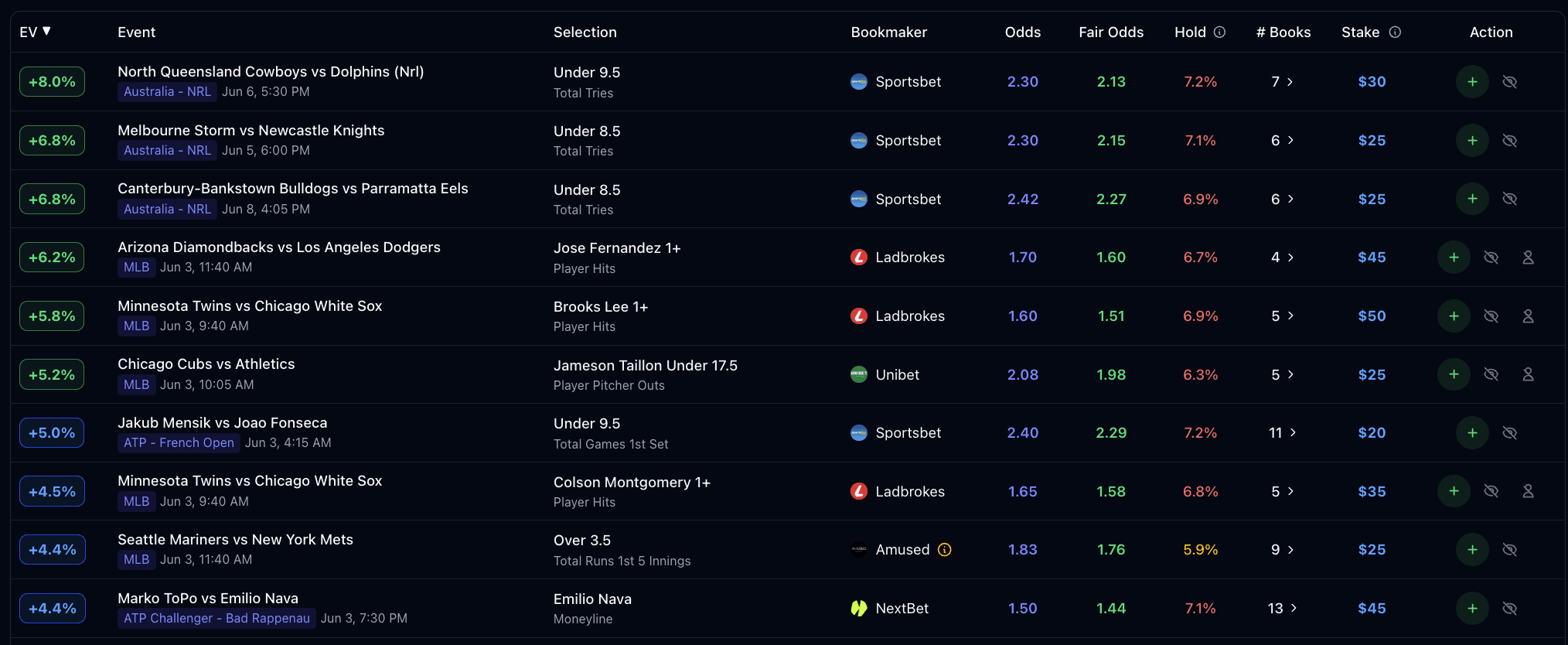
Let’s take a look at an example:
How much money should you bet?
A good rule of thumb: stake 1–2% of your bankroll per bet for odds under $3.00, and drop to around 0.5% for anything above that. Higher odds carry more variance, so smaller stakes protect you from getting wiped out by a losing streak.
If you want to be more precise, you can use the Kelly Criterion, a formula that sizes your stake based on both your edge and the odds. The full Kelly stake is mathematically optimal but aggressive, so most serious punters use quarter Kelly (25% of the recommended stake) to smooth out variance while still capturing most of the long-term growth. You can see the Kelly stake in the tool.
One thing to keep in mind: EV betting is a volume game. The faster you compound your bankroll, the more bets you've placed, not the bigger each bet was. If you find yourself running out of time or bankroll to take all the +EV opportunities you're seeing, scale your stakes down, not up. Taking 50 bets at 1% beats taking 10 bets at 5% every time.
Understanding variance
Variance is the most important concept to understand when it comes to EV betting.
If you place enough +EV bets, you will go on losing streaks. Not might. Will. A 10-bet losing streak with a real edge isn't a sign that something is broken or that your edge has disappeared. It's a statistical certainty, and the more bets you place, the higher your chance of running into one.
The good news is variance is predictable. We can calculate, for any given edge and odds level, how big your worst drawdown is likely to be over the next 100, 500, or 1,000 bets.
This is why staking discipline matters more than anything else. If you stick to 1-2% stakes, you will be in a good position.
Before you place a single bet, run your strategy through our EV Betting Simulator to see what your bankroll curve will actually look like. It’s a really useful exercise to get your head around what an EV betting strategy looks like as well as seem some advanced analytics around drawdowns, risk and profitability.
Positive EV multis
Early on in this guide, we mentioned that multis are terrible expected value plays for the punters. This is because each leg is negative EV.
But… What happens if each leg is positive EV? Then the edge compounds in our favour.
We highly recommend playing multis for a few reasons:
Can get more money down per positive EV selection
Your edge compounds
Better for your account sustainability as bookmakers like you playing multis
By playing multis, you are adding a lot more variance to your strategy. But it is still positive expected value. As long as you play enough volume, it will still be profitable.
Below is one BetSniper subscribers results from playing Positive EV multis. They only win 26.3% of their bets but have a 32.8% ROI which is insane!
To get an understanding of volume, they gave placed 1,300+ multis. All of those 1,300+ multis were found using BetSniper, using our recommend strategy shared here.

How to use the BetSniper Positve EV tool?
The BetSniper positive EV tool is super easy to use. Each row on the tool is a unique positive EV bet. Before you place bet, there are a few things to consider:
| Question | What to look for |
|---|---|
| How many bookmakers are pricing the market? |
Generally speaking, the more bookmakers pricing the market, the better the fair odds estimate will be. More bookmakers means a more robust fair odds calculation.
Our recommendation is to have at least 6 bookmakers pricing the market. |
| What are the odds? |
Expected value is expected value, so it doesn't actually matter what the odds are. What matters about the odds is the variance — the higher the odds you play, the higher the variance. This can be a lot harder for new punters as the bumps can be very big.
When you play EV bets with higher odds, you usually want higher EV percentages to overcome the variance. Odds > 3 would be considered quite high and would carry high variance. An important concept: not all EV is the same. A 5% edge at $2.00 will grow your bankroll far faster, and far more reliably, than a 5% edge at $8.00 — shorter odds let you stake more per bet and ride out variance with smaller losing streaks. |
| How long until the match starts? |
The fair odds estimate is always most accurate as close to the start of the match as possible. Where possible, bet within one hour of the match starting.
This isn't always possible — the further out you bet, the fair odds can drift down (improving your edge) or up (decreasing it). That's a small risk you take betting hours before an event. We strongly advise against betting the day before an event. It's a very quick way for bookmakers to know you're sniping prices — no regular punter bets a day out. |
| What is the EV %? |
There's no perfect number, but you want to be playing with some edge. We recommend taking anything above 2%.
The idea with EV betting is high volume across a high number of different positive EV opportunities. Don't just pick one or two bets a day — while that's profitable long-run, it's not how to implement an EV strategy. |
Our recommend Positive EV betting strategy
From our experience of implementing this strategy for 5+ years, here is our recommend betting strategy:
A minimum of 6 bookmakers pricing the market
A minimum EV of 2%
Odds < 4 (odds < 3 for new positive EV betters)
Bet as close to the match as possible (ideally within 1 hour)
We are also always running back-dated tests to see how the strategy performs. Over 7,000+ bets, here is how this strategy has performed

This is the over/under 5.5 rebounds market for Julian Champagnie in the Spurs vs Thunder game. Ten different bookmakers have priced both sides of the market, that's ten independent estimates of how likely Champagnie is to grab 6 or more rebounds.
Taking the average of all ten bookies and stripping out the vig, we calculate a fair price of $2.08 on the over, an implied probability of 48.1%. This is our best estimate of the true probability of the outcome.
But Unibet is currently offering $2.14 on the over, an implied probability of 46.7%. They're out of step with the rest of the market.
That gap is your edge. Betting Unibet's $2.14 against a true price of $2.08 gives you a 2.9% edge. Over the long run, for every $100 you stake on bets like this, you expect to win $2.90 on average.
It doesn't sound like much. But place a hundred of these a week at proper stakes, and the maths compounds quickly. This is how professional punters think about betting. It is a volume of game. In reality, it would be super rare to find opportunities where bookmakers are significantly wrong. They way to win is to pick off little edges every day.

Coming soon
Want to make 100 units every month?
This guide covers all the main strategies and the basics to get you started. But if you are serious about going to the next level, we are also building the Sniper Academy. This will be a tight community with hands-on coaching, detailed guides and instructional videos, advanced analytics, and the deeper tips and strategies we use ourselves to win consistently.
Over the last few years we've profited $100,000+ from BetSniper ourselves, and helped hundreds of other punters bank $10,000+ a year.
Detailed video lessons
Every strategy taught step by step
Live walkthroughs
Real bets analysed in real time
Advanced strategies
The plays we don't share publicly
More data and tools
Beyond what standard members get
Private community
Other serious punters to learn with
Direct founder access
For questions and strategy reviews
Whether you're starting from zero or already turning a profit, the Academy is built to cut years off your learning curve.
We're putting it together now and want to make sure it solves the problems serious punters actually have. Register your interest and you'll be the first to know when it opens.
Benchmark EV
Benchmark EV works on the same principle as Positive EV, find bets priced higher than fair value, but with one key difference: instead of using the average of every bookie in the market, you use a single sharp bookmaker as your benchmark for fair odds.
Pick a bookmaker as your benchmark, strip out the vig from their prices, and the tool surfaces every market where another bookie is offering odds higher than that benchmark. That gap is your edge.
When we are using a benchmark, we want to use a sharp book. Their prices are tighter, their limits are higher, and they update faster than recreational books. Sharp book prices are very good approximation for the true probability of an event especially near the start of the event.
Why use a benchmark instead of the market average?
Sharp bookmakers (like Pinnacle) price markets tightly, take large bets from professional punters, and update their odds the moment new information arrives.
Soft books price loosely, cater to recreational punters, and are slower to react. Exchanges (Betfair, Novig, Polymarket) can also be good sources of true price. The gap between a sharp and a soft price is often where the cleanest edges live. Read more about the difference between sharp and soft books here.
Further, there are some bookmakers that specialise in certain sports. They can be really useful to use as a benchmark to find more positive EV betting opportunities.

How to use Benchmark EV?
The Benchmark EV tool in BetSniper is really easy to use. It’s like the other EV tools where you have your filters for leagues, bookmaker, markets, start time, EV% and max odds.
Additionally, you can set your benchmark with three different modes:
Single: benchmark to a single bookmaker
Average: benchmark to the average of two or more bookmakers
Weighted: benchmark to a custom weighted average of two or more bookmakers
Once you have set your benchmark, you can check can see all the plays where the other bookmakers are larger than the fair odds price at the benchmark bookmaker.
Similar to all EV betting strategies, it is advisable to try and bet as close to the start of the match as possible.
What benchmarks should I use?
Pinnacle: for match and totals markets
Pinnacle is the gold standard for sharp pricing globally. They’ve operated on a low-margin, high-volume model for over 25 years, run vig as low as 2% on major markets, and famously welcome winning players rather than limiting them. Their head-to-head and totals prices are widely regarded as the closest thing to a “true” price in betting.
A useful trick: use Pinnacle’s stake limit as a signal of how confident they are in a price. When Pinnacle has a $1,000+ limit on a market, it means their traders are confident the line is correct and they’re happy to take big action on either side. Smaller limits (under $200) usually mean the price is unsettled or they’re waiting for more information. The bigger the limit, the more weight you can put on Pinnacle’s number.
From our testing, here are what results have looked like betting within 1 hour of the match starting with EV > 2%
Circa Sports: for US sports
Circa is the sharpest book in the United States and the benchmark for US sports markets. A few reasons they’re respected:
Low spreads on every market: they consistently post the tightest lines in the US, often well inside other major books
They accept professional money: unlike most US sportsbooks, Circa actively encourages sharp action. Big bettors can place serious stakes without being limited
They move first on news: Circa’s traders react to injury reports, lineup changes, and weather faster than the rest of the US market, which makes their prices the leading indicator for NFL, NBA, MLB, and NHL
From our testing, here are what results have looked like betting within 1 hour of the match starting with EV > 2%:
Sportsbet — for NBA player props
This one surprises people. Sportsbet is a soft book overall, but their NBA player props are genuinely sharp and here’s why:
They accept sharp money on props: Sportsbet is owned by Fanduel who are known for taking some small sharp action so they can move their prices quickest
They’re always first to move on news: injury announcements, lineup changes, Sportsbet’s NBA props react within seconds, well ahead of the rest of the Aussie market
You can’t beat them with a standard +EV strategy: by the time the market average catches up to a Sportsbet price move, the edge has already disappeared. They’re not a soft book to bet against on NBA props; they’re the sharp reference everyone else is following
They are comfortable hanging prices: Sportsbet will often sit out from the rest of market due to their confidence in their pricing
For NBA player props specifically, indexing off Sportsbet’s price gives you a far more accurate benchmark than the market consensus.
However, this strategy works bets when you bet with Sportsbet when matches are starting in 30 minutes or less.
We actually did a project where we tracked the results and we discovered there was a really big edge here.
—
We are constantly monitoring the market for new edges and will share with BetSniper users when we find new edges.
Coming soon
Want to make 100 units every month?
This guide covers all the main strategies and the basics to get you started. But if you are serious about going to the next level, we are also building the Sniper Academy. This will be a tight community with hands-on coaching, detailed guides and instructional videos, advanced analytics, and the deeper tips and strategies we use ourselves to win consistently.
Over the last few years we've profited $100,000+ from BetSniper ourselves, and helped hundreds of other punters bank $10,000+ a year.
Detailed video lessons
Every strategy taught step by step
Live walkthroughs
Real bets analysed in real time
Advanced strategies
The plays we don't share publicly
More data and tools
Beyond what standard members get
Private community
Other serious punters to learn with
Direct founder access
For questions and strategy reviews
Whether you're starting from zero or already turning a profit, the Academy is built to cut years off your learning curve.
We're putting it together now and want to make sure it solves the problems serious punters actually have. Register your interest and you'll be the first to know when it opens.
Line Out EV
Line Out EV applies the same core EV principle of using the market to identify value but does this by comparing prices across lines for props.
For most props, bookmakers will price the main line. Some bookies will have multiple over/under lines where as others will just provide alternate over lines. Most bookies will focus on the main line, but their alternate lines are often derived quickly from a model and don't always reflect the true probability of each outcome. By comparing prices across lines, we open ourselves to more opportunities (that may not be captured by Positive EV and Benchmark EV).
We built an algorithm that uses historical over/under prices as well as live market prices to infer the true probability at the consensus main line. We then transform that probability to estimate fair value at any deviating line.
It's the same top-down approach as our other EV tools. We use the collective wisdom of the market as a guide, then identify where one book has stepped out of line without properly accounting for the difference.
The result is a whole layer of opportunities that the standard +EV scanner misses, because most +EV tools only look at the primary line.
For some sports, there are alternate over/under priced at multiple lines so these bets may already appear in positive EV (like for NBA). On the other hand, there are spots like AFL (specifically player disposals) or NFL where there is usually limited alternate over/under lines and this is where this tool shines.
How is fair value calculated?
The challenge with alternate lines is that you usually don't have many bookies pricing the same alternate line for direct comparison. If one book is offering over 21.5 disposals when every other book is pricing over 20.5, the standard +EV approach falls down, there's no consensus to benchmark against.
Our algorithm solves this by working in two steps.
Step 1: Anchor the true probability at the consensus main line. We take every bookie's over/under prices at the consensus main line (where there is deep coverage), strip out the vig, and calculate the true implied probability of the outcome.
Step 2: Transform that probability to estimate fair value at any deviating line. Using historical over/under data as well as live market prices, we've modelled how probability shifts when a line moves up or down for different stats at different values. From the anchored true probability at the main line, we can project a fair price at any alternate line — over 21.5, over 22.5, over 23.5, and so on.
The two-way nature of over/under markets is what makes this possible. Because every market has both an over and an under, we can strip out the vig and benchmark against the market's own implied true odds, which is the cleanest signal available.
We continue to refine the algorithm as we collect more historical data, tuning it for specific stats and player distributions.
How to use the Line Out EV tool?
The Line Out EV tool is similar to all the other EV betting tools. All the bets are recommended to take due to a top-down analysis of the market.
Like the other EV tools, we have filters for:
Leagues
Bookmakers
Starting time
Min EV %
Min odds
What is unique to the line out EV tool
Minimum number of consensus books
Value of the line
Deviation of the line
The higher EV % returns better as well as the more bookmakers as the consensus.
Our recommended filter are:
Minimum 5 books pricing the consensus line
Minimum EV of 2%
Betting within 1 hour of the match happening
If you would have followed this strategy, here is what your results would look like:
The two main criteria we need to think about are:
Number of consensus books
Minimum EV %
From our backtesting, there is a clear recommendation:


Coming soon
Want to make 100 units every month?
This guide covers all the main strategies and the basics to get you started. But if you are serious about going to the next level, we are also building the Sniper Academy. This will be a tight community with hands-on coaching, detailed guides and instructional videos, advanced analytics, and the deeper tips and strategies we use ourselves to win consistently.
Over the last few years we've profited $100,000+ from BetSniper ourselves, and helped hundreds of other punters bank $10,000+ a year.
Detailed video lessons
Every strategy taught step by step
Live walkthroughs
Real bets analysed in real time
Advanced strategies
The plays we don't share publicly
More data and tools
Beyond what standard members get
Private community
Other serious punters to learn with
Direct founder access
For questions and strategy reviews
Whether you're starting from zero or already turning a profit, the Academy is built to cut years off your learning curve.
We're putting it together now and want to make sure it solves the problems serious punters actually have. Register your interest and you'll be the first to know when it opens.
Pick'Em EV
Pick’Em is a fixed-odds player prop format unique to Dabble in the Australian market. Instead of standard over/under odds, you pick More or Less on a set of player projections and the payout multiplier is fixed based on how many legs you include.
There are no odds, but rather a fixed payout for the number of legs you include. As you can only pick over or under, the concept is that each option is (close to) a 50-50.
The more legs you put in your Pick’Em, the bigger the payout. They offer two types:
All-in: need all legs to win for the payout
Hedge: can have some legs lose but still get a smaller payout
Check out this article where we going into more details explaining the differences between All-In and Hedge options for Dabble Pick’Em
Because you are multiplying bets together, it’s usually massively advantageous for the bookmaker. But using the BetSniper Pick’Em EV tool, we can turn that edge into our favour in a big way.
Why is Pick'Em beatable?
Dabble's fixed payouts are the entire reason this product is exploitable.
Every other betting market on the planet has bookies setting custom odds for each leg, with the vig built in dynamically. Pick'Em doesn't. The payouts are locked in regardless of which players you pick or what their true probabilities are, which means you can calculate exactly what win rate you need on each leg to be profitable.
A 3-leg Pick'Em has a 6.5x payout. This means you need each leg to win 53.56% of the time on average to break even. We can convert that to odds which means you need every leg to have a true price below 1.867 to have value.
Dabble are pricing up even more props than most bookmakers, so with the right tools and EV methodology we have been going through over the last few sections, we can easily beat Dabble Pick’Em.
Our recommended Pick’Em betting strategy and how to use the tool
The Pick’Em EV tool is one of the easiest tools to use.
Simply, go to the Pick’Em EV page, select the legs you want to play as long as they are positive EV and put the bet on.
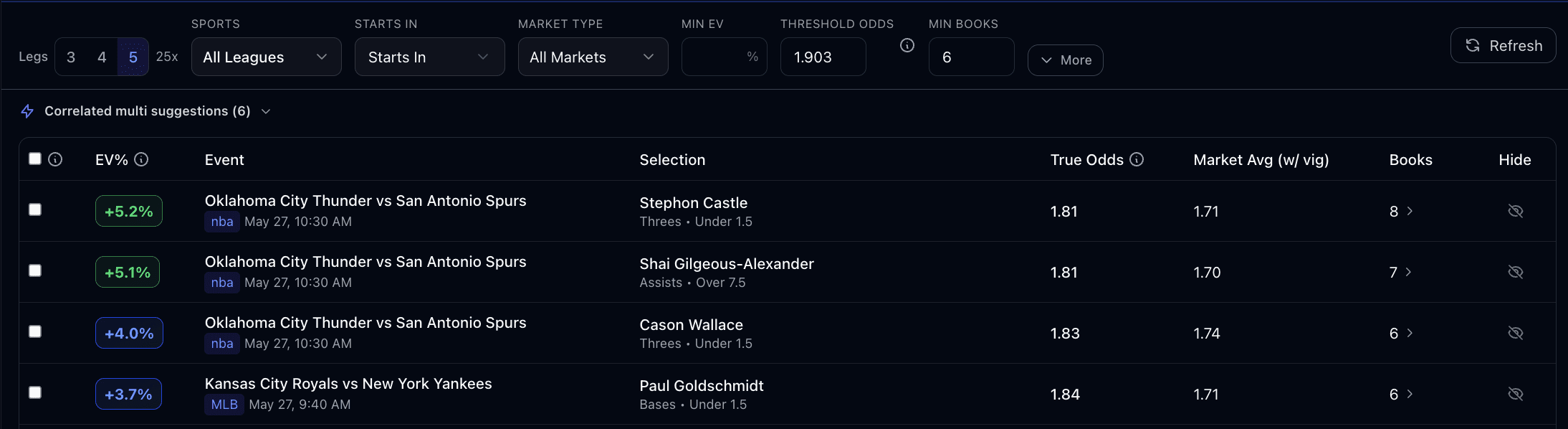
You can quickly filter the options based on the numbers of legs you are going to play with the buttons in the top left corner.
We also have all the normal filters for sports, start time, market, min EV%.
We recommend at least six bookmakers but this can be relaxed if the the EV% is high.
Our recommendation on what Pick’Ems to play:
1. Never play Hedge. It's almost always worse EV than All-In. The reduced variance isn't worth the payout cut you take in exchange — you're paying a premium for a safety net that costs more than it's worth. We've broken down the maths in this article if you want the full comparison.
2. Play 3-leg All-In if variance scares you. The threshold odds are reasonable ($1.867), the EV per bet is solid, and the wins land often enough that you won't sit through brutal cold streaks. This is the most beginner-friendly Pick'Em format.
3. The optimal play is 5-leg All-In. This is the most generous Pick'Em on the board. The threshold odds are $1.903 — the lowest of any size — which makes finding qualifying legs significantly easier, and the EV per bet is materially higher than 3-leg or 4-leg. Variance is higher too, but as long as you have the bankroll and patience for it, you're almost always better off adding the fifth leg.
4. Don't go above 5 legs. Beyond 5, the threshold odds tighten back up and you stop being rewarded for the extra variance you're taking on. A 10-leg Pick'Em paying 500x might look exciting, but the EV gain per leg flattens out while the variance compounds aggressively. You'll wait far longer for wins to land, and the maths doesn't justify the wait.
A few habits that separate winning Pick'Em players from everyone else:
Keep your stakes small. Pick'Em variance is brutal, so stake 0.5% of your bankroll or less per bet. A $1,000 bankroll means $5 stakes maximum. This isn't being conservative — it's being realistic about how long the cold runs can last. Stake too big and you blow up before the wins land.
Bet as close to game time as possible. Late lineup changes (injuries, rotations, rest days) move prop lines significantly — a line that was +EV in the morning might be soft or even -EV by tip-off. Betting last-minute also keeps your account looking recreational rather than sharp, which delays the day Dabble starts limiting you.
Make sure the market is properly priced. Aim for at least 4 bookmakers pricing each leg, ideally 6+. The more books in the consensus, the more reliable the fair price. If you only have 2-3 books, the no-vig benchmark can be noisy and you risk taking bets that aren't actually +EV. As a backup, you can use a single sharp book (Pinnacle, Novig, Betfair Exchange) as your reference price instead of the market average.
Always check the payout is the full payout. Dabble can — and does — reduce the multiplier if they think your legs are correlated (e.g. two players from the same team on the same stat). If you're shown a reduced payout, the EV calculation no longer holds. Recheck the threshold odds against the actual payout, and if it's no longer +EV, skip the bet.
Exploit correlations Dabble misses. Dabble's correlation detection isn't perfect. Some leg combinations are genuinely correlated (e.g. one player's assists and a teammate's points, or rebounds in a high-total game) but Dabble still pays the full multiplier. When you can identify these without triggering a payout reduction, you're stacking additional edge on top of your +EV picks. We're putting together an advanced guide on Pick'Em correlation strategies — coming soon.
Using our strategies and the Pick’Em EV tool, this is one of the easiest edges to exploit as long as you have a long-term mindset and keep your volume high.
Understanding the threshold odds required to win
To be able to beat Dabble Pick’Em, you need to know what the threshold odds are that we need to beat for each Pick’Em.
| Legs | Dabble payout | Threshold odds (All-in) | Threshold odds (Hedge) |
|---|---|---|---|
| 2-leg | 3.2x | 1.790 | N/A |
| 3-leg | 6.5x | 1.867 | 1.808 |
| 4-leg | 12x | 1.861 | 1.855 |
| 5-leg | 25x | 1.903 | 1.861 |
| 6-leg | 40x | 1.849 | 1.879 |
| 7-leg | 80x | 1.870 | 1.871 |
| 8-leg | 150x | 1.870 | 1.875 |
| 9-leg | 275x | 1.867 | 1.888 |
| 10-leg | 500x | 1.862 | 1.884 |
| 11-leg | 1000x | 1.874 | 1.854 |
| 12-leg | 1500x | 1.839 | 1.876 |
How we calculate true odds and expected value for Pick'Em
The Pick'Em EV tool works on the same wisdom-of-the-crowd principle as Positive EV.
For every Pick'Em line Dabble offers, we pull prices from every Australian bookie offering that same prop, strip out the vig, and calculate the true no-vig price. If the no-vig price is below the threshold for your chosen Pick'Em size, the leg is +EV. Stack 3–5 of these and you've got a positive EV bet that beats the fixed Dabble payout.
The more bookmakers pricing the market, the more accurate the fair odds.

Let’s take a look at an individual leg:
The first recommendation is Dane Myers over 0.5 bases. The market average price is 1.62 and 1.75 when you remove the vig. But there are only 3 bookmakers pricing the market.
Pro tip: By default we calculate the fair price using every book in the market, but you can also build a custom benchmark using only sharp books if you want a tighter reference.
Now when we add multiple legs together, to get the combined fair odds, we simply multiply the true odds together. If we take the first three legs from the image above our true odds would be:
1.75 x 1.77 x 1.78 = 5.589
In the Pick’Em EV tool you can select the legs and it will dynamically calculate your combined EV%. For this Pick’Em, we expect a 16.31% edge.

Coming soon
Want to make 100 units every month?
This guide covers all the main strategies and the basics to get you started. But if you are serious about going to the next level, we are also building the Sniper Academy. This will be a tight community with hands-on coaching, detailed guides and instructional videos, advanced analytics, and the deeper tips and strategies we use ourselves to win consistently.
Over the last few years we've profited $100,000+ from BetSniper ourselves, and helped hundreds of other punters bank $10,000+ a year.
Detailed video lessons
Every strategy taught step by step
Live walkthroughs
Real bets analysed in real time
Advanced strategies
The plays we don't share publicly
More data and tools
Beyond what standard members get
Private community
Other serious punters to learn with
Direct founder access
For questions and strategy reviews
Whether you're starting from zero or already turning a profit, the Academy is built to cut years off your learning curve.
We're putting it together now and want to make sure it solves the problems serious punters actually have. Register your interest and you'll be the first to know when it opens.
A note on using multiple EV methodologies
We have several EV tools at BetSniper. We have gone over how they all work and explain why it works. But there are some nuances that you must understand if you are going to bet using multiple different EV methodologies:
A bet can be +EV in both directions. It sounds strange, but it’s true. One book might be pricing the over too high (+EV over), while another book is pricing the under too high (+EV under) on the exact same market. The bet you take depends on the price you’re getting as well as the methodology you have used to derive the fair value.
Different methodologies will give different fair odds. Positive EV uses the market consensus. Pinnacle EV uses Pinnacle as the truth. Benchmark EV lets you pick your own reference. These approaches won’t always agree, and they shouldn’t. A bet that’s +EV on the market consensus but not on Pinnacle just means the market thinks it’s value but Pinnacle disagrees.
Think twice about double or triple up on the same player or team. It’s tempting to back the same player across multiple +EV markets (e.g. Jokić’s points, assists, and rebounds all flag as +EV) but doing this concentrates your risk. If Jokić has a quiet game, all three legs lose together. The maths says each leg is +EV individually, but your variance shoots up because the outcomes are correlated. Spread your action across different players and games when you can. At the end of the day, this is a personal risk tolerance question.
Avoid betting both sides of a conflicting outcome. If one tool flags Team A’s over and another tool flags Team A’s under at a different book, you’re capping your upside. Yes, one will win, but you’ve turned a high-EV play into a low-EV hedge. Pick the side with the bigger edge and stick with it, unless you’re deliberately running an arbitrage.
Multis are powerful, but variance scales fast. Combining multiple +EV legs into a multi compounds your edge, but it also compounds the variance. Two 5% edges combined into a multi don’t give you a 10% edge; they give you a roughly 10% edge with significantly more variance. Multis work, but only if you have the bankroll and discipline to ride out the swings.
Same-game multis are a special case. Bookmakers know that legs within the same game are correlated so they price SGMs differently to standard multis. Instead of just multiplying the individual leg prices together, they collapse the combined price down significantly to account for the correlation. A SGM that should pay 8.00 if you just multiplied the legs might be offered at 5.50 once the correlation adjustment is applied. That collapse often eats every cent of your edge. If you’re going to play SGMs, the question to ask is: has the bookie’s correlation adjustment removed all the value, or is there still edge left after their collapse? Sometimes there genuinely is, books don’t always model correlation correctly, but you need to check the final SGM price against the no-vig benchmark, not assume your edge survives just because the individual legs were +EV.
Coming soon
Want to make 100 units every month?
This guide covers all the main strategies and the basics to get you started. But if you are serious about going to the next level, we are also building the Sniper Academy. This will be a tight community with hands-on coaching, detailed guides and instructional videos, advanced analytics, and the deeper tips and strategies we use ourselves to win consistently.
Over the last few years we've profited $100,000+ from BetSniper ourselves, and helped hundreds of other punters bank $10,000+ a year.
Detailed video lessons
Every strategy taught step by step
Live walkthroughs
Real bets analysed in real time
Advanced strategies
The plays we don't share publicly
More data and tools
Beyond what standard members get
Private community
Other serious punters to learn with
Direct founder access
For questions and strategy reviews
Whether you're starting from zero or already turning a profit, the Academy is built to cut years off your learning curve.
We're putting it together now and want to make sure it solves the problems serious punters actually have. Register your interest and you'll be the first to know when it opens.
Bottom-up betting - show me the tools to use to do research to find my own angles
Before you go any further, it's important to be clear about what bottom-up betting is and isn't.
This is much harder than top-down betting, and no edge is guaranteed. Top-down EV tools find mathematically positive expected value against a sharp benchmark, every flagged bet is a real edge by definition. Bottom-up tools don't work that way. They surface opportunities that might have value, but whether they actually do depends entirely on the research and judgement you bring to them.
It's not as simple as opening a tool and getting an answer. It requires digging. It requires sport knowledge. It can require watching games, understanding roles, tracking matchups, and knowing when historical data applies and when it doesn't. The biggest mistake new users make is treating bottom-up tools like an EV scanner, placing every bet that flags as "potential value" and then being surprised when the results don't land. We categorically advise against this.
There are no shortcuts. To succeed with bottom-up strategies you need rigour, patience, and a willingness to do the work. If that doesn't appeal, you're far better off sticking to the top-down tools, where the platform does the validation for you.
A note on how to use these tools. The bottom-up tools at BetSniper are built to help you quickly organise, filter, and sort otherwise disparate data so you can build your own analysis. They are not blind bet recommendations. Every bet they surface needs to be evaluated. We don't intend or claim that following these tools blindly is profitable. They are purely informational, and you are free to use the information they surface however you want.
In saying all of that — used properly, bottoms-up betting can be one of the most powerful approaches available to a serious punter. The edges are larger than top-down. The ceiling is higher. The opportunities are yours rather than the platform's. Just go in with realistic expectations about the work involved, and you'll get out what you put in.
A warning to all aspiring bottoms-up punters
This is the way 99% of people bet (even if they don’t know it). They make a bet because they believe the price the bookmaker is giving them is “value”. For more regular people even though they would not say it in those terms, the reason they put the bet on is there is some part of their brain that thinks its a “good” bet.
Bottom-up betting essentially means you derive the fair price either from using your own analysis, models, prop research, and judgement and then compare that against the prices bookies are offering.
This is the strategy that you may see from a lot of professional gamblers, syndicates or tipsters online (to varying degrees of success)
A few things to understand about bottom-up betting:
You need an opinion the market doesn’t have. If your edge comes from the same information every bookie is already using, your edge is zero. Bottom-up works when you’ve identified something the market is undervaluing, a defensive matchup nobody’s pricing in, a player whose role just changed, a structural mismatch the line doesn’t reflect. These are not easy to find.
It’s more work than top-down. Top-down EV are bets served to you on a platter. Bottom-up requires research or model-building, constantly keeping up to date with player and team news and intellectual rigour to find your edge.
With the right knowledge and tools, bottom-up betting can be very lucrative. But it does take a lot of skill and discipline to do it right.
Here are some of the tools that bottom-up punters use at BetSniper
Implied EV: uses historical player and team data to derive an implied true probability for a market, then highlights bookmakers whose prices are out of step with that historical baseline.
Market EV: compares the one-sided market average against the current price at each book, flagging bets where a single bookie is offering value relative to where the broader market has settled.
Prop Tools: an advanced research and analytics suite for digging into player props: stat trends, matchup data, defensive splits, and the underlying numbers behind every line on the board.
Dropping Odds: tracks which prices have moved across the market and highlights the bookmakers slow to follow, giving you a window to bet the old line before they update.
Coming soon
Want to make 100 units every month?
This guide covers all the main strategies and the basics to get you started. But if you are serious about going to the next level, we are also building the Sniper Academy. This will be a tight community with hands-on coaching, detailed guides and instructional videos, advanced analytics, and the deeper tips and strategies we use ourselves to win consistently.
Over the last few years we've profited $100,000+ from BetSniper ourselves, and helped hundreds of other punters bank $10,000+ a year.
Detailed video lessons
Every strategy taught step by step
Live walkthroughs
Real bets analysed in real time
Advanced strategies
The plays we don't share publicly
More data and tools
Beyond what standard members get
Private community
Other serious punters to learn with
Direct founder access
For questions and strategy reviews
Whether you're starting from zero or already turning a profit, the Academy is built to cut years off your learning curve.
We're putting it together now and want to make sure it solves the problems serious punters actually have. Register your interest and you'll be the first to know when it opens.
Hit Rates
How to find value with the Hit Ratestool?
How to find value with the Hit Rates tool?
Our Hit Rates tool compares market price to historical performance. If a bookie is offering odds higher than the historical rate implies, the tool flags it as a potential edge.
The most important thing to understand is that Hit Rates is an informational tool, not a blind betting recommendation.
With Hit Rates, the tool surfaces bets that might have value based on historical data, but you need to do the work to determine whether they actually do. Has the player changed teams? Changed role? Is this a stat where historical data is reliable? Is the matchup similar to past games?
Hit Rates requires a level of knowledge of the sport and some further research in order to find bets that truly have a positive expected value. But the Implied EV is a great tool to start off your research.
Why historical data can be used to find edges?
When bookmakers make odds, especially for player props, one of the key components of the price will be historical performance. How often has this player hit this stat? What has their recent form been? What does their season-long average look like? The bookmaker model crunches all of it and spits out a price.
Essentially, a players implied probability is a good starting point for a price. Think about this as a thought experiment. Take Player A. They have scores a goal in 50% of games for the last 3 seasons, they are on the same team and playing the same role. All things considered, we can assume that odds for them to kick a goal in the next game should be ~50% or 2.00 (if the match-up is neutral). If a bookmaker is offering 3.00, this looks like a good value bet.
In reality, that probably won’t happen, but there are still some reasons how you can use implied data to highlight where bookmakers might be wrong:
Bookies don't always weigh historical data correctly. Bookmakers usually model the average/median case and then extrapolate. When a player's recent form, role, or matchup history points to something the model isn't capturing, the price can drift away from what the historical data actually implies.
One-sided markets are where this matters most. Most major Aussie bookies price player props as over-only — they'll offer "Player X over 14.5 disposals" but not the under. With no under price to derive a no-vig consensus from, top-down EV tools struggle to operate. Historical data fills that gap. It gives us a good starting point for a fair-value benchmark even when the rest of the market doesn't offer one. This is exactly where Implied EV does its best work.
Bookies have higher margins on one-sided markets. Without a two-sided market keeping them honest, the vig on over-only props is often 20%+. That sounds like it would kill any edge, but the flip side is that bookies don't have to be as accurate on these markets, which means they're slower to update, more prone to mispricings, and less likely to correct quickly when the historical baseline disagrees with their model.
So in certain situations and particularly for certain sports (AFL and NRL), using historical data can be a great way to build up a fair price for a prop.
What historical data is useful?
The biggest question we need to ask when using historical data is:
What historical data is actually useful?
Hit Rates gives you a baseline price derived from the past, but historical data is only useful if the past is actually predictive of the present. A player's last 10 games tell you a lot if their role, team, and circumstances are the same today. They tell you very little if any of that has changed.
Before placing any bet from the Implied EV tool, run it through our six-question framework. The first two questions decide whether you should trust historical data at all. The remaining four determine how much weight to put on it and whether to adjust the implied price up or down.
Foundational questions - does the historical data even apply?
| Question | What to look for |
|---|---|
| Has the player changed teams? |
If yes, historical data from their previous team becomes largely irrelevant. Different teams mean different systems, teammates, coaching styles, and roles. Even data from the same player in a previous season can be misleading if the team has had significant turnover.
When a player has switched teams recently, default to ignoring historical data and only consider games at the new club. |
| Has the player kept the same role? |
This is harder to spot but just as important. Roles change based on opponent, lineup, injuries, or coaching decisions, and bookies often update prices quickly when a role changes — but the historical data on the Implied EV screen won't. That mismatch is a trap.
Lots of "opportunities" show up precisely because a role change has shifted the player's stat profile, and the past data no longer reflects what they're being asked to do now. If a player's role has changed, only consider games where they've been in their current role — even if that's only a handful of games. |
For role changes, you can check our prop tool where we flag when players may be going through a role change
Calibration questions - how much weight should put into the historical data?
| Question | What to look for |
|---|---|
| How volatile and variable is the stat? |
Different stats behave very differently. Some are stable game-to-game (a player who averages 6 assists and almost always falls between 5 and 7). Others swing wildly (a player who averages 6 but ranges from 2 to 12 depending on the matchup).
Low-volatility stats give you high confidence with a small sample. High-volatility stats require much larger samples. |
| How big is the game span of data? |
More data is generally better, provided the underlying conditions have been constant. A 20-game sample beats a 10-game sample if the player has had the same role, team, and matchup type across all 20.
But if you have to filter down to "only games since the trade" or "only games since the role change," sometimes 5 recent games tells you more than 20 historical ones. |
| What are the odds? |
This is the trickiest one to get right. Higher odds mean you're betting on less frequent outcomes, which makes small-sample variance a much bigger problem. If a player has hit a 20% outcome in 4 of their last 20 games, that matches the implied probability perfectly — but those 4 hits could easily be statistical noise (games where the team was down big, or against particularly weak defenders).
For longer odds, you need either a much larger sample or a deeper understanding of why the player hit in those specific games. For shorter odds, smaller samples are more trustworthy because the outcomes are more frequent and more stable. |
| What is the matchup? |
Implied odds are calculated against the player's average opponent, but the next game isn't average. Easy matchups should push the fair price below the historical baseline; tough matchups should push it above.
The opposite also matters: who have the past matchups been? If a forward's last 10 games have been against weak defensive teams and this week's opponent is league-best, the historical hit rate is misleadingly high. Always think about the matchup spread baked into the sample. |
All of these questions should help you take the historical data and then adjust it up or down to get to a bottom-up built fair price. From there you can compare this to odds in the market and see if you have value.
Pro-tip: whenever you use historical data, you should always set up the dataset so you are using relevant data. E.g. for NBA, you always want to include key players who are in as well as key players who are out, this will have dramatic impacts on player stats. You then also want to filter for a range of expected minutes (filtering out outlier results). This gives you a good baseline for your analysis.
How to use the Hit Rates tool?
What does each row display?
The Hit Rates tool surfaces player props where the historical hit rate implies a higher probability than the current bookmaker price. Each row gives you everything you need to evaluate the bet at a glance — and a deep set of filters lets you narrow down to exactly the opportunities you care about.
EV — the difference between the historical implied price and the bookmaker's price
Matchup — the game, start time, line, and total
Player — name, position, and a clickable link into their full game log
Prop — the market, line, and any alternate lines available
Best odds — the best price across all bookies, plus the implied price and the % difference vs the market average
Recent 5 — a quick visualisation of the player's last 5 game outcomes against the line
Hit rates — historical hit rate for the last 5, 10, 20 games, season, and head-to-head against this opponent
Sport-specific stats — additional context tailored to each sport:
NBA: DVP, defensive rating, pace
AFL: DVP, defensive rating, venue
NRL: DVP, defensive rating, venue
MLB: opponent rating, park factor

How are implied odds calculated?
Our implied odds are calculated by taking the number of times the prop has hit and dividing it by the total number of games.
By default, you can get implied odds for the last 5 games, last 10 games, last 20 games, the entire current season or a blend which incorporates all of these implied odds into one.
The EV% is then calculated as the difference from the price to the implied odd.

Understanding volatility and variance of stats
Before you trust historical data on any market, you need to understand how the underlying stat behaves. The same 10-game sample can be highly predictive for one stat and almost meaningless for another, and the difference comes down to two things: volatility and variance.
Volatility measures how predictable the stat is game-to-game. A low-volatility stat lands close to its average most nights. A high-volatility stat swings unpredictably, a player might be 0 one game and 4 the next.
Variance measures how spread out the outcomes are. A low-variance stat clusters tightly around its average. A high-variance stat ranges widely across game outcomes.
Both matter, but they tell you different things. Volatility tells you how stable the stat is over time. Variance tells you how stable it is within the distribution. The combination determines how much historical data you actually need to trust a baseline.
A quick way to think about it:
Low volatility + low variance — historical data is highly reliable. A 10-game sample is usually enough.
High volatility + high variance — historical data is much weaker on its own. You need larger samples, situational research, and lower odds before trusting an implied price.
Mixed combinations — sit somewhere in the middle. Use historical data as a baseline but lean harder on the calibration factors (matchup, role, odds) to validate.
This is a generalisation. Every player has their own distribution and circumstances. But knowing where a stat sits on this scale tells you immediately how much weight to give the implied price.
Here's a quick reference for the most commonly bet stats across the major sports:

The tool is organised by sport, pick the sport you want to analyse, and everything is scoped to that sport's markets and stats.
Implied odds method. You can choose how the implied odds (and therefore the EV) are calculated. Switch between methodologies depending on the player situation — for example, weight recent games more heavily for a player in a new role, or use a longer sample for a player whose situation has been stable.
Standard filters. Narrow down by:
Bookmakers — only show bets at the books you have accounts with
Start time — focus on games starting in the next hour, today, tomorrow, etc.
Bet type — filter by prop type (points, rebounds, disposals, etc.)
Hit rate — minimum historical hit rate threshold
Advanced filters. For more targeted research:
Minimum price difference vs market average — find bets where a bookie is genuinely out of step with the rest of the market, not just out of step with history
Match filter — isolate a single game you're going to watch
Player search — look up a specific player's available markets
Exclude players — remove players you've already bet, are unsure on, or don't want to consider
Sport-specific matchup filters — isolate bets where the matchup is particularly favourable (e.g. only show NBA bets where DVP is top 10, or AFL bets where the defensive rating favours the over)
We have put together this video which is a crash course as to how you can find value with implied EV tool:
Coming soon
Want to make 100 units every month?
This guide covers all the main strategies and the basics to get you started. But if you are serious about going to the next level, we are also building the Sniper Academy. This will be a tight community with hands-on coaching, detailed guides and instructional videos, advanced analytics, and the deeper tips and strategies we use ourselves to win consistently.
Over the last few years we've profited $100,000+ from BetSniper ourselves, and helped hundreds of other punters bank $10,000+ a year.
Detailed video lessons
Every strategy taught step by step
Live walkthroughs
Real bets analysed in real time
Advanced strategies
The plays we don't share publicly
More data and tools
Beyond what standard members get
Private community
Other serious punters to learn with
Direct founder access
For questions and strategy reviews
Whether you're starting from zero or already turning a profit, the Academy is built to cut years off your learning curve.
We're putting it together now and want to make sure it solves the problems serious punters actually have. Register your interest and you'll be the first to know when it opens.
Market Outliers
Best strategies using the Market Outliers tool
Market Outliers is a bottom-up tool that compares one-sided market prices (markets with no under price available) against the average price across all bookies offering that market. When a single bookie's price is significantly higher than the market average, the tool surfaces it.
This tool is purely informational and cannot be used on its own to find value as odds with no under price have uncapped margin.
What is unique about one-sided markets?
Most of the tools we spoke about in the top-down section rely on markets having an over and under price. This is how we can calculate true odds.
But a lot of props these days do not offer the under side, so we can only compare the over markets. When there is no under price, you don’t know what the true price is nor can you know how much juice the bookmakers have applied to the price.
That’s why bookmakers love one-sided markets. There is nothing keeping them honest. They are able to put 20%+ margin on these markets and people will still bet them (especially in same game multis where they get further crushed by positive correlation).
BUT, by offering one-sided markets what happens is the bookmakers get lazy. Because they have such a big margin, they feel like they can offer props for every player. And when you have the right tools, you can spot where bookmakers may make a mistake.

How is the edge for Market Outliers calculated?
The way we calculate the edge on the Market Outliers tool is quite simple. We take the average price in the market for a given prop and compare that to the odd of the best bookmaker.
How to use the Market Outliers tool?
The Market Outliers tool scans 100,000+ one-sided markets in real time and surfaces the bets where a single bookmaker's price is significantly higher than the average price across the rest of the market. Each row shows you the discrepancy at a glance, and a set of filters lets you cut the list down to exactly what you want to research.
What does each row display?
By default, the tool is sorted by the largest discrepancy between a bookmaker's price and the market average for that market. For every flagged bet, you'll see:
Market Edge — the difference between the best available price and the market average. Remember: this is not true expected value. It's the gap between one bookie and the average of the others, which is a starting point for research, not a guarantee of value.
Outlier — an assigned number of how much does the quoted price stand out from the market as an outlier
Matchup — the game and start time
Player and prop — the market being priced
Best odds — the highest price available and which bookie is offering it
Market average — the average price across all books pricing that market, so you can see how far the outlier sits from the pack
Reference prices — the spread of prices across every book offering the market, which is the single most important thing to check before betting (more on this below)
There are various strategies that BetSniper users implement to get value from the Market EV tool:
Use it as a top-down tool for one-sided markets — identify bets where one bookmaker is significantly different from the rest of the bookmakers. This works particularly well when references are tight (most books in a narrow range) and one bookie is an outlier e.g. Mo Salah 1 + Goals at 2.50 and all the other books clustered ~2.1
Use it with promotions — TAB's "miss by 1+ and still get paid" promotions are tailor-made for Market EV. When a bookie is already leading the market AND running a promo, you stack two edges.
Find right-tailed mispricings — bookies are often good at pricing the median/average outcomes but can struggle with right-tailed outcomes. Market EV can be a great tool to see where some bookmakers have misjudged the more extreme outcomes for players
Use it as a research starting point with Prop Tools — surface the candidates, then validate with game logs and matchup data.
At any given time there can be thousands of bets on screen, so the filters are essential for narrowing down to something you can actually work through.
Bookmakers — show all books, or filter to only the ones you have accounts with. No point surfacing value at a book you can't bet at.
Sport / League — filter to the sports you know well. Market EV rewards sport knowledge, so stick to what you follow.
Matches — isolate a specific game you're going to research or watch.
Markets — filter by market type (goals, tackles, tries, etc.). Note: the markets filter only appears once you've selected a single league, since market types differ between sports.
Odds size — narrow to the price range you want to bet in.
Start time — focus on games starting soon, or look further ahead for early-week opportunities.
Min books — ****select how many references prices you need to show an opportunity

Coming soon
Want to make 100 units every month?
This guide covers all the main strategies and the basics to get you started. But if you are serious about going to the next level, we are also building the Sniper Academy. This will be a tight community with hands-on coaching, detailed guides and instructional videos, advanced analytics, and the deeper tips and strategies we use ourselves to win consistently.
Over the last few years we've profited $100,000+ from BetSniper ourselves, and helped hundreds of other punters bank $10,000+ a year.
Detailed video lessons
Every strategy taught step by step
Live walkthroughs
Real bets analysed in real time
Advanced strategies
The plays we don't share publicly
More data and tools
Beyond what standard members get
Private community
Other serious punters to learn with
Direct founder access
For questions and strategy reviews
Whether you're starting from zero or already turning a profit, the Academy is built to cut years off your learning curve.
We're putting it together now and want to make sure it solves the problems serious punters actually have. Register your interest and you'll be the first to know when it opens.
Prop tools
Every prop tool will have different content based on the sport. By far our most comprehensive prop tools are for AFL and NBA. But for each prop tool, we have a specific guide you can look at to learn more about what’s in the prop tools.
Generally speaking, here is what you can expect from every prop tool:
Game logs — full game-by-game history for any player, so you can see exactly how often they've hit a line rather than relying on a season average.
Hit rate analysis — how often a player has gone over a given line across different samples (last 5, 10, 20, season, head-to-head), so you can quickly gauge how stable a stat is.
Matchup data — defensive matchup ratings (DVP), opponent strength, and pace, so you can see whether the upcoming game favours the over or the under.
Splits — home/away, venue, and situational breakdowns that reveal patterns a raw average hides.
Distribution view — how a player's outcomes are actually spread, which is essential for spotting the right-tailed mispricings we covered in the Market EV section.
How to use the prop tools?
The prop tools is the ultimate toolkit to enable you to do any player research. Our objective with the prop tool is for any punters that like to do research, you won’t need to leave the tool to get any question answered.
The prop tool is where you want to go to validate any price you see from one of our other bottom-up tools. A quick research in the prop tool can you help feel more confident in a bet, or help you make the decision to fade it.
Who should use the prop tools?
Prop Tools reward punters who enjoy doing their own research and want to originate their own edges rather than follow point-and-click signals. If you like watching the games, understanding the players, and building a thesis before you bet, this is where you'll spend most of your time on the platform.
Prop Tools work best when you combine them with your own knowledge of the game and a basic mathematical understanding of probabilities and odds.
The prop tools are also really useful for more experienced bottoms up punters who want all the daat in one place as well as access to advanced analytics
Prop tool deepdives
Each prop tool we have built is completely custom to the sport and league.
We are constantly making updates to the prop tools,
Keep your eye on our YouTube channel to get updates as we do deepdives on our prop tools.
Coming soon
Want to make 100 units every month?
This guide covers all the main strategies and the basics to get you started. But if you are serious about going to the next level, we are also building the Sniper Academy. This will be a tight community with hands-on coaching, detailed guides and instructional videos, advanced analytics, and the deeper tips and strategies we use ourselves to win consistently.
Over the last few years we've profited $100,000+ from BetSniper ourselves, and helped hundreds of other punters bank $10,000+ a year.
Detailed video lessons
Every strategy taught step by step
Live walkthroughs
Real bets analysed in real time
Advanced strategies
The plays we don't share publicly
More data and tools
Beyond what standard members get
Private community
Other serious punters to learn with
Direct founder access
For questions and strategy reviews
Whether you're starting from zero or already turning a profit, the Academy is built to cut years off your learning curve.
We're putting it together now and want to make sure it solves the problems serious punters actually have. Register your interest and you'll be the first to know when it opens.
Dropping Odds
Dropping Odds tracks markets where the price has moved in i.e. where the odds have dropped and the implied probability has risen. Short-priced moves like these often follow sharp money: when professional bettors hit a market, the price moves to reflect it, and that movement is one of the most reliable signals in betting.
We are most interested in the odds movement from sharp bookmakers as they often lead the rest of the market.
The tool has two tabs that do different jobs.
Movement shows you what's moving across the market.
Opps finds the bets where that movement has created value you can still capture.
Dopping Odds: Movement
The Movement tab is a pure line-tracking tool. It shows you every outcome whose price has shortened the most within a selected time window, ranked by how big the drop has been.
You are also able to filter your search sport, bookmaker, market, and odds range to focus on what you bet. There is also a specific filters for the dropping odds tool such as the window to filter for recently as well as the drop %.
This is about following the money. When a price drops sharply, it usually means sharp bettors have backed that outcome and the market is adjusting. The logic of steam-chasing is simple: sharp money moves lines, sharp money is usually right, so getting on the same side as a confirmed sharp move can be an edge in itself — if you can still get a price close to where the move started.
Each row shows you:
The peak price (where the odds were before the drop)
The current price (where they are now)
The price drop % (how much the line has shortened)
The win probability shift — how much the implied probability has moved, in percentage points
Chart - click on the chart icon to see a visualisation of the price movement


Dopping Odds: Opps
The Opps tab takes the same dropping-odds signal and layers EV on top of it. Instead of just showing you what's moving, it shows you where a sharp book's price has dropped while a slower target book still has the old, longer price, creating a bet with some edge.
This is essentially Benchmark EV applied to line movement. The tool watches a sharp book (like Pinnacle) for drops, treats the new sharp price as the fair value, and then finds target books that haven't caught up yet. You bet the stale price at the slow book before they adjust.
Each row shows you:
The sharp drop — the sharp book's old price, new price, and how much it dropped, with a timestamp and max stake
Bet At — the target book still offering value, and the price you can get there
Fair — the fair price implied by the sharp book's new number
EV % — the edge available betting the target book against the sharp benchmark
How to use it:
Choose your sharp book as the benchmark (Pinnacle is the default for most markets)
Select your target books — the books you have accounts with and want to find value at
Filter by EV %, sharp odds, market, start time, and minimum drop to narrow the list
Use Min Liquidity to ensure the sharp move had real money behind it, not a thin-market blip

Which tool should I use?
The two tabs serve different purposes:
Use Movement when you want to track and follow line movement yourself — watching the steam, building your own read on which way the market is heading, and deciding when to get on.
Use Opps when you want the tool to do the work — surfacing the specific bets where a sharp drop has left value at a slower book, with the EV calculated for you.
For most users, Opps is the more actionable of the two.
Both are powered by the same core insight: sharp money moves lines, and the books that are slow to follow are where the value lives.
Coming soon
Want to make 100 units every month?
This guide covers all the main strategies and the basics to get you started. But if you are serious about going to the next level, we are also building the Sniper Academy. This will be a tight community with hands-on coaching, detailed guides and instructional videos, advanced analytics, and the deeper tips and strategies we use ourselves to win consistently.
Over the last few years we've profited $100,000+ from BetSniper ourselves, and helped hundreds of other punters bank $10,000+ a year.
Detailed video lessons
Every strategy taught step by step
Live walkthroughs
Real bets analysed in real time
Advanced strategies
The plays we don't share publicly
More data and tools
Beyond what standard members get
Private community
Other serious punters to learn with
Direct founder access
For questions and strategy reviews
Whether you're starting from zero or already turning a profit, the Academy is built to cut years off your learning curve.
We're putting it together now and want to make sure it solves the problems serious punters actually have. Register your interest and you'll be the first to know when it opens.
Hedging or arbitrage - show me how to bet with minimal risk
For the more conservative people, hedging may be the best option for you. Instead of placing a single bet and trusting the maths to play out over hundreds of wagers, you bet both sides of a market across different bookies, where you can lock in an outcome even before the match has started.
This is the lowest-variance way to bet. Where EV betting asks you to ride out drawdowns and trust your edge over a large sample, hedging gives you a known outcome on every single bet. By hedging you do limit your upside, but you take on very little risk. You're exploiting the fact that bookies price markets independently, which means the odds across different books sometimes don't line up, and when they don't, you can cover every outcome and still come out ahead.
A few things to understand about hedging:
You're betting the market, not the outcome. Your profit comes from the discrepancy between bookies' prices, not from picking a winner. It doesn't matter who wins, your return is locked in the moment you place both sides.
The edges are small but near-guaranteed. There are hundreds of hedges every day for less than 5% and occasionally you can find some for more than 5%. You make small wins, but they compound over time.
It's the best place to start. Hedging is the gentlest introduction to structured betting. It's perfect for clearing bonus bets, building confidence, and getting comfortable with the platform before you graduate into higher-variance strategies like +EV.
Bookies don't like it. Because hedging is so reliable, books will limit your account if they catch you doing it consistently (especially arbing). It is a very quick way to get your account limited especially if you are tying to stake big or you are betting on a fresh account.
We have three hedging tools at BetSniper:
Arbitrage: finds markets where you can bet every outcome across different bookies and lock in a guaranteed profit no matter the result.
Middles: finds bets on either side of a line where, if the result lands in the middle, both bets win — giving you a low-risk bet with a high-upside payout.
Low Holds: finds markets where betting both sides costs you only a tiny amount, ideal for turning over bonus bets or building betting volume with minimal loss.
Bonus Bet Converter: extract 80%+ of the value of your bonus bet back with no risk
We covered the Bonus Bet Converter at the start of the guide as it’s one of the first tool all people who are learning about how to become a profitable bettor should know.
Coming soon
Want to make 100 units every month?
This guide covers all the main strategies and the basics to get you started. But if you are serious about going to the next level, we are also building the Sniper Academy. This will be a tight community with hands-on coaching, detailed guides and instructional videos, advanced analytics, and the deeper tips and strategies we use ourselves to win consistently.
Over the last few years we've profited $100,000+ from BetSniper ourselves, and helped hundreds of other punters bank $10,000+ a year.
Detailed video lessons
Every strategy taught step by step
Live walkthroughs
Real bets analysed in real time
Advanced strategies
The plays we don't share publicly
More data and tools
Beyond what standard members get
Private community
Other serious punters to learn with
Direct founder access
For questions and strategy reviews
Whether you're starting from zero or already turning a profit, the Academy is built to cut years off your learning curve.
We're putting it together now and want to make sure it solves the problems serious punters actually have. Register your interest and you'll be the first to know when it opens.
Arbitrage betting
No matter what happens, we make the same amount of profit:
Over 6.5 corners
Win our bet with Tabtouch = $74 x 1.40 = $103.6 = $29.6 profit
Lost our bet with Pointsbet = -$26
Total = $3.6
Under 6.5 corners
Lose our bet with Tabtouch = -$74
Win our bet with Pointsbet = $26 x 3.90 = $101.4 = $77.6 profit
Total = $3.6
This isn't a niche or grey-area strategy. It's 100% legal, there's nothing wrong with placing opposing bets at two different bookies. The challenge isn't the legality. It's keeping your account alive long enough to keep doing it.
Arbitrage is a great beginner strategy, but if you want to make long-term profits we do not encourage it
Arbitrage betting is the practice of placing bets on every possible outcome of a market across different bookies, locking in guaranteed profit no matter what happens**.** It's possible because every bookmaker prices markets independently and when the discrepancy in price between two books is large enough, the combined odds add up to less than 100% implied probability. That gap is your edge.
Bookmakers post millions of odds everyday. To find arbitrage opportunities on your own would be impossible. But from these millions of odds, you can find hundreds of opportunities everyday.
Let's walk through a concrete example.
How to find arbitrage bets?
You can't find arbs by hand. Bookies post hundreds of thousands of prices a day across hundreds of events, and arbs typically last minutes, sometimes seconds, before one of the prices moves. The only realistic way to find them is with software that scans every market in real time.
Our arbitrage tool does exactly this. It pulls live odds from every major Aussie bookie, runs them against each other across 1,000,000+ markets, and surfaces every arbitrage opportunity the moment it appears. Each row shows you the two bets, the two bookies, the recommended stakes, and the guaranteed profit.
A few practical things to know:
Most arbs return 1-5% per bet. Small per-bet but compounds quickly.
Speed matters. Successful arbers sit on the Surebets screen for 30-60 minutes at a time, ready to act the moment an opportunity appears. The biggest arbs disappear fastest.
Have accounts funded everywhere. You need money in every major Aussie bookie before you start, because the time it takes to deposit will cost you the bet. If you're chasing an arb and one side requires you to top up a wallet first, the price will be gone.
Filter for what fits your bankroll. Use the EV filter to surface only the bets you want to take, and use the bookmaker filter to only see markets at books you're funded with.
You can also set up Discord alerts to get notified of arbs as soon as it appears. Useful if you don't want to sit on the screen all day, but the trade-off is that high-ROI arbs are also the ones most likely to get your account flagged (more on that below).

Strategies to keep your account alive
Bookies don't ban arbitrage betting, but they will absolutely limit or restrict your account if they catch you doing it. Limiting means your max bet drops to a few dollars on most markets.
Here are some of the strategies you should follow if you want to keep your account for long:
Round your stakes. The arb calculator might tell you to stake $118.42. Round it to $120, or better, $125. Stakes with cents in them scream "I'm using software." A small loss of edge on each bet is worth months of additional account life.
Bet modestly. It can be super exciting to load up $500 either side and rack in the guaranteed profit. But this is the quickest way to kill your accounts. Most arbitrage bets will be on prop markets where bookmakers have much lower limits. We would advise not spending more than $100 per side on the arb (unless your account is well primed)
Stay consistent with your account history. If you've been a $5-$10 punter for the last two years and suddenly you're placing $300 bets, you'll get flagged immediately. Build up to higher stakes gradually — start at your normal size and scale up over weeks, not days.
Mix arbs with other betting activity. Arbs should make up no more than 30% of your betting activity. Bookies pattern-match against typical punter behaviour: multis, single bets on favourites, the occasional silly play. If your account is 100% arbs, you will be found.
Bet only near the start of matches. Sniping stale prices a day before or even hours before will also not be good for your account. Try as much as possible bet into the start of matches.
Stick to liquid markets when you can. Match markets (head-to-heads, totals, handicaps) are highly liquid, so $200-$500 stakes look normal. Player props are less liquid, anything over $100 looks sharp. Stake accordingly to the market.
Avoid the huge ROI traps. Sometimes a bookie makes an error and you'll see a 50%+ arb. Tempting, but these are exactly the bets that get accounts killed in a single transaction. The bigger the obvious error, the harder traders look at who took it. Often the right move is to leave it alone.
Another important thing to be aware of when arbitrage betting. Every bookmaker will have a different tolerance to arbitrage betting. Some bookmakers will limit you immediately while others you can have a longer life with.
A warning to arbitrage betters
While arbitrage betting is the closest thing to free money in betting that doesn’t mean it’s risk-free. A few things to be aware of before you start.
Different bookies have different settlement rules. This is the most overlooked risk. Two bookies pricing the same market might settle it differently, different definitions of “starts the game” in soccer, different handling of draws in head-to-head markets, different data sources for player stats. We flag these on BetSniper, but it is important to be aware of this
Prices move fast. The most common way arbs go wrong isn’t settlement disputes. It’s that you place the first bet, the second price moves before you can hit submit, and now you’re stuck holding one side of a market without the hedge. You have three options: find a new price that still creates an arb (use the BetSniper odds screen), accept a small loss by hedging at a worse price, or let the bet ride and gamble.
You need every account in Australia. If you only have accounts at 2-3 bookies, you’re severely limiting your opportunities. The edge in arbing comes from putting every bookie against every other bookie. The more accounts you have funded, the more arbs you can act on, and the longer you can spread your activity to delay limiting.
Don’t quit your job over it. Realistic earnings for a consistent, disciplined arber in Australia are around $500-$1,500 per month risk-free during peak sports seasons. With well-established accounts and an aggressive (but careful) strategy, some users push higher. But it’s not infinite. Bookies eventually catch up, account lives have limits, and Australian sports betting is a finite ecosystem. Treat arbing as a great side income, not a career replacement.
The single biggest mistake new arbers make is greed. Stakes too big, ROI thresholds too aggressive, no filler activity, no respect for the account longevity game.
Our take. Arbing is a a great way to get started. But if you want to make more money, over a longer time horizon, we recommend pursuing a top-down betting approach.
Coming soon
Want to make 100 units every month?
This guide covers all the main strategies and the basics to get you started. But if you are serious about going to the next level, we are also building the Sniper Academy. This will be a tight community with hands-on coaching, detailed guides and instructional videos, advanced analytics, and the deeper tips and strategies we use ourselves to win consistently.
Over the last few years we've profited $100,000+ from BetSniper ourselves, and helped hundreds of other punters bank $10,000+ a year.
Detailed video lessons
Every strategy taught step by step
Live walkthroughs
Real bets analysed in real time
Advanced strategies
The plays we don't share publicly
More data and tools
Beyond what standard members get
Private community
Other serious punters to learn with
Direct founder access
For questions and strategy reviews
Whether you're starting from zero or already turning a profit, the Academy is built to cut years off your learning curve.
We're putting it together now and want to make sure it solves the problems serious punters actually have. Register your interest and you'll be the first to know when it opens.
Middles
In this bet, we are taking the above 40.5 games and below 43.5 games. With a $100 total stake, we are betting:
$41 on over 40.5 games at TAB
$59 on under 43.5 games at Unibet
If the match lands outside of our middle, we will lose 12.9% of our total stake i.e. $12.40. Or if the middle hits we will win 74.3% of our total stake which is $74.3.
Why should you play middles?
There are really two good reasons to play middles that have very different outcomes:
Turning over money in your accounts
To make profit
Strategy #2: using middles to be profitable
Middle betting is the practice of placing bets on both sides of a market at different lines, hoping the final result lands in the gap between the two. If it does, both bets win. If it doesn't, you lose a small known amount on one side and recover most of it from the other.
It works because bookmakers set lines independently. When one bookie has a player at over 7.5 points and another has the same player at under 8.5 points, you can take both and if the player scores exactly 8, both bets cash. That gap between the two lines is the middle, and hitting it is the goal.
Unlike arbitrage betting, middles are not guaranteed profit. A typical middle looks something like this:
If the middle misses: -5% to -10% loss on your total stake
If the middle hits: +80% to +200% return on your total stake
So the idea of middles is you take small losses most of the time, looking for the big hit that more than covers all the misses. The maths only works if you have the patience and bankroll to ride out long losing streaks before a winner lands.
Let’s take a look at an example:
Strategy #1: using middles to turnover funds
The first reason to play middles is to disguise your account as a recreational punter while turning over large sums of money.
If you've come from the arbitrage section, you'll remember the core problem: bookies profile sharp punters and limit them fast. The single biggest signal they look for is betting patterns that don't look normal. An account that only places arbs, with no losses and no recreational activity, gets flagged quickly.
Middles are one of the best ways to solve this. You place small known losses on highly liquid markets like match totals and handicaps. Bookmakers are very happy to accept bets on these markets.
For this mode, the middle hitting is a bonus, not the goal. What you're actually buying is:
Account longevity (you look recreational)
Permission to stake big on liquid markets without being reviewed
Volume that justifies bigger arb and EV stakes on the same account
You take small losses as a tax to keep your account alive. Occasionally you will hit a middle that will cover all those small losses.

How to spot good middles?
Whether a middle is “good” depends on what you are trying to achieve. Here are some things to think about when looking for middles to play:
Low risk. The smaller the loss when the middle misses, the more middles you can place before the cumulative losses start to hurt. Low line. Lines with smaller numbers tend to have less variability in their outcomes. A middle on over 5.5 / under 6.5 rebounds is far more likely to land in the gap than a middle on over 25.5 / under 26.5 points, because the range of possible outcomes is smaller relative to the gap.
Low variance. Two middles can have identical lines and identical ROI but very different probabilities of hitting, because the underlying stat behaves differently.
Multi-point middles. The wider the gap between the two lines, the higher the probability the result lands inside it.
Our recommendation is always to sort by either:
Edge: only taking middles that have an expected positive value
Min loss: filter middles that have a very low expected loss
Often when you filter by edge, you will have a lot of middles that are occurring at the extremes of the distribution that can have a lower probability of hitting. You can also add min odds require for the filter to reduce these opportunities being shown
Read this before you start implementing a middles strategy
Middling looks attractive on paper. But before you commit to it, you need to understand what you’re actually signing up for.
Most middles miss. This is the single hardest thing to internalise. You’ll play 20 middles before hitting one. Sometimes 30. Sometimes 50. Even when every middle you place is genuinely +EV, you’ll still lose a lot.
High capital requirement. Middles are capital-intensive in a way that arbs and EV aren’t. Every middle requires you to fund both sides at the same time, and because you’ll have many middles open simultaneously, your bankroll gets locked up across multiple bets and multiple bookies all at once.
High volume needed. Because middles hit so rarely, meaningful returns require a high volume of bets. One or two middles a week won’t produce results, you need to be placing them consistently across multiple sports, multiple markets, every day there’s action.
Here is also some advice if you are looking to be a succesful punter with middles:
Only play +EV middles. Try and stick to playing middles where you know you have an edge. Betting middles for fun will be a quick way to lose money
Middles on lines that are lower or have low variance are better. The maths of middling rewards stat distributions that cluster tightly around their average.
Manage your bankroll. Because middles are high-variance, stake sizing matters more here than in any other hedging strategy.
Have accounts funded everywhere before you start. This is non-negotiable. The best middles require you to act in seconds across two specific bookies. if your money isn’t already deposited at both, you’ll miss every meaningful opportunity.
Use middles for both profit and account turnover strategically. The best middlers will run both strategies or even run them at the same time. Big middles on liquid match totals to turn over their account and keep their bookie profile recreational, plus smaller targeted middles on low-line player props to chase actual profit.
Watch your timing. Where possible, place your middles closer to the start of the event, especially on player prop markets where bookie scrutiny is highest.
Track every middle you place. It’s tempting to skip tracking on hedging plays because the per-bet outcomes feel manageable. Don’t. Middling variance is severe enough that without proper tracking, you’ll have no idea whether you’re genuinely +EV or quietly losing money to bad bet selection. All middles can be easily tracked with BetSniper and automatically settled after the game is finished.

The second reason to play middles is to make money directly from the middle hitting.
This is the strategy most people think of when they hear “middle betting.” You’re looking for a middle that has positive EV.
To figure out if a middle is positive EV, you need to be able to calculate, what is the probability of the middle hitting? On your own, this is very difficult. At BetSniper, we attempt to solve this by calculating the fair odds.
The fair odds are calculating by using the odds provided to get a gauge of what they suggest the probability of the middle hitting. We then compare those odds to the effective odds of the middle i.e. how much are we risking vs how much will we get if the middle wins.
If you want to be a profitable middle punter, we suggest you start with the middles that have a positive edge.
But even with bets that have a positive edge, implementing a succesful middle stratgy requires extreme patience.

Coming soon
Want to make 100 units every month?
This guide covers all the main strategies and the basics to get you started. But if you are serious about going to the next level, we are also building the Sniper Academy. This will be a tight community with hands-on coaching, detailed guides and instructional videos, advanced analytics, and the deeper tips and strategies we use ourselves to win consistently.
Over the last few years we've profited $100,000+ from BetSniper ourselves, and helped hundreds of other punters bank $10,000+ a year.
Detailed video lessons
Every strategy taught step by step
Live walkthroughs
Real bets analysed in real time
Advanced strategies
The plays we don't share publicly
More data and tools
Beyond what standard members get
Private community
Other serious punters to learn with
Direct founder access
For questions and strategy reviews
Whether you're starting from zero or already turning a profit, the Academy is built to cut years off your learning curve.
We're putting it together now and want to make sure it solves the problems serious punters actually have. Register your interest and you'll be the first to know when it opens.
Low Holds
Low hold betting is the practice of placing bets on every outcome of a market across different bookies, accepting a small known loss in exchange for betting on recreational markets.
It works exactly like arbitrage, you spread your stake across both sides of a market, but with one key difference: the combined implied probability adds up to just above 100% instead of below it. That gap is the "hold," and it's the small cost you pay to lock in the result.
We often refer to these as "negative arbs".
Why would you deliberately bet to lose?
The unfortunate truth about making money is betting, is your accounts can be limited. We want to do whatever we can to extend the lifetime of our account. If we can get an extra 6 months of profitable betting on an account by losing small money in the short-term, it's definitely a good trade off.
Low holds help with:
Account turnover — staking large amounts on liquid markets to make your account look recreational, keeping it alive longer for your arbing and EV plays
Building bookie limits — placing high-volume, low-risk activity that can increase your maximum stakes and qualify you for VIP treatment at some books
In all three cases, the small loss is the cost of doing business, you're trading a known, controlled few cents on the dollar for benefits that compound into much larger profits over time.
Low Holds are particularly important to play on accounts you want to keep alive for longer.
They work best when you have opened up a new account. In those first few weeks, your account is being watches and profiled. If for the first few weeks you don't take any sharp prices and you betting only on liquid markets close to the jump, it will put your account in a good position.
What are the best markets for low holds
Low holds work best on markets with high liquidity, tight pricing, and large stake limits. The lower the bookies' combined margin, the smaller your loss, and the more of your bankroll you can safely turn over without paying a noticeable tax.
Where low holds work best:
Match lines and totals. Super liquid and well-priced by the bookmakers.
Head-to-heads on major sports. Often have the lowest margins.
Two-way exchange markets. Using Betfair Lay. This is an amazing strategy to shuffle losses into Betfair to keep your account looking like a loser.
Where to avoid low holds:
Player props. These markets have much lower limits and can look like EV betting if you are taking low holds with player props.
Low-liquidity sports. Not worth doing for low holds as you want to make yourself look like a recreational punter.
How to use the Low Holds tool?
What does each row on the Low Holds tool show you?
The BetSniper Low Holds tool scans every major Aussie bookie and surfaces every two-sided opportunity sorted by hold percentage, the lower the hold, the smaller your loss. The screen updates in real time as prices move, so the best opportunities are always at the top.
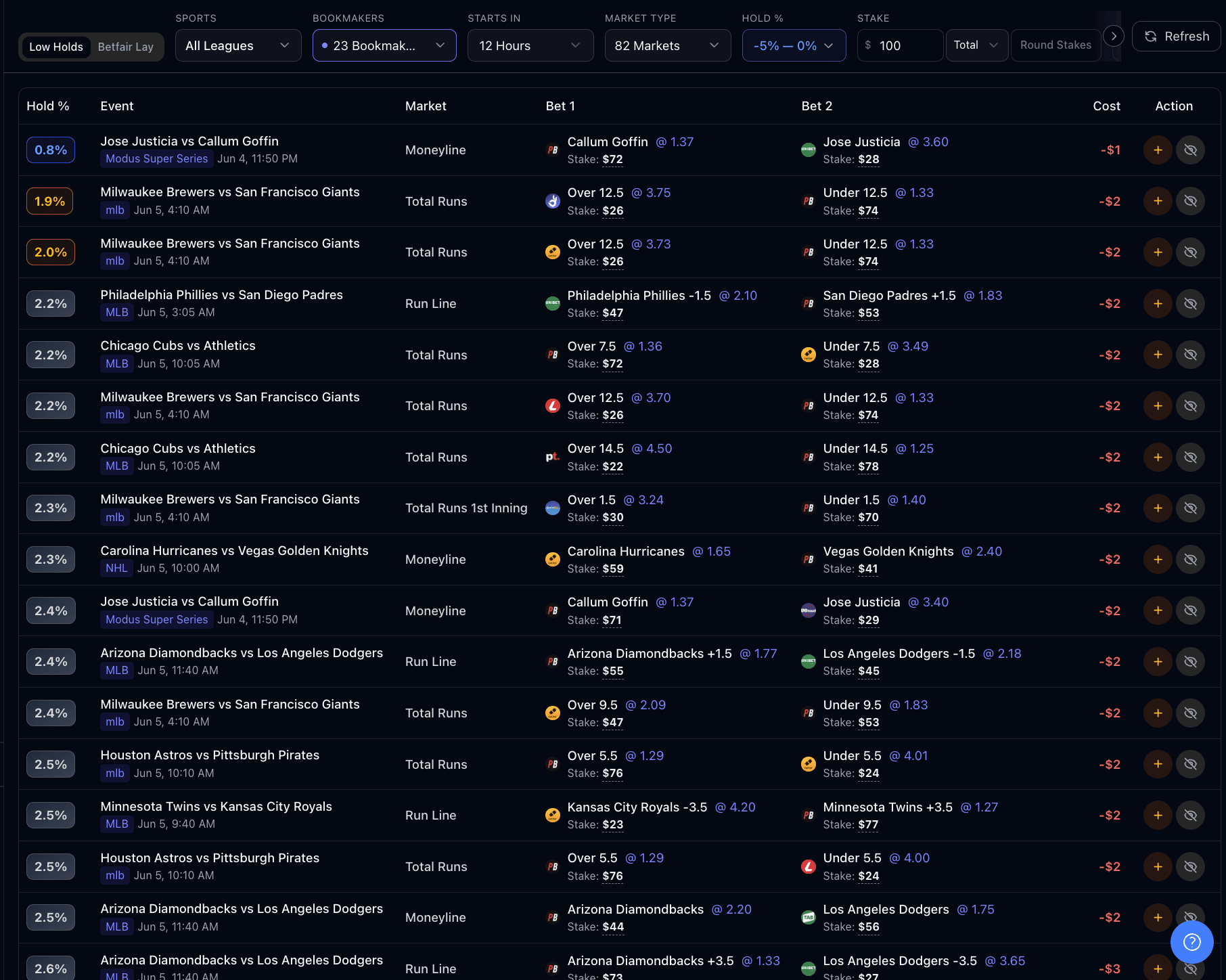
For every low hold the tool surfaces, you'll see:
Hold % — the combined margin across both bookies, which is your maximum loss as a percentage of total stake
Event — the game, sport, and start time
Market — the line being bet (run line, total runs, moneyline, etc.)
Bet 1 and Bet 2 — the two sides of the market, the bookies offering each, the price, and the recommended stake
Cost — your guaranteed loss in dollars based on the stake you've entered
Action — quick-add buttons to track the bet or hide the opportunity
The filter bar at the top lets you narrow down exactly what you want to see:
Sports — filter to the sports you want to turn over volume on
Bookmakers — show only books you have accounts at
Starts in — focus on games starting soon, or look further out
Market type — choose specific markets like match lines, totals, or moneylines
Hold % — set the maximum hold you're willing to accept (default range typically 0-5%)
Stake — enter how much you want to bet in total
Round stakes — toggle on to round both stakes to whole dollar amounts, which keeps your account looking less like software-driven betting
How to filter the Low Holds tool?
How to set your stakes?
You can stake low holds two different ways depending on what you're trying to do:
Set a total stake — enter your total combined stake (e.g. $100) and the tool calculates the individual stake for each side so the payout is balanced. This is the default and works for most turnover plays.
Set an individual stake — if want to bet a specific amount on one side, enter that stake and the other side will automatically update. This is the mode you'll use for bonus bet conversions and partial hedges.
Follow these strategies to successfully use low holds:
Stick to holds under 2.5%. Anything above that and the loss starts to outweigh the longevity benefit. The whole point of low holds is that the cost is small enough to be worth paying once it climbs past 3-4%, you're just losing money for activity.
Always round your stakes. Stakes ending in $.43 or $.71 is a dead giveaway of sharp betting.
Bet on liquid markets where large stakes look normal. A $500 stake on an NBA total is unremarkable. A $500 stake on a niche player prop will get reviewed. Match your stake size to the market's natural liquidity.
Vary the bookies you use. Don't use the same two bookies on every low hold. Spread your activity across your full account list so no single bookie sees a constant pattern of two-sided hedging coming from your account.
Bet as close to the start of the event. This is normal betting behaviour and your bets get mixed in with everyone else.
The goal with low holds is consistent, low-cost activity that keeps your accounts alive and lets your real edges compound.
Best practices for Low Holds
Coming soon
Want to make 100 units every month?
This guide covers all the main strategies and the basics to get you started. But if you are serious about going to the next level, we are also building the Sniper Academy. This will be a tight community with hands-on coaching, detailed guides and instructional videos, advanced analytics, and the deeper tips and strategies we use ourselves to win consistently.
Over the last few years we've profited $100,000+ from BetSniper ourselves, and helped hundreds of other punters bank $10,000+ a year.
Detailed video lessons
Every strategy taught step by step
Live walkthroughs
Real bets analysed in real time
Advanced strategies
The plays we don't share publicly
More data and tools
Beyond what standard members get
Private community
Other serious punters to learn with
Direct founder access
For questions and strategy reviews
Whether you're starting from zero or already turning a profit, the Academy is built to cut years off your learning curve.
We're putting it together now and want to make sure it solves the problems serious punters actually have. Register your interest and you'll be the first to know when it opens.
Tracking Your Bets
On every tool, you are able to add bets directly to the bet tracker. All the information for the bet will come across. You are able to edit your odds, stake at the time of placing the bet as well as add tags so your bets can be organsised. You should tag every bet you make so it’s easy to analyse your returns.
Across the top of the tracker, six numbers tell you exactly where you stand:
Total P/L — your overall profit or loss across every bet you've placed
Total Staked — how much money you've turned over
Win Rate — what percentage of your bets have won
ROI — your return as a percentage of total staked
Avg Bet Size — your average stake
Pending — how many open bets you have and their total stake
Avg CLV — the metric that actually tells you if you're sharp (more on this below)
You can switch between Units and Dollars, and between All Time, last 30 days, last 7 days, or custom date ranges. The same dashboard adapts to whichever frame you want to see.
The performance chart on the left shows your cumulative profit over time. Toggle between Cumulative P&L, Daily Profit, and Expected Profit views — expected profit is particularly useful for comparing what you should have made (based on the EV of every bet) against what you actually made. A big gap between the two means variance is hiding your real edge.
The calendar view on the right gives you a day-by-day breakdown of profit and loss. Green days are winners, red days are losers, and the running monthly total sits at the top. Useful for spotting whether your losing days are clustered (variance) or spread out (a systemic issue worth investigating).
The tracker resolves bets automatically when results come in. No manual ticking off, no chasing every market to settle a bet, no "did I log that win?" guesswork.
If you want to override the auto-settle (e.g. for markets with unusual settlement rules), toggle on Manual Settle Only and you handle resolution yourself.
The filter bar above the bet list is where the real analytical power lives. You can slice your bets by:
Sport — see your performance per sport
League — drill into a specific competition
Bookmaker — find which books are paying you and which aren't
Status — won, lost, void, pending
Markets — head-to-heads vs totals vs player props
Matches — isolate a specific event
Date range — any window from a single day to all-time
Tags — by strategy (EV, Pick'Em, arbs, middles, low holds) or any custom tag you've created
Profit range, stake range, odds range — find your biggest winners, biggest losers, or specific stake-size buckets
We know how important bet tracking is, so we have built a Bet Tracker into BetSniper. Never use a spreadsheet again and keep track of all your bets in one place.
Why you must track your bets
Headline metrics
Performance chart and calendar
Auto settlement
Filtering and slicing your data
If you take one thing from this entire guide, take this: without tracking, you have no idea if your strategy is working.
Being a succesful punter requires discipline and accuracy. The difference between a good bet and a bad bet is usually just a few cents. Tracking is paramount to keeping yourself accountable as well as being able to give you insights into strategies to exploit or areas to improve.
Tracking is what separates two punters who place identical bets and get wildly different outcomes:
The first punter loses 8 bets in a row, decides EV betting “doesn’t work,” abandons the strategy, and goes back to recreational punting. They had a genuine edge. They quit during normal variance. The bookies thanked them.
The second punter loses 8 bets in a row, opens their tracker, sees their CLV is still positive, recognises the cold streak as statistically expected, and keeps placing the bets. Three weeks later their bankroll is at an all-time high.
Here are some other reasons why you need to track your bets:
1. Accountability — keeping yourself honest. Human memory is biased toward dramatic events, and in betting that means you remember your wins and forget your losses. Without tracking, you have no chance of knowing how you are going.
2. Analysis — finding the patterns you can’t see day-to-day. You won’t notice that you’re +12% on NBA props but -4% on NBA totals just by placing the bets. You won’t notice that 60% of your losing weeks come from the same two bookies. Or that your “favourite” sport is your worst performer. These patterns are real, meaningful, and invisible without tracked data.
3. Discipline — protecting yourself from yourself. Punters who have a data-led approach are less likely yo bet on emotion. Because every bet is going on a permanent record, they think twice before placing a stupid one.
If you only do one thing differently after reading this guide, even if you do not use BetSniper, is you must track every bet.
How to use the BetSniper tracker?
Tracking your live bets
If you're running any BetSniper strategy seriously, you'll quickly find yourself with dozens of bets live at any given time. Trying to track all of that mentally is impossible.
We've built a live tracker to solve exactly this. It pulls in every open bet you have across the platform and shows you, in real time, how each one is tracking and what your expected return is right now.
Instead of waiting for results to come in and adding up the damage at the end of the night, you see:
Every open bet in a single view, regardless of sport, bookie, or strategy
Live status of each leg as games play out (winning, losing, on track for a middle, etc.)
Updated return predictions for each bet based on what's happening live — so a Pick'Em with three legs cashing and two still in play shows you exactly how much it's currently worth
Aggregate live P/L across your whole portfolio, so you know whether the day is shaping up green or red without having to do the maths yourself
Advanced Analytics
This is where tracking goes from "knowing your P/L" to actually understanding your edge. Most punters never get past the top-line numbers. Those numbers are useful, but they hide everything that actually matters. Without the ability to slice your data, you can't see which strategies are paying you and which are quietly leaking money.
The BetSniper analytics page is built to surface those answers. You can view your bets across any slice — sport, league, market, bookmaker, day of week, time of day, bet type, odds range, EV %, CLV %, or tag — and the dashboard recalculates instantly.
You can also go a level deeper for every cut of data and look at how that data interacts with other data.

Closing line value (CLV)
CLV deserves its own callout because it's the single most important metric in serious betting, and the one most punters don't track at all.
Closing line value compares the odds you placed your bet at against the closing odds — the final price right before the market closes. The closing line is the sharpest the market ever gets, because by then sharp money has moved the line and every bookie has reacted to the latest information.
If you consistently beat the closing line, you're sharp. If you don't, you're not. It's that simple.
Why CLV matters more than your P/L:
Your P/L is a lagging indicator. It tells you what happened, but it's polluted by variance. A bad month can hide a good edge. A good month can hide a bad one.
CLV is a leading indicator. It tells you whether the bets you're placing are worth placing, regardless of how they actually settled. If your CLV is positive, your P/L will catch up over enough bets. Maths is on your side.
CLV separates skill from luck. Two punters with the same P/L can have wildly different CLV. The one with positive CLV will pull ahead over time. The one with negative CLV will fall behind.
In the tracker you can view your average CLV across all bets, or filter to specific strategies, sports, or bookies to see exactly where you're sharp and where you're not. The BetSniper tracker also lets you view CLV against multiple benchmarks — Book (the best available closing price across all bookies), Book+ (best available), Pinn (Pinnacle's closing price, the global sharp standard), and Pinn+ (Pinnacle's closing price including weight adjustments).
Account Health and Balance
The tracker also keeps a live view of your account balances across every bookie. You can see at a glance:
How much you have at each bookmaker
How much is locked in pending bets
How much is available to deploy on the next opportunity
We also rate your account health based on the betting activity.
The score factors in your strategy mix at that book, your stake patterns, your win rate, your turnover, and signals that bookies use internally to flag sharp punters. The output is a single number per account that tells you whether to push that account harder or back off.
The point isn't to avoid being limited forever (no advantage bettor escapes that). It's to stretch every account as far as it will go before the limits come down. The longer you stay un-limited, the more your edge compounds.
If you see an account health score sliding into the red, that's your signal to dilute the sharp activity with some recreational-looking volume (low holds on liquid markets, occasional multis) until the score recovers.

Coming soon
Want to make 100 units every month?
This guide covers all the main strategies and the basics to get you started. But if you are serious about going to the next level, we are also building the Sniper Academy. This will be a tight community with hands-on coaching, detailed guides and instructional videos, advanced analytics, and the deeper tips and strategies we use ourselves to win consistently.
Over the last few years we've profited $100,000+ from BetSniper ourselves, and helped hundreds of other punters bank $10,000+ a year.
Detailed video lessons
Every strategy taught step by step
Live walkthroughs
Real bets analysed in real time
Advanced strategies
The plays we don't share publicly
More data and tools
Beyond what standard members get
Private community
Other serious punters to learn with
Direct founder access
For questions and strategy reviews
Whether you're starting from zero or already turning a profit, the Academy is built to cut years off your learning curve.
We're putting it together now and want to make sure it solves the problems serious punters actually have. Register your interest and you'll be the first to know when it opens.


Get exclusive updates and expert strategies for maximising profits.
Follow Us


Features
© Copyright 2024. BetSniper
Think you have a gambling problem? Call Gambling Help Online on 1800 858 858 or visit gamblinghelponline.org.au.
Get exclusive updates and expert strategies for maximising profits.
Follow Us
Features
© Copyright 2024. BetSniper
Think you have a gambling problem? Call Gambling Help Online on 1800 858 858 or visit gamblinghelponline.org.au.
Get exclusive updates and expert strategies for maximising profits.
Follow Us
Features
© Copyright 2024. BetSniper
Think you have a gambling problem? Call Gambling Help Online on 1800 858 858 or visit gamblinghelponline.org.au.
Getting Started With BetSniper
This guide goes over all the tools and some betting basics. Depending on your level of experience and expertise you may not need to reach every section.
What is BetSniper?
Welcome! BetSniper is the ultimate tool for the smart punter to use data and mathematical strategies to get an edge over the bookmaker.
We have been betting for 10+ years, and it’s the tool we always wish existed in Australia. Check out our full story here.
BetSniper is an information product. We pull real-time betting data from every major Australian bookie, run it through our algorithms, and surface it in dashboards that show you where prices are moving and where the edges are.
These are not tips. What we do is show you exactly how professional punters bet and we teach you how to make smarter betting decisions where the edge is in your favour.
Built for: Punters who want a systematic, data-driven edge
Not built for: Anyone looking for tips, locks, or “guaranteed winners.” If that’s what you want, you’re in the wrong place (and truthfully, these never exist)
Claim your free trial
You can sign up to BetSniper here. A free account gives you limited access to some of our tools, which is enough to get a feel for the platform.
For full access, we offer a 7-day free trial for first-time users. You’ll need to add your card details to start, but you can cancel anytime during the trial and still keep access for the full 7 days.
Join the Discord
Once your trial is active, head over to our Discord and verify yourself. This is where the BetSniper community lives, ask other members what strategies are working for them, follow the day-to-day discussion on bets and edges, and learn from punters who’ve been doing this for a while.
Verifying yourself unlocks our premium-only channels, including the alert channels. Instructions are in the #verify-yourself channel and takes only 30 seconds to complete.
PS: users on free trial can verify themselves and get access to premium-only channels.
Coming soon
Want to make 100 units every month?
This guide covers all the main strategies and the basics to get you started. But if you are serious about going to the next level, we are also building the Sniper Academy. This will be a tight community with hands-on coaching, detailed guides and instructional videos, advanced analytics, and the deeper tips and strategies we use ourselves to win consistently.
Over the last few years we've profited $100,000+ from BetSniper ourselves, and helped hundreds of other punters bank $10,000+ a year.
Detailed video lessons
Every strategy taught step by step
Live walkthroughs
Real bets analysed in real time
Advanced strategies
The plays we don't share publicly
More data and tools
Beyond what standard members get
Private community
Other serious punters to learn with
Direct founder access
For questions and strategy reviews
Whether you're starting from zero or already turning a profit, the Academy is built to cut years off your learning curve.
We're putting it together now and want to make sure it solves the problems serious punters actually have. Register your interest and you'll be the first to know when it opens.
Introduction to Betting Basics
Before you start using BetSniper, it’s worth understanding how betting markets actually work. Most punters lose money not because they’re unlucky, but because they don’t understand the maths working against them. This section will get you up to speed.
Bookmakers
Every bookmaker sets their own odds, independently. This is based on their own traders, models, and risk appetites.
A few things worth knowing:
Some books offer way more markets than others. larger bookmakers tend to have the deepest market coverage (player props, exotic markets, niche sports). Where smaller books often only price head-to-heads, lines, and totals.
Bookmakers are considered either sharp or soft. Sharp books (like Pinnacle) price tightly with low margin and welcome winners, their lines reflect the true probability of an outcome. Soft books (most Aussie bookies e.g. Sportsbet, Ladbrokes, Neds, TAB, Betr price loosely with higher vig and limit winning accounts.
You need accounts at multiple books. You can only act on an edge if you have an account at the book offering it. If you want to make money from sports betting, you need to have accounts open at all the bookmakers
There are over 100+ bookmakers in Australia. We have compiled the full bookmaker list as well as available deposit offers.
Note: there are 100+ bookmakers in Australia, however a lot of them get their odds from the same provider. You can see our bookmaker list to understand all the unique bookmakers in the market as well as the bookmaker that share their odds from one provider (we refer to these bookmakers as clones).
What are betting limits?
You can't just bet whatever you want, whenever you want.
Every market has a maximum stake the book will accept, and it varies wildly:
Major markets (AFL/NRL head-to-heads) might let you bet thousands
Player props and niche markets often cap at $500
Sharp markets and live betting are usually the tightest
On top of market limits, books will also limit your account personally if they decide you're winning too much or betting too sharply. This is called being "stake-limited" or "factored down." A bet that used to take $500 might suddenly only take $5.
It is important you have a basic understanding of betting limits before you start. We have put together a guide where we go over everything you need to know about betting limits.
Why do 99% of punters lose?
Punters lose because it’s odds are engineered so that before you even place a bet the edge is with the bookmaker. The system is built so regular people can’t win:
1. They take negative EV bets. Every bet a recreational punter places at standard bookie odds is, on average, a losing bet, because the vig is built in, no matter how confident your mate is at the pub.
2. They bet multis. Multis are the bookies’ favourite product, and for good reason. Every leg you add multiplies the vig or the edge for the bookmaker. Assume the average vig of 7%. Remember that means on average you will lose 7% on every bet. When you play a multi, you are multiplying the vig together. For a multi, your expected loss will be:
2 legs: 1.07² = 1.1449 → 14.5% vig
3 legs: 1.07³ = 1.2250 → 22.5% vig
4 legs: 1.07⁴ = 1.3108 → 31.1% vig
5 legs: 1.07⁵ = 1.4026 → 40.3% vig
How is anyone supposed to win, when the odds are so much in favour of the bookmaker.
3. They take one-sided markets. Markets like “Will [Player] score a try in the first 10 minutes?” can carry unlimited vig. Because the bookmaker does not post the otherside of the market, they are able to offer punters really bad odds.
4. They have no way to identify edges. This is the big one. The average punter sees a market on a betting app and has no idea whether the odds are sharp or soft, whether there’s value or vig, or how this book compares to the rest of the market. Without a tool that aggregates every bookie’s prices in real time, identifying an edge is essentially impossible.
That last point is the whole reason BetSniper exists. We take the data the books would rather you didn’t see, every price, across every book, updated live, and turn it into a clear signal.
Setting up accounts
To get started with BetSniper, the first step is to actually set up your betting accounts.
When you set up your account, make sure to take advantage of the sign-up offer bookies have. Bookmakers no longer can publicly advertise these bonuses but can offer them to you once you are an existing customer.
Most bookmakers have a bonus immediately on sign-up, or will offer it to you in the first week or so. You can also always call up and see if they would be willing to give you one as well. But even if you don’t want to deposit right away, it is a good idea to set up the account as they will eventually send you a sign-up offer.
There are so many bookmakers in Australia. We have a complete list on all bookmakers in Australia as well as which ones are offering deposit bonuses.
To maximise your winnings from punting, you need to have money spread across multiple accounts so that you can always get the best price.
Once you put money into a betting account, there are usually turnover requirements. This is normally turning over your deposit once over. Once you read through the rest of this guide, this will be very easy to do and should not be anything you need to worry about.
Converting bonus bets
This is the first skill you need to learn to be become a profitable punter.
If you do get bonus bets, you can quickly turn that into cash. The catch with bonus bets is that you don’t get your stake back if the bet wins, you only collect the profit. A $100 bonus bet on $2.00 odds returns $100, not $200.
That makes bonus bets feel less valuable than cash, but there’s a way to convert them into guaranteed profit: bet both sides of the same market. Use the bonus bet on one side, and place a cash bet on the other side at a different bookie. No matter which outcome wins, you lock in a known profit. We should aim for at least 70%+ conversion and in most instances an find an 80%+ conversion if we are patient.
The BetSniper Bonus Bet Converter does the maths for you. Pick the bookie holding your bonus, and we’ll surface every market across our 50+ bookies where you can convert it. Enter your bonus bet amount, and we’ll calculate exactly how much to stake on the other side, what you’ll profit, and which bookie to place it at.
So we place a $50 bonus bet on St George -3.5 at 5.20 odds. At the same time we place a bet on Ladbrokes on Cronulla +3.5 at 1.25.
We have now covered all options and no matter what happens, we will get a profit of $42.
Let's look at an example:
What are odds?
Probably the most important concept to understand in betting, but most people even punters who bet everyday, would not be able to explain it to you. So here is what you need to know:
Odds are just probabilities, dressed up in decimal form.
If a bookie offers $2.00 on a team, they're saying "we think this team has roughly a 50% chance of winning." The maths is straightforward: implied probability = 1 ÷ decimal odds.
A few quick examples:
$1.50 → 66.7% implied probability
$2.00 → 50% implied probability
$3.00 → 33.3% implied probability
$5.00 → 20% implied probability
When you place a bet, you're really making a claim that the true probability is higher than what the odds imply. If a bookie is offering $2.20 (45.5% implied) on something you think is genuinely a 50% shot, you've got an edge.
What is vig/juice/margin?
This is the most important concept to understand about betting markets. It explains how bookmakers are billion dollar corporations.
The price you get from a bookmaker does not reflect the true probability. They will always have their price underneath the true probability. That is how they make money.
If a bookie offered "fair" odds on both sides of a coin flip, they'd price both sides at $2.00. Each side has a 50% chance, the implied probabilities add up to exactly 100%, and over time the bookie would break even. No profit.
So they don't do that. Instead, they price both sides at something like $1.91 / $1.91. Now the implied probabilities are 52.4% on each side, adding up to 104.8%. That extra 4.8% is the vig (also called juice, margin, or overround). It's the bookmaker's built-in edge, baked into every market they price. Another way to interpret this number is that by placing this bet, in the long-run you can expect to lost 4.8%.
The vig that bookmakers offer varies greatly depending on the market as well as the bookmaker. The vig on head to head markets ranges from 3-5% whereas the vig on player props usually is 6-8%. For some niche markets or markets with more than one selection the vig is often >10%.
To calculate the vig in a market you add up the implied probabilities of every outcome in a market. If they total more than 100%, the difference is the vig.
You can use our fair odds calculator to calculate how much edge the bookmaker has on markets
Coming soon
Want to make 100 units every month?
This guide covers all the main strategies and the basics to get you started. But if you are serious about going to the next level, we are also building the Sniper Academy. This will be a tight community with hands-on coaching, detailed guides and instructional videos, advanced analytics, and the deeper tips and strategies we use ourselves to win consistently.
Over the last few years we've profited $100,000+ from BetSniper ourselves, and helped hundreds of other punters bank $10,000+ a year.
Detailed video lessons
Every strategy taught step by step
Live walkthroughs
Real bets analysed in real time
Advanced strategies
The plays we don't share publicly
More data and tools
Beyond what standard members get
Private community
Other serious punters to learn with
Direct founder access
For questions and strategy reviews
Whether you're starting from zero or already turning a profit, the Academy is built to cut years off your learning curve.
We're putting it together now and want to make sure it solves the problems serious punters actually have. Register your interest and you'll be the first to know when it opens.
The Guide To Become A Profitable Punter
There's no single way to beat the bookies. There are several, and they all work, but they suit different types of punters.
What every winning strategy has in common is maths. You're not picking winners on gut feel or chasing tips. You're finding situations where the odds are wrong, and you're placing enough of those bets over a long time horizon so that variance smooths out and your edge shows up in your bottom line.
BetSniper is built around three core approaches:
Top-down betting
Bottom-up betting
Hedging/arbitrage.
Most successful punters end up using a mix of all three, but it's worth understanding each one on its own before you blend them.
Pick your betting style
Before we get into the tools, it's worth being honest about which approach suits you. Each one has a different trade-off between effort, variance, and ceiling.
We have tools built for all of these different strategies. We advise you to first start off with one strategy and learn the tools and strategies for that before trying another one.
In the following sections, we will go through all the tools for each strategy and explain how to best use them.
| Approach | Best for | Effort | Variance | Profit |
|---|---|---|---|---|
| Top-down | Recommended — Punters who want the platform to find bets for them | Low | Medium | High |
| Bottom-up | Punters who enjoy research and want their own edges | High | Medium | High |
| Hedging / Arbitrage | Punters who want low-risk, consistent returns | Low | Low | Low-medium |
Words of advice from 10+ years professional betting
We have been betting professionally for over a decade. In that time we’ve learned a lot about winning and even more about losing. If I knew everything I knew now when I started, I would have saved myself a lot of pain and suffering.
That is completely expected when you are doing something that inherently is risky. The purpose of this guide is to share with you all of the lessons we have learnt and fast track your experience so you can be making money with betting as soon as possible.
If you are interested in becoming a profitable better and using BetSniper, it’s really important you read this guide. If you wing it, you will lose. If you take the time to read this properly, you’ll come away with everything you need to start beating the bookies yourself.
We will save you a lot of money, time, and heartache along the way.
Enjoy.
Tracking your live bets
If you're running any BetSniper strategy seriously, you'll quickly find yourself with dozens of bets live at any given time. Trying to track all of that mentally is impossible.
We've built a live tracker to solve exactly this. It pulls in every open bet you have across the platform and shows you, in real time, how each one is tracking and what your expected return is right now.
Instead of waiting for results to come in and adding up the damage at the end of the night, you see:
Every open bet in a single view, regardless of sport, bookie, or strategy
Live status of each leg as games play out (winning, losing, on track for a middle, etc.)
Updated return predictions for each bet based on what's happening live — so a Pick'Em with three legs cashing and two still in play shows you exactly how much it's currently worth
Aggregate live P/L across your whole portfolio, so you know whether the day is shaping up green or red without having to do the maths yourself
Coming soon
Want to make 100 units every month?
This guide covers all the main strategies and the basics to get you started. But if you are serious about going to the next level, we are also building the Sniper Academy. This will be a tight community with hands-on coaching, detailed guides and instructional videos, advanced analytics, and the deeper tips and strategies we use ourselves to win consistently.
Over the last few years we've profited $100,000+ from BetSniper ourselves, and helped hundreds of other punters bank $10,000+ a year.
Detailed video lessons
Every strategy taught step by step
Live walkthroughs
Real bets analysed in real time
Advanced strategies
The plays we don't share publicly
More data and tools
Beyond what standard members get
Private community
Other serious punters to learn with
Direct founder access
For questions and strategy reviews
Whether you're starting from zero or already turning a profit, the Academy is built to cut years off your learning curve.
We're putting it together now and want to make sure it solves the problems serious punters actually have. Register your interest and you'll be the first to know when it opens.
Top-down betting i.e. show me the bets to place
Top-down betting (often referred to as EV betting) uses the market itself to identify a fair price, removes the vig, and then searches for opportunities priced higher than that fair value.
This is one of the purest ways to get true expected value. All bookmakers are trying to set the price as close to true probability as possible. By removing the vig, we get a good estimation of true probability. We can use this to our advantage to find edges.
You don’t need to know who’s playing, what the injury list looks like, or how a team has been travelling. All of this is already baked into the price. We are looking for where there are inefficiencies and sniping them.
A few things to understand about top-down EV:
You’re betting sharp, not picking winners. Your edge comes from getting a better price than the true probability of the outcome. You won’t feel “right” about every bet, you’re trusting the maths.
You won’t win all the time. A 5% EV bet at $2.00 odds still loses ~48% of the time. That’s normal. The edge shows up over hundreds of bets, not five. You must be willing to place hundreds of bets to evaluate your EV strategy. Have a play with our EV betting simulator which can show you what it feels like to implement a top down betting strategy.
You’re grinding out small edges, cents matter. Most +EV bets carry 2-6% edge. That sounds small, but compounded across hundreds of bets per month at proper stakes, it adds up fast.
Patience and discipline are the whole game. There are drawdowns, flat stretches, and runs that test your nerve. The punters who win are the ones who keep placing the bets when it feels like it’s not working.
We have a variety of different top-down EV tools at BetSniper:
Positive EV: scans every bookie in real time and surfaces bets priced higher than the sharp market’s fair value.
Benchmark EV: compares every bookie’s price against a single sharp benchmark (like Pinnacle or Novig) to find the biggest mispricings.
Line-out EV: identifies value across alternate lines and totals, and uses our algorithm to compare odds across lines to spot value betting opportunities
Pick’Em EV: finds positive expected value legs to include in your Dabble Pick’Ems
What is BetSniper?
Coming soon
Want to make 100 units every month?
This guide covers all the main strategies and the basics to get you started. But if you are serious about going to the next level, we are also building the Sniper Academy. This will be a tight community with hands-on coaching, detailed guides and instructional videos, advanced analytics, and the deeper tips and strategies we use ourselves to win consistently.
Over the last few years we've profited $100,000+ from BetSniper ourselves, and helped hundreds of other punters bank $10,000+ a year.
Detailed video lessons
Every strategy taught step by step
Live walkthroughs
Real bets analysed in real time
Advanced strategies
The plays we don't share publicly
More data and tools
Beyond what standard members get
Private community
Other serious punters to learn with
Direct founder access
For questions and strategy reviews
Whether you're starting from zero or already turning a profit, the Academy is built to cut years off your learning curve.
We're putting it together now and want to make sure it solves the problems serious punters actually have. Register your interest and you'll be the first to know when it opens.
Positive EV
Positive EV (expected value) betting is the strategy that underpins most of what BetSniper is all about. If you understand this section, the rest of the platform makes sense.
If you want a full guide to positive EV betting, check out our detailed guide here
The idea is simple: you place bets where the odds the bookie is offering are higher than the true probability of the outcome. This is not a get rich quick scheme nor do we promise you will win every bet. In fact, you will lose plenty, but over hundreds of bets, the edge will be in your favour and profitability is a matter of when not if.
The simplest way to understand positive EV betting is with a coin flip. If someone gave you 3.00 odds for heads, you should always take the bet. You are still going to lose 50% of the time. But when you win, your edge will cover the losses. What if someone gives you 2.10 odds, would you still say yes? Of course you should! You still are getting better odds than 2.00.
Our Positive EV screen, highlights thousands of positive EV betting opportunities every day.
How do you determine what the true odds are?
The truth is that bookmakers are very good at what they do. Bookmaker prices are very good approximations of true probability. So trying to figure out the true odds on your own is a very hard endeavour.
Because each bookmaker is independently pricing a market, we can get many different unique perspective on the price. When we combine those together to form a composite price, this becomes a very good indicator. This is a statistical principle called “wisdom of the crowds”.
The concept was first documented in 1906 by Francis Galton, a British statistician who attended a country fair where 800 people guessed the weight of an ox. No single guess was correct, but when Galton averaged all 800 guesses together, the result was 1,197 pounds — within 1% of the ox's actual weight of 1,198 pounds. The crowd, collectively, was more accurate than any individual expert in the room.
The principle holds whenever you have a large group of independent estimators. Individual errors cancel each other out, and the average converges on the truth.
Betting markets work exactly the same way. Every bookmaker prices each market independently, using their own traders, models, and risk appetites. No single bookie is right all the time, but when you average the prices of every bookie together, the consensus is remarkably accurate. More accurate than any individual bookie on their own.
That consensus is our benchmark. We take every bookie's price for a given market, strip out the vig, and calculate what the bet is actually worth. This is the no-vig market price or fair odds. Our best estimate of the true probability of the outcome.
From there, the strategy is straightforward. If a single bookie is offering odds higher than the fair odds, we can assume this bet has positive expected value. The bigger the gap between their price and the consensus, the bigger your edge.
Let’s take a look at an example:
How much money should you bet?
A good rule of thumb: stake 1–2% of your bankroll per bet for odds under $3.00, and drop to around 0.5% for anything above that. Higher odds carry more variance, so smaller stakes protect you from getting wiped out by a losing streak.
If you want to be more precise, you can use the Kelly Criterion, a formula that sizes your stake based on both your edge and the odds. The full Kelly stake is mathematically optimal but aggressive, so most serious punters use quarter Kelly (25% of the recommended stake) to smooth out variance while still capturing most of the long-term growth. You can see the Kelly stake in the tool.
One thing to keep in mind: EV betting is a volume game. The faster you compound your bankroll, the more bets you've placed, not the bigger each bet was. If you find yourself running out of time or bankroll to take all the +EV opportunities you're seeing, scale your stakes down, not up. Taking 50 bets at 1% beats taking 10 bets at 5% every time.
Understanding variance
Variance is the most important concept to understand when it comes to EV betting.
If you place enough +EV bets, you will go on losing streaks. Not might. Will. A 10-bet losing streak with a real edge isn't a sign that something is broken or that your edge has disappeared. It's a statistical certainty, and the more bets you place, the higher your chance of running into one.
The good news is variance is predictable. We can calculate, for any given edge and odds level, how big your worst drawdown is likely to be over the next 100, 500, or 1,000 bets.
This is why staking discipline matters more than anything else. If you stick to 1-2% stakes, you will be in a good position.
Before you place a single bet, run your strategy through our EV Betting Simulator to see what your bankroll curve will actually look like. It’s a really useful exercise to get your head around what an EV betting strategy looks like as well as seem some advanced analytics around drawdowns, risk and profitability.
Positive EV multis
Early on in this guide, we mentioned that multis are terrible expected value plays for the punters. This is because each leg is negative EV.
But… What happens if each leg is positive EV? Then the edge compounds in our favour.
We highly recommend playing multis for a few reasons:
Can get more money down per positive EV selection
Your edge compounds
Better for your account sustainability as bookmakers like you playing multis
By playing multis, you are adding a lot more variance to your strategy. But it is still positive expected value. As long as you play enough volume, it will still be profitable.
Below is one BetSniper subscribers results from playing Positive EV multis. They only win 26.3% of their bets but have a 32.8% ROI which is insane!
To get an understanding of volume, they gave placed 1,300+ multis. All of those 1,300+ multis were found using BetSniper, using our recommend strategy shared here.
Coming soon
Want to make 100 units every month?
This guide covers all the main strategies and the basics to get you started. But if you are serious about going to the next level, we are also building the Sniper Academy. This will be a tight community with hands-on coaching, detailed guides and instructional videos, advanced analytics, and the deeper tips and strategies we use ourselves to win consistently.
Over the last few years we've profited $100,000+ from BetSniper ourselves, and helped hundreds of other punters bank $10,000+ a year.
Detailed video lessons
Every strategy taught step by step
Live walkthroughs
Real bets analysed in real time
Advanced strategies
The plays we don't share publicly
More data and tools
Beyond what standard members get
Private community
Other serious punters to learn with
Direct founder access
For questions and strategy reviews
Whether you're starting from zero or already turning a profit, the Academy is built to cut years off your learning curve.
We're putting it together now and want to make sure it solves the problems serious punters actually have. Register your interest and you'll be the first to know when it opens.
How to use the BetSniper Positve EV tool?
The BetSniper positive EV tool is super easy to use. Each row on the tool is a unique positive EV bet. Before you place bet, there are a few things to consider:
| Question | What to look for |
|---|---|
| How many bookmakers are pricing the market? |
Generally speaking, the more bookmakers pricing the market, the better the fair odds estimate will be. More bookmakers means a more robust fair odds calculation.
Our recommendation is to have at least 6 bookmakers pricing the market. |
| What are the odds? |
Expected value is expected value, so it doesn't actually matter what the odds are. What matters about the odds is the variance — the higher the odds you play, the higher the variance. This can be a lot harder for new punters as the bumps can be very big.
When you play EV bets with higher odds, you usually want higher EV percentages to overcome the variance. Odds > 3 would be considered quite high and would carry high variance. An important concept: not all EV is the same. A 5% edge at $2.00 will grow your bankroll far faster, and far more reliably, than a 5% edge at $8.00 — shorter odds let you stake more per bet and ride out variance with smaller losing streaks. |
| How long until the match starts? |
The fair odds estimate is always most accurate as close to the start of the match as possible. Where possible, bet within one hour of the match starting.
This isn't always possible — the further out you bet, the fair odds can drift down (improving your edge) or up (decreasing it). That's a small risk you take betting hours before an event. We strongly advise against betting the day before an event. It's a very quick way for bookmakers to know you're sniping prices — no regular punter bets a day out. |
| What is the EV %? |
There's no perfect number, but you want to be playing with some edge. We recommend taking anything above 2%.
The idea with EV betting is high volume across a high number of different positive EV opportunities. Don't just pick one or two bets a day — while that's profitable long-run, it's not how to implement an EV strategy. |
Our recommend Positive EV betting strategy
From our experience of implementing this strategy for 5+ years, here is our recommend betting strategy:
A minimum of 6 bookmakers pricing the market
A minimum EV of 2%
Odds < 4 (odds < 3 for new positive EV betters)
Bet as close to the match as possible (ideally within 1 hour)
We are also always running back-dated tests to see how the strategy performs. Over 7,000+ bets, here is how this strategy has performed
This is the over/under 5.5 rebounds market for Julian Champagnie in the Spurs vs Thunder game. Ten different bookmakers have priced both sides of the market, that's ten independent estimates of how likely Champagnie is to grab 6 or more rebounds.
Taking the average of all ten bookies and stripping out the vig, we calculate a fair price of $2.08 on the over, an implied probability of 48.1%. This is our best estimate of the true probability of the outcome.
But Unibet is currently offering $2.14 on the over, an implied probability of 46.7%. They're out of step with the rest of the market.
That gap is your edge. Betting Unibet's $2.14 against a true price of $2.08 gives you a 2.9% edge. Over the long run, for every $100 you stake on bets like this, you expect to win $2.90 on average.
It doesn't sound like much. But place a hundred of these a week at proper stakes, and the maths compounds quickly. This is how professional punters think about betting. It is a volume of game. In reality, it would be super rare to find opportunities where bookmakers are significantly wrong. They way to win is to pick off little edges every day.
Benchmark EV
Benchmark EV works on the same principle as Positive EV, find bets priced higher than fair value, but with one key difference: instead of using the average of every bookie in the market, you use a single sharp bookmaker as your benchmark for fair odds.
Pick a bookmaker as your benchmark, strip out the vig from their prices, and the tool surfaces every market where another bookie is offering odds higher than that benchmark. That gap is your edge.
When we are using a benchmark, we want to use a sharp book. Their prices are tighter, their limits are higher, and they update faster than recreational books. Sharp book prices are very good approximation for the true probability of an event especially near the start of the event.
Why use a benchmark instead of the market average?
Sharp bookmakers (like Pinnacle) price markets tightly, take large bets from professional punters, and update their odds the moment new information arrives.
Soft books price loosely, cater to recreational punters, and are slower to react. Exchanges (Betfair, Novig, Polymarket) can also be good sources of true price. The gap between a sharp and a soft price is often where the cleanest edges live. Read more about the difference between sharp and soft books here.
Further, there are some bookmakers that specialise in certain sports. They can be really useful to use as a benchmark to find more positive EV betting opportunities.
How to use Benchmark EV?
The Benchmark EV tool in BetSniper is really easy to use. It’s like the other EV tools where you have your filters for leagues, bookmaker, markets, start time, EV% and max odds.
Additionally, you can set your benchmark with three different modes:
Single: benchmark to a single bookmaker
Average: benchmark to the average of two or more bookmakers
Weighted: benchmark to a custom weighted average of two or more bookmakers
Once you have set your benchmark, you can check can see all the plays where the other bookmakers are larger than the fair odds price at the benchmark bookmaker.
Similar to all EV betting strategies, it is advisable to try and bet as close to the start of the match as possible.
What benchmarks should I use?
Pinnacle: for match and totals markets
Pinnacle is the gold standard for sharp pricing globally. They’ve operated on a low-margin, high-volume model for over 25 years, run vig as low as 2% on major markets, and famously welcome winning players rather than limiting them. Their head-to-head and totals prices are widely regarded as the closest thing to a “true” price in betting.
A useful trick: use Pinnacle’s stake limit as a signal of how confident they are in a price. When Pinnacle has a $1,000+ limit on a market, it means their traders are confident the line is correct and they’re happy to take big action on either side. Smaller limits (under $200) usually mean the price is unsettled or they’re waiting for more information. The bigger the limit, the more weight you can put on Pinnacle’s number.
From our testing, here are what results have looked like betting within 1 hour of the match starting with EV > 2%
Circa Sports: for US sports
Circa is the sharpest book in the United States and the benchmark for US sports markets. A few reasons they’re respected:
Low spreads on every market: they consistently post the tightest lines in the US, often well inside other major books
They accept professional money: unlike most US sportsbooks, Circa actively encourages sharp action. Big bettors can place serious stakes without being limited
They move first on news: Circa’s traders react to injury reports, lineup changes, and weather faster than the rest of the US market, which makes their prices the leading indicator for NFL, NBA, MLB, and NHL
From our testing, here are what results have looked like betting within 1 hour of the match starting with EV > 2%:
Sportsbet — for NBA player props
This one surprises people. Sportsbet is a soft book overall, but their NBA player props are genuinely sharp and here’s why:
They accept sharp money on props: Sportsbet is owned by Fanduel who are known for taking some small sharp action so they can move their prices quickest
They’re always first to move on news: injury announcements, lineup changes, Sportsbet’s NBA props react within seconds, well ahead of the rest of the Aussie market
You can’t beat them with a standard +EV strategy: by the time the market average catches up to a Sportsbet price move, the edge has already disappeared. They’re not a soft book to bet against on NBA props; they’re the sharp reference everyone else is following
They are comfortable hanging prices: Sportsbet will often sit out from the rest of market due to their confidence in their pricing
For NBA player props specifically, indexing off Sportsbet’s price gives you a far more accurate benchmark than the market consensus.
However, this strategy works bets when you bet with Sportsbet when matches are starting in 30 minutes or less.
We actually did a project where we tracked the results and we discovered there was a really big edge here.
—
We are constantly monitoring the market for new edges and will share with BetSniper users when we find new edges.
Coming soon
Want to make 100 units every month?
This guide covers all the main strategies and the basics to get you started. But if you are serious about going to the next level, we are also building the Sniper Academy. This will be a tight community with hands-on coaching, detailed guides and instructional videos, advanced analytics, and the deeper tips and strategies we use ourselves to win consistently.
Over the last few years we've profited $100,000+ from BetSniper ourselves, and helped hundreds of other punters bank $10,000+ a year.
Detailed video lessons
Every strategy taught step by step
Live walkthroughs
Real bets analysed in real time
Advanced strategies
The plays we don't share publicly
More data and tools
Beyond what standard members get
Private community
Other serious punters to learn with
Direct founder access
For questions and strategy reviews
Whether you're starting from zero or already turning a profit, the Academy is built to cut years off your learning curve.
We're putting it together now and want to make sure it solves the problems serious punters actually have. Register your interest and you'll be the first to know when it opens.
Line Out EV
Line Out EV applies the same core EV principle of using the market to identify value but does this by comparing prices across lines for props.
For most props, bookmakers will price the main line. Some bookies will have multiple over/under lines where as others will just provide alternate over lines. Most bookies will focus on the main line, but their alternate lines are often derived quickly from a model and don't always reflect the true probability of each outcome. By comparing prices across lines, we open ourselves to more opportunities (that may not be captured by Positive EV and Benchmark EV).
We built an algorithm that uses historical over/under prices as well as live market prices to infer the true probability at the consensus main line. We then transform that probability to estimate fair value at any deviating line.
It's the same top-down approach as our other EV tools. We use the collective wisdom of the market as a guide, then identify where one book has stepped out of line without properly accounting for the difference.
The result is a whole layer of opportunities that the standard +EV scanner misses, because most +EV tools only look at the primary line.
For some sports, there are alternate over/under priced at multiple lines so these bets may already appear in positive EV (like for NBA). On the other hand, there are spots like AFL (specifically player disposals) or NFL where there is usually limited alternate over/under lines and this is where this tool shines.
How is fair value calculated?
The challenge with alternate lines is that you usually don't have many bookies pricing the same alternate line for direct comparison. If one book is offering over 21.5 disposals when every other book is pricing over 20.5, the standard +EV approach falls down, there's no consensus to benchmark against.
Our algorithm solves this by working in two steps.
Step 1: Anchor the true probability at the consensus main line. We take every bookie's over/under prices at the consensus main line (where there is deep coverage), strip out the vig, and calculate the true implied probability of the outcome.
Step 2: Transform that probability to estimate fair value at any deviating line. Using historical over/under data as well as live market prices, we've modelled how probability shifts when a line moves up or down for different stats at different values. From the anchored true probability at the main line, we can project a fair price at any alternate line — over 21.5, over 22.5, over 23.5, and so on.
The two-way nature of over/under markets is what makes this possible. Because every market has both an over and an under, we can strip out the vig and benchmark against the market's own implied true odds, which is the cleanest signal available.
We continue to refine the algorithm as we collect more historical data, tuning it for specific stats and player distributions.
How to use the Line Out EV tool?
The Line Out EV tool is similar to all the other EV betting tools. All the bets are recommended to take due to a top-down analysis of the market.
Like the other EV tools, we have filters for:
Leagues
Bookmakers
Starting time
Min EV %
Min odds
What is unique to the line out EV tool
Minimum number of consensus books
Value of the line
Deviation of the line
The higher EV % returns better as well as the more bookmakers as the consensus.
Our recommended filter are:
Minimum 5 books pricing the consensus line
Minimum EV of 2%
Betting within 1 hour of the match happening
If you would have followed this strategy, here is what your results would look like:
The two main criteria we need to think about are:
Number of consensus books
Minimum EV %
From our backtesting, there is a clear recommendation:
Coming soon
Want to make 100 units every month?
This guide covers all the main strategies and the basics to get you started. But if you are serious about going to the next level, we are also building the Sniper Academy. This will be a tight community with hands-on coaching, detailed guides and instructional videos, advanced analytics, and the deeper tips and strategies we use ourselves to win consistently.
Over the last few years we've profited $100,000+ from BetSniper ourselves, and helped hundreds of other punters bank $10,000+ a year.
Detailed video lessons
Every strategy taught step by step
Live walkthroughs
Real bets analysed in real time
Advanced strategies
The plays we don't share publicly
More data and tools
Beyond what standard members get
Private community
Other serious punters to learn with
Direct founder access
For questions and strategy reviews
Whether you're starting from zero or already turning a profit, the Academy is built to cut years off your learning curve.
We're putting it together now and want to make sure it solves the problems serious punters actually have. Register your interest and you'll be the first to know when it opens.
Pick'Em EV
Pick’Em is a fixed-odds player prop format unique to Dabble in the Australian market. Instead of standard over/under odds, you pick More or Less on a set of player projections and the payout multiplier is fixed based on how many legs you include.
There are no odds, but rather a fixed payout for the number of legs you include. As you can only pick over or under, the concept is that each option is (close to) a 50-50.
The more legs you put in your Pick’Em, the bigger the payout. They offer two types:
All-in: need all legs to win for the payout
Hedge: can have some legs lose but still get a smaller payout
Check out this article where we going into more details explaining the differences between All-In and Hedge options for Dabble Pick’Em
Because you are multiplying bets together, it’s usually massively advantageous for the bookmaker. But using the BetSniper Pick’Em EV tool, we can turn that edge into our favour in a big way.
Why is Pick'Em beatable?
Dabble's fixed payouts are the entire reason this product is exploitable.
Every other betting market on the planet has bookies setting custom odds for each leg, with the vig built in dynamically. Pick'Em doesn't. The payouts are locked in regardless of which players you pick or what their true probabilities are, which means you can calculate exactly what win rate you need on each leg to be profitable.
A 3-leg Pick'Em has a 6.5x payout. This means you need each leg to win 53.56% of the time on average to break even. We can convert that to odds which means you need every leg to have a true price below 1.867 to have value.
Dabble are pricing up even more props than most bookmakers, so with the right tools and EV methodology we have been going through over the last few sections, we can easily beat Dabble Pick’Em.
Our recommended Pick’Em betting strategy and how to use the tool
The Pick’Em EV tool is one of the easiest tools to use.
Simply, go to the Pick’Em EV page, select the legs you want to play as long as they are positive EV and put the bet on.
You can quickly filter the options based on the numbers of legs you are going to play with the buttons in the top left corner.
We also have all the normal filters for sports, start time, market, min EV%.
We recommend at least six bookmakers but this can be relaxed if the the EV% is high.
Our recommendation on what Pick’Ems to play:
1. Never play Hedge. It's almost always worse EV than All-In. The reduced variance isn't worth the payout cut you take in exchange — you're paying a premium for a safety net that costs more than it's worth. We've broken down the maths in this article if you want the full comparison.
2. Play 3-leg All-In if variance scares you. The threshold odds are reasonable ($1.867), the EV per bet is solid, and the wins land often enough that you won't sit through brutal cold streaks. This is the most beginner-friendly Pick'Em format.
3. The optimal play is 5-leg All-In. This is the most generous Pick'Em on the board. The threshold odds are $1.903 — the lowest of any size — which makes finding qualifying legs significantly easier, and the EV per bet is materially higher than 3-leg or 4-leg. Variance is higher too, but as long as you have the bankroll and patience for it, you're almost always better off adding the fifth leg.
4. Don't go above 5 legs. Beyond 5, the threshold odds tighten back up and you stop being rewarded for the extra variance you're taking on. A 10-leg Pick'Em paying 500x might look exciting, but the EV gain per leg flattens out while the variance compounds aggressively. You'll wait far longer for wins to land, and the maths doesn't justify the wait.
A few habits that separate winning Pick'Em players from everyone else:
Keep your stakes small. Pick'Em variance is brutal, so stake 0.5% of your bankroll or less per bet. A $1,000 bankroll means $5 stakes maximum. This isn't being conservative — it's being realistic about how long the cold runs can last. Stake too big and you blow up before the wins land.
Bet as close to game time as possible. Late lineup changes (injuries, rotations, rest days) move prop lines significantly — a line that was +EV in the morning might be soft or even -EV by tip-off. Betting last-minute also keeps your account looking recreational rather than sharp, which delays the day Dabble starts limiting you.
Make sure the market is properly priced. Aim for at least 4 bookmakers pricing each leg, ideally 6+. The more books in the consensus, the more reliable the fair price. If you only have 2-3 books, the no-vig benchmark can be noisy and you risk taking bets that aren't actually +EV. As a backup, you can use a single sharp book (Pinnacle, Novig, Betfair Exchange) as your reference price instead of the market average.
Always check the payout is the full payout. Dabble can — and does — reduce the multiplier if they think your legs are correlated (e.g. two players from the same team on the same stat). If you're shown a reduced payout, the EV calculation no longer holds. Recheck the threshold odds against the actual payout, and if it's no longer +EV, skip the bet.
Exploit correlations Dabble misses. Dabble's correlation detection isn't perfect. Some leg combinations are genuinely correlated (e.g. one player's assists and a teammate's points, or rebounds in a high-total game) but Dabble still pays the full multiplier. When you can identify these without triggering a payout reduction, you're stacking additional edge on top of your +EV picks. We're putting together an advanced guide on Pick'Em correlation strategies — coming soon.
Using our strategies and the Pick’Em EV tool, this is one of the easiest edges to exploit as long as you have a long-term mindset and keep your volume high.
Coming soon
Want to make 100 units every month?
This guide covers all the main strategies and the basics to get you started. But if you are serious about going to the next level, we are also building the Sniper Academy. This will be a tight community with hands-on coaching, detailed guides and instructional videos, advanced analytics, and the deeper tips and strategies we use ourselves to win consistently.
Over the last few years we've profited $100,000+ from BetSniper ourselves, and helped hundreds of other punters bank $10,000+ a year.
Detailed video lessons
Every strategy taught step by step
Live walkthroughs
Real bets analysed in real time
Advanced strategies
The plays we don't share publicly
More data and tools
Beyond what standard members get
Private community
Other serious punters to learn with
Direct founder access
For questions and strategy reviews
Whether you're starting from zero or already turning a profit, the Academy is built to cut years off your learning curve.
We're putting it together now and want to make sure it solves the problems serious punters actually have. Register your interest and you'll be the first to know when it opens.
Understanding the threshold odds required to win
To be able to beat Dabble Pick’Em, you need to know what the threshold odds are that we need to beat for each Pick’Em.
| Legs | Dabble payout | Threshold odds (All-in) | Threshold odds (Hedge) |
|---|---|---|---|
| 2-leg | 3.2x | 1.790 | N/A |
| 3-leg | 6.5x | 1.867 | 1.808 |
| 4-leg | 12x | 1.861 | 1.855 |
| 5-leg | 25x | 1.903 | 1.861 |
| 6-leg | 40x | 1.849 | 1.879 |
| 7-leg | 80x | 1.870 | 1.871 |
| 8-leg | 150x | 1.870 | 1.875 |
| 9-leg | 275x | 1.867 | 1.888 |
| 10-leg | 500x | 1.862 | 1.884 |
| 11-leg | 1000x | 1.874 | 1.854 |
| 12-leg | 1500x | 1.839 | 1.876 |
How we calculate true odds and expected value for Pick'Em
The Pick'Em EV tool works on the same wisdom-of-the-crowd principle as Positive EV.
For every Pick'Em line Dabble offers, we pull prices from every Australian bookie offering that same prop, strip out the vig, and calculate the true no-vig price. If the no-vig price is below the threshold for your chosen Pick'Em size, the leg is +EV. Stack 3–5 of these and you've got a positive EV bet that beats the fixed Dabble payout.
The more bookmakers pricing the market, the more accurate the fair odds.
Let’s take a look at an individual leg:
The first recommendation is Dane Myers over 0.5 bases. The market average price is 1.62 and 1.75 when you remove the vig. But there are only 3 bookmakers pricing the market.
Pro tip: By default we calculate the fair price using every book in the market, but you can also build a custom benchmark using only sharp books if you want a tighter reference.
Now when we add multiple legs together, to get the combined fair odds, we simply multiply the true odds together. If we take the first three legs from the image above our true odds would be:
1.75 x 1.77 x 1.78 = 5.589
In the Pick’Em EV tool you can select the legs and it will dynamically calculate your combined EV%. For this Pick’Em, we expect a 16.31% edge.
A note on using multiple EV methodologies
We have several EV tools at BetSniper. We have gone over how they all work and explain why it works. But there are some nuances that you must understand if you are going to bet using multiple different EV methodologies:
A bet can be +EV in both directions. It sounds strange, but it’s true. One book might be pricing the over too high (+EV over), while another book is pricing the under too high (+EV under) on the exact same market. The bet you take depends on the price you’re getting as well as the methodology you have used to derive the fair value.
Different methodologies will give different fair odds. Positive EV uses the market consensus. Pinnacle EV uses Pinnacle as the truth. Benchmark EV lets you pick your own reference. These approaches won’t always agree, and they shouldn’t. A bet that’s +EV on the market consensus but not on Pinnacle just means the market thinks it’s value but Pinnacle disagrees.
Think twice about double or triple up on the same player or team. It’s tempting to back the same player across multiple +EV markets (e.g. Jokić’s points, assists, and rebounds all flag as +EV) but doing this concentrates your risk. If Jokić has a quiet game, all three legs lose together. The maths says each leg is +EV individually, but your variance shoots up because the outcomes are correlated. Spread your action across different players and games when you can. At the end of the day, this is a personal risk tolerance question.
Avoid betting both sides of a conflicting outcome. If one tool flags Team A’s over and another tool flags Team A’s under at a different book, you’re capping your upside. Yes, one will win, but you’ve turned a high-EV play into a low-EV hedge. Pick the side with the bigger edge and stick with it, unless you’re deliberately running an arbitrage.
Multis are powerful, but variance scales fast. Combining multiple +EV legs into a multi compounds your edge, but it also compounds the variance. Two 5% edges combined into a multi don’t give you a 10% edge; they give you a roughly 10% edge with significantly more variance. Multis work, but only if you have the bankroll and discipline to ride out the swings.
Same-game multis are a special case. Bookmakers know that legs within the same game are correlated so they price SGMs differently to standard multis. Instead of just multiplying the individual leg prices together, they collapse the combined price down significantly to account for the correlation. A SGM that should pay 8.00 if you just multiplied the legs might be offered at 5.50 once the correlation adjustment is applied. That collapse often eats every cent of your edge. If you’re going to play SGMs, the question to ask is: has the bookie’s correlation adjustment removed all the value, or is there still edge left after their collapse? Sometimes there genuinely is, books don’t always model correlation correctly, but you need to check the final SGM price against the no-vig benchmark, not assume your edge survives just because the individual legs were +EV.
What is BetSniper?
Coming soon
Want to make 100 units every month?
This guide covers all the main strategies and the basics to get you started. But if you are serious about going to the next level, we are also building the Sniper Academy. This will be a tight community with hands-on coaching, detailed guides and instructional videos, advanced analytics, and the deeper tips and strategies we use ourselves to win consistently.
Over the last few years we've profited $100,000+ from BetSniper ourselves, and helped hundreds of other punters bank $10,000+ a year.
Detailed video lessons
Every strategy taught step by step
Live walkthroughs
Real bets analysed in real time
Advanced strategies
The plays we don't share publicly
More data and tools
Beyond what standard members get
Private community
Other serious punters to learn with
Direct founder access
For questions and strategy reviews
Whether you're starting from zero or already turning a profit, the Academy is built to cut years off your learning curve.
We're putting it together now and want to make sure it solves the problems serious punters actually have. Register your interest and you'll be the first to know when it opens.
Bottom-up betting - show me the tools to use to do research to find my own angles
Before you go any further, it's important to be clear about what bottom-up betting is and isn't.
This is much harder than top-down betting, and no edge is guaranteed. Top-down EV tools find mathematically positive expected value against a sharp benchmark, every flagged bet is a real edge by definition. Bottom-up tools don't work that way. They surface opportunities that might have value, but whether they actually do depends entirely on the research and judgement you bring to them.
It's not as simple as opening a tool and getting an answer. It requires digging. It requires sport knowledge. It can require watching games, understanding roles, tracking matchups, and knowing when historical data applies and when it doesn't. The biggest mistake new users make is treating bottom-up tools like an EV scanner, placing every bet that flags as "potential value" and then being surprised when the results don't land. We categorically advise against this.
There are no shortcuts. To succeed with bottom-up strategies you need rigour, patience, and a willingness to do the work. If that doesn't appeal, you're far better off sticking to the top-down tools, where the platform does the validation for you.
A note on how to use these tools. The bottom-up tools at BetSniper are built to help you quickly organise, filter, and sort otherwise disparate data so you can build your own analysis. They are not blind bet recommendations. Every bet they surface needs to be evaluated. We don't intend or claim that following these tools blindly is profitable. They are purely informational, and you are free to use the information they surface however you want.
In saying all of that — used properly, bottoms-up betting can be one of the most powerful approaches available to a serious punter. The edges are larger than top-down. The ceiling is higher. The opportunities are yours rather than the platform's. Just go in with realistic expectations about the work involved, and you'll get out what you put in.
A warning to all aspiring bottoms-up punters
This is the way 99% of people bet (even if they don’t know it). They make a bet because they believe the price the bookmaker is giving them is “value”. For more regular people even though they would not say it in those terms, the reason they put the bet on is there is some part of their brain that thinks its a “good” bet.
Bottom-up betting essentially means you derive the fair price either from using your own analysis, models, prop research, and judgement and then compare that against the prices bookies are offering.
This is the strategy that you may see from a lot of professional gamblers, syndicates or tipsters online (to varying degrees of success)
A few things to understand about bottom-up betting:
You need an opinion the market doesn’t have. If your edge comes from the same information every bookie is already using, your edge is zero. Bottom-up works when you’ve identified something the market is undervaluing, a defensive matchup nobody’s pricing in, a player whose role just changed, a structural mismatch the line doesn’t reflect. These are not easy to find.
It’s more work than top-down. Top-down EV are bets served to you on a platter. Bottom-up requires research or model-building, constantly keeping up to date with player and team news and intellectual rigour to find your edge.
With the right knowledge and tools, bottom-up betting can be very lucrative. But it does take a lot of skill and discipline to do it right.
Here are some of the tools that bottom-up punters use at BetSniper
Implied EV: uses historical player and team data to derive an implied true probability for a market, then highlights bookmakers whose prices are out of step with that historical baseline.
Market EV: compares the one-sided market average against the current price at each book, flagging bets where a single bookie is offering value relative to where the broader market has settled.
Prop Tools: an advanced research and analytics suite for digging into player props: stat trends, matchup data, defensive splits, and the underlying numbers behind every line on the board.
Dropping Odds: tracks which prices have moved across the market and highlights the bookmakers slow to follow, giving you a window to bet the old line before they update.
Coming soon
Want to make 100 units every month?
This guide covers all the main strategies and the basics to get you started. But if you are serious about going to the next level, we are also building the Sniper Academy. This will be a tight community with hands-on coaching, detailed guides and instructional videos, advanced analytics, and the deeper tips and strategies we use ourselves to win consistently.
Over the last few years we've profited $100,000+ from BetSniper ourselves, and helped hundreds of other punters bank $10,000+ a year.
Detailed video lessons
Every strategy taught step by step
Live walkthroughs
Real bets analysed in real time
Advanced strategies
The plays we don't share publicly
More data and tools
Beyond what standard members get
Private community
Other serious punters to learn with
Direct founder access
For questions and strategy reviews
Whether you're starting from zero or already turning a profit, the Academy is built to cut years off your learning curve.
We're putting it together now and want to make sure it solves the problems serious punters actually have. Register your interest and you'll be the first to know when it opens.
Implied EV
Coming soon
Want to make 100 units every month?
This guide covers all the main strategies and the basics to get you started. But if you are serious about going to the next level, we are also building the Sniper Academy. This will be a tight community with hands-on coaching, detailed guides and instructional videos, advanced analytics, and the deeper tips and strategies we use ourselves to win consistently.
Over the last few years we've profited $100,000+ from BetSniper ourselves, and helped hundreds of other punters bank $10,000+ a year.
Detailed video lessons
Every strategy taught step by step
Live walkthroughs
Real bets analysed in real time
Advanced strategies
The plays we don't share publicly
More data and tools
Beyond what standard members get
Private community
Other serious punters to learn with
Direct founder access
For questions and strategy reviews
Whether you're starting from zero or already turning a profit, the Academy is built to cut years off your learning curve.
We're putting it together now and want to make sure it solves the problems serious punters actually have. Register your interest and you'll be the first to know when it opens.
How to filter the implied EV tool?
How to find value with the implied EV tool?
Our Implied EV tool compares market price to historical performance. If a bookie is offering odds higher than the historical rate implies, the tool flags it as a potential edge.
The most important thing to understand is that implied EV is an informational tool, not a blind betting recommendation.
With Implied EV, the tool surfaces bets that might have value based on historical data, but you need to do the work to determine whether they actually do. Has the player changed teams? Changed role? Is this a stat where historical data is reliable? Is the matchup similar to past games?
Implied EV requires a level of knowledge of the sport and some further research in order to find bets that truly have a positive expected value. But the Implied EV is a great tool to start off your research.
Why historical data can be used to find edges?
When bookmakers make odds, especially for player props, one of the key components of the price will be historical performance. How often has this player hit this stat? What has their recent form been? What does their season-long average look like? The bookmaker model crunches all of it and spits out a price.
Essentially, a players implied probability is a good starting point for a price. Think about this as a thought experiment. Take Player A. They have scores a goal in 50% of games for the last 3 seasons, they are on the same team and playing the same role. All things considered, we can assume that odds for them to kick a goal in the next game should be ~50% or 2.00 (if the match-up is neutral). If a bookmaker is offering 3.00, this looks like a good value bet.
In reality, that probably won’t happen, but there are still some reasons how you can use implied data to highlight where bookmakers might be wrong:
Bookies don't always weigh historical data correctly. Bookmakers usually model the average/median case and then extrapolate. When a player's recent form, role, or matchup history points to something the model isn't capturing, the price can drift away from what the historical data actually implies.
One-sided markets are where this matters most. Most major Aussie bookies price player props as over-only — they'll offer "Player X over 14.5 disposals" but not the under. With no under price to derive a no-vig consensus from, top-down EV tools struggle to operate. Historical data fills that gap. It gives us a good starting point for a fair-value benchmark even when the rest of the market doesn't offer one. This is exactly where Implied EV does its best work.
Bookies have higher margins on one-sided markets. Without a two-sided market keeping them honest, the vig on over-only props is often 20%+. That sounds like it would kill any edge, but the flip side is that bookies don't have to be as accurate on these markets, which means they're slower to update, more prone to mispricings, and less likely to correct quickly when the historical baseline disagrees with their model.
So in certain situations and particularly for certain sports (AFL and NRL), using historical data can be a great way to build up a fair price for a prop.
What historical data is useful?
The biggest question we need to ask when using historical data is:
What historical data is actually useful?
Implied EV gives you a baseline price derived from the past, but historical data is only useful if the past is actually predictive of the present. A player's last 10 games tell you a lot if their role, team, and circumstances are the same today. They tell you very little if any of that has changed.
Before placing any bet from the Implied EV tool, run it through our six-question framework. The first two questions decide whether you should trust historical data at all. The remaining four determine how much weight to put on it and whether to adjust the implied price up or down.
Foundational questions - does the historical data even apply?
| Question | What to look for |
|---|---|
| Has the player changed teams? |
If yes, historical data from their previous team becomes largely irrelevant. Different teams mean different systems, teammates, coaching styles, and roles. Even data from the same player in a previous season can be misleading if the team has had significant turnover.
When a player has switched teams recently, default to ignoring historical data and only consider games at the new club. |
| Has the player kept the same role? |
This is harder to spot but just as important. Roles change based on opponent, lineup, injuries, or coaching decisions, and bookies often update prices quickly when a role changes — but the historical data on the Implied EV screen won't. That mismatch is a trap.
Lots of "opportunities" show up precisely because a role change has shifted the player's stat profile, and the past data no longer reflects what they're being asked to do now. If a player's role has changed, only consider games where they've been in their current role — even if that's only a handful of games. |
For role changes, you can check our prop tool where we flag when players may be going through a role change
Calibration questions - how much weight should put into the historical data?
| Question | What to look for |
|---|---|
| How volatile and variable is the stat? |
Different stats behave very differently. Some are stable game-to-game (a player who averages 6 assists and almost always falls between 5 and 7). Others swing wildly (a player who averages 6 but ranges from 2 to 12 depending on the matchup).
Low-volatility stats give you high confidence with a small sample. High-volatility stats require much larger samples. |
| How big is the game span of data? |
More data is generally better, provided the underlying conditions have been constant. A 20-game sample beats a 10-game sample if the player has had the same role, team, and matchup type across all 20.
But if you have to filter down to "only games since the trade" or "only games since the role change," sometimes 5 recent games tells you more than 20 historical ones. |
| What are the odds? |
This is the trickiest one to get right. Higher odds mean you're betting on less frequent outcomes, which makes small-sample variance a much bigger problem. If a player has hit a 20% outcome in 4 of their last 20 games, that matches the implied probability perfectly — but those 4 hits could easily be statistical noise (games where the team was down big, or against particularly weak defenders).
For longer odds, you need either a much larger sample or a deeper understanding of why the player hit in those specific games. For shorter odds, smaller samples are more trustworthy because the outcomes are more frequent and more stable. |
| What is the matchup? |
Implied odds are calculated against the player's average opponent, but the next game isn't average. Easy matchups should push the fair price below the historical baseline; tough matchups should push it above.
The opposite also matters: who have the past matchups been? If a forward's last 10 games have been against weak defensive teams and this week's opponent is league-best, the historical hit rate is misleadingly high. Always think about the matchup spread baked into the sample. |
All of these questions should help you take the historical data and then adjust it up or down to get to a bottom-up built fair price. From there you can compare this to odds in the market and see if you have value.
Pro-tip: whenever you use historical data, you should always set up the dataset so you are using relevant data. E.g. for NBA, you always want to include key players who are in as well as key players who are out, this will have dramatic impacts on player stats. You then also want to filter for a range of expected minutes (filtering out outlier results). This gives you a good baseline for your analysis.
How to use the implied EV tool?
What does each row display?
The Implied EV tool surfaces player props where the historical hit rate implies a higher probability than the current bookmaker price. Each row gives you everything you need to evaluate the bet at a glance — and a deep set of filters lets you narrow down to exactly the opportunities you care about.
EV — the difference between the historical implied price and the bookmaker's price
Matchup — the game, start time, line, and total
Player — name, position, and a clickable link into their full game log
Prop — the market, line, and any alternate lines available
Best odds — the best price across all bookies, plus the implied price and the % difference vs the market average
Recent 5 — a quick visualisation of the player's last 5 game outcomes against the line
Hit rates — historical hit rate for the last 5, 10, 20 games, season, and head-to-head against this opponent
Sport-specific stats — additional context tailored to each sport:
NBA: DVP, defensive rating, pace
AFL: DVP, defensive rating, venue
NRL: DVP, defensive rating, venue
MLB: opponent rating, park factor
How are implied odds calculated?
Our implied odds are calculated by taking the number of times the prop has hit and dividing it by the total number of games.
By default, you can get implied odds for the last 5 games, last 10 games, last 20 games, the entire current season or a blend which incorporates all of these implied odds into one.
The EV% is then calculated as the difference from the price to the implied odd.
Understanding volatility and variance of stats
Before you trust historical data on any market, you need to understand how the underlying stat behaves. The same 10-game sample can be highly predictive for one stat and almost meaningless for another, and the difference comes down to two things: volatility and variance.
Volatility measures how predictable the stat is game-to-game. A low-volatility stat lands close to its average most nights. A high-volatility stat swings unpredictably, a player might be 0 one game and 4 the next.
Variance measures how spread out the outcomes are. A low-variance stat clusters tightly around its average. A high-variance stat ranges widely across game outcomes.
Both matter, but they tell you different things. Volatility tells you how stable the stat is over time. Variance tells you how stable it is within the distribution. The combination determines how much historical data you actually need to trust a baseline.
A quick way to think about it:
Low volatility + low variance — historical data is highly reliable. A 10-game sample is usually enough.
High volatility + high variance — historical data is much weaker on its own. You need larger samples, situational research, and lower odds before trusting an implied price.
Mixed combinations — sit somewhere in the middle. Use historical data as a baseline but lean harder on the calibration factors (matchup, role, odds) to validate.
This is a generalisation. Every player has their own distribution and circumstances. But knowing where a stat sits on this scale tells you immediately how much weight to give the implied price.
Here's a quick reference for the most commonly bet stats across the major sports:
The tool is organised by sport, pick the sport you want to analyse, and everything is scoped to that sport's markets and stats.
Implied odds method. You can choose how the implied odds (and therefore the EV) are calculated. Switch between methodologies depending on the player situation — for example, weight recent games more heavily for a player in a new role, or use a longer sample for a player whose situation has been stable.
Standard filters. Narrow down by:
Bookmakers — only show bets at the books you have accounts with
Start time — focus on games starting in the next hour, today, tomorrow, etc.
Bet type — filter by prop type (points, rebounds, disposals, etc.)
Hit rate — minimum historical hit rate threshold
Advanced filters. For more targeted research:
Minimum price difference vs market average — find bets where a bookie is genuinely out of step with the rest of the market, not just out of step with history
Match filter — isolate a single game you're going to watch
Player search — look up a specific player's available markets
Exclude players — remove players you've already bet, are unsure on, or don't want to consider
Sport-specific matchup filters — isolate bets where the matchup is particularly favourable (e.g. only show NBA bets where DVP is top 10, or AFL bets where the defensive rating favours the over)
We have put together this video which is a crash course as to how you can find value with implied EV tool:
Market EV
How to filter the implied EV tool?
Best strategies using the Market EV tool
Market EV is a bottom-up tool that compares one-sided market prices (markets with no under price available) against the average price across all bookies offering that market. When a single bookie's price is significantly higher than the market average, the tool surfaces it.
This tool is purely informational and cannot be used on its own to find value as odds with no under price have uncapped margin.
What is unique about one-sided markets?
Most of the tools we spoke about in the top-down section rely on markets having an over and under price. This is how we can calculate true odds.
But a lot of props these days do not offer the under side, so we can only compare the over markets. When there is no under price, you don’t know what the true price is nor can you know how much juice the bookmakers have applied to the price.
That’s why bookmakers love one-sided markets. There is nothing keeping them honest. They are able to put 20%+ margin on these markets and people will still bet them (especially in same game multis where they get further crushed by positive correlation).
BUT, by offering one-sided markets what happens is the bookmakers get lazy. Because they have such a big margin, they feel like they can offer props for every player. And when you have the right tools, you can spot where bookmakers may make a mistake.

How is the Market EV calculated?
The way we calculate the EV on the Market EV tool is quite simple. We take the average price in the market for a given prop and compare that to the odd of the best bookmaker.
How to use the Market EV tool?
The Market EV tool scans 100,000+ one-sided markets in real time and surfaces the bets where a single bookmaker's price is significantly higher than the average price across the rest of the market. Each row shows you the discrepancy at a glance, and a set of filters lets you cut the list down to exactly what you want to research.
What does each row display?
Coming soon
Want to make 100 units every month?
This guide covers all the main strategies and the basics to get you started. But if you are serious about going to the next level, we are also building the Sniper Academy. This will be a tight community with hands-on coaching, detailed guides and instructional videos, advanced analytics, and the deeper tips and strategies we use ourselves to win consistently.
Over the last few years we've profited $100,000+ from BetSniper ourselves, and helped hundreds of other punters bank $10,000+ a year.
Detailed video lessons
Every strategy taught step by step
Live walkthroughs
Real bets analysed in real time
Advanced strategies
The plays we don't share publicly
More data and tools
Beyond what standard members get
Private community
Other serious punters to learn with
Direct founder access
For questions and strategy reviews
Whether you're starting from zero or already turning a profit, the Academy is built to cut years off your learning curve.
We're putting it together now and want to make sure it solves the problems serious punters actually have. Register your interest and you'll be the first to know when it opens.
By default, the tool is sorted by the largest discrepancy between a bookmaker's price and the market average for that market. For every flagged bet, you'll see:
EV % — the difference between the best available price and the market average. Remember: this is not true expected value. It's the gap between one bookie and the average of the others, which is a starting point for research, not a guarantee of value.
Matchup — the game and start time
Player and prop — the market being priced
Best odds — the highest price available and which bookie is offering it
Market average — the average price across all books pricing that market, so you can see how far the outlier sits from the pack
Reference prices — the spread of prices across every book offering the market, which is the single most important thing to check before betting (more on this below)
There are various strategies that BetSniper users implement to get value from the Market EV tool:
Use it as a top-down tool for one-sided markets — identify bets where one bookmaker is significantly different from the rest of the bookmakers. This works particularly well when references are tight (most books in a narrow range) and one bookie is an outlier e.g. Mo Salah 1 + Goals at 2.50 and all the other books clustered ~2.1
Use it with promotions — TAB's "miss by 1+ and still get paid" promotions are tailor-made for Market EV. When a bookie is already leading the market AND running a promo, you stack two edges.
Find right-tailed mispricings — bookies are often good at pricing the median/average outcomes but can struggle with right-tailed outcomes. Market EV can be a great tool to see where some bookmakers have misjudged the more extreme outcomes for players
Use it as a research starting point with Prop Tools — surface the candidates, then validate with game logs and matchup data.
At any given time there can be thousands of bets on screen, so the filters are essential for narrowing down to something you can actually work through.
Bookmakers — show all books, or filter to only the ones you have accounts with. No point surfacing value at a book you can't bet at.
Sport / League — filter to the sports you know well. Market EV rewards sport knowledge, so stick to what you follow.
Matches — isolate a specific game you're going to research or watch.
Markets — filter by market type (goals, tackles, tries, etc.). Note: the markets filter only appears once you've selected a single league, since market types differ between sports.
Odds size — narrow to the price range you want to bet in.
Start time — focus on games starting soon, or look further ahead for early-week opportunities.
Min books — ****select how many references prices you need to show an opportunity
Prop tools
Every prop tool will have different content based on the sport. By far our most comprehensive prop tools are for AFL and NBA. But for each prop tool, we have a specific guide you can look at to learn more about what’s in the prop tools.
Generally speaking, here is what you can expect from every prop tool:
Game logs — full game-by-game history for any player, so you can see exactly how often they've hit a line rather than relying on a season average.
Hit rate analysis — how often a player has gone over a given line across different samples (last 5, 10, 20, season, head-to-head), so you can quickly gauge how stable a stat is.
Matchup data — defensive matchup ratings (DVP), opponent strength, and pace, so you can see whether the upcoming game favours the over or the under.
Splits — home/away, venue, and situational breakdowns that reveal patterns a raw average hides.
Distribution view — how a player's outcomes are actually spread, which is essential for spotting the right-tailed mispricings we covered in the Market EV section.
How to use the prop tools?
The prop tools is the ultimate toolkit to enable you to do any player research. Our objective with the prop tool is for any punters that like to do research, you won’t need to leave the tool to get any question answered.
The prop tool is where you want to go to validate any price you see from one of our other bottom-up tools. A quick research in the prop tool can you help feel more confident in a bet, or help you make the decision to fade it.
Who should use the prop tools?
Prop Tools reward punters who enjoy doing their own research and want to originate their own edges rather than follow point-and-click signals. If you like watching the games, understanding the players, and building a thesis before you bet, this is where you'll spend most of your time on the platform.
Prop Tools work best when you combine them with your own knowledge of the game and a basic mathematical understanding of probabilities and odds.
The prop tools are also really useful for more experienced bottoms up punters who want all the daat in one place as well as access to advanced analytics
Prop tool deepdives
Each prop tool we have built is completely custom to the sport and league.
We are constantly making updates to the prop tools,
Keep your eye on our YouTube channel to get updates as we do deepdives on our prop tools.
Coming soon
Want to make 100 units every month?
This guide covers all the main strategies and the basics to get you started. But if you are serious about going to the next level, we are also building the Sniper Academy. This will be a tight community with hands-on coaching, detailed guides and instructional videos, advanced analytics, and the deeper tips and strategies we use ourselves to win consistently.
Over the last few years we've profited $100,000+ from BetSniper ourselves, and helped hundreds of other punters bank $10,000+ a year.
Detailed video lessons
Every strategy taught step by step
Live walkthroughs
Real bets analysed in real time
Advanced strategies
The plays we don't share publicly
More data and tools
Beyond what standard members get
Private community
Other serious punters to learn with
Direct founder access
For questions and strategy reviews
Whether you're starting from zero or already turning a profit, the Academy is built to cut years off your learning curve.
We're putting it together now and want to make sure it solves the problems serious punters actually have. Register your interest and you'll be the first to know when it opens.
Dropping Odds
Dropping Odds tracks markets where the price has moved in i.e. where the odds have dropped and the implied probability has risen. Short-priced moves like these often follow sharp money: when professional bettors hit a market, the price moves to reflect it, and that movement is one of the most reliable signals in betting.
We are most interested in the odds movement from sharp bookmakers as they often lead the rest of the market.
The tool has two tabs that do different jobs.
Movement shows you what's moving across the market.
Opps finds the bets where that movement has created value you can still capture.
Dopping Odds: Movement
The Movement tab is a pure line-tracking tool. It shows you every outcome whose price has shortened the most within a selected time window, ranked by how big the drop has been.
You are also able to filter your search sport, bookmaker, market, and odds range to focus on what you bet. There is also a specific filters for the dropping odds tool such as the window to filter for recently as well as the drop %.
This is about following the money. When a price drops sharply, it usually means sharp bettors have backed that outcome and the market is adjusting. The logic of steam-chasing is simple: sharp money moves lines, sharp money is usually right, so getting on the same side as a confirmed sharp move can be an edge in itself — if you can still get a price close to where the move started.
Each row shows you:
The peak price (where the odds were before the drop)
The current price (where they are now)
The price drop % (how much the line has shortened)
The win probability shift — how much the implied probability has moved, in percentage points
Chart - click on the chart icon to see a visualisation of the price movement
Dopping Odds: Opps
The Opps tab takes the same dropping-odds signal and layers EV on top of it. Instead of just showing you what's moving, it shows you where a sharp book's price has dropped while a slower target book still has the old, longer price, creating a bet with some edge.
This is essentially Benchmark EV applied to line movement. The tool watches a sharp book (like Pinnacle) for drops, treats the new sharp price as the fair value, and then finds target books that haven't caught up yet. You bet the stale price at the slow book before they adjust.
Each row shows you:
The sharp drop — the sharp book's old price, new price, and how much it dropped, with a timestamp and max stake
Bet At — the target book still offering value, and the price you can get there
Fair — the fair price implied by the sharp book's new number
EV % — the edge available betting the target book against the sharp benchmark
How to use it:
Choose your sharp book as the benchmark (Pinnacle is the default for most markets)
Select your target books — the books you have accounts with and want to find value at
Filter by EV %, sharp odds, market, start time, and minimum drop to narrow the list
Use Min Liquidity to ensure the sharp move had real money behind it, not a thin-market blip
Which tool should I use?
The two tabs serve different purposes:
Use Movement when you want to track and follow line movement yourself — watching the steam, building your own read on which way the market is heading, and deciding when to get on.
Use Opps when you want the tool to do the work — surfacing the specific bets where a sharp drop has left value at a slower book, with the EV calculated for you.
For most users, Opps is the more actionable of the two.
Both are powered by the same core insight: sharp money moves lines, and the books that are slow to follow are where the value lives.
Coming soon
Want to make 100 units every month?
This guide covers all the main strategies and the basics to get you started. But if you are serious about going to the next level, we are also building the Sniper Academy. This will be a tight community with hands-on coaching, detailed guides and instructional videos, advanced analytics, and the deeper tips and strategies we use ourselves to win consistently.
Over the last few years we've profited $100,000+ from BetSniper ourselves, and helped hundreds of other punters bank $10,000+ a year.
Detailed video lessons
Every strategy taught step by step
Live walkthroughs
Real bets analysed in real time
Advanced strategies
The plays we don't share publicly
More data and tools
Beyond what standard members get
Private community
Other serious punters to learn with
Direct founder access
For questions and strategy reviews
Whether you're starting from zero or already turning a profit, the Academy is built to cut years off your learning curve.
We're putting it together now and want to make sure it solves the problems serious punters actually have. Register your interest and you'll be the first to know when it opens.
Hedging or arbitrage - show me how to bet with minimal risk
For the more conservative people, hedging may be the best option for you. Instead of placing a single bet and trusting the maths to play out over hundreds of wagers, you bet both sides of a market across different bookies, where you can lock in an outcome even before the match has started.
This is the lowest-variance way to bet. Where EV betting asks you to ride out drawdowns and trust your edge over a large sample, hedging gives you a known outcome on every single bet. By hedging you do limit your upside, but you take on very little risk. You're exploiting the fact that bookies price markets independently, which means the odds across different books sometimes don't line up, and when they don't, you can cover every outcome and still come out ahead.
A few things to understand about hedging:
You're betting the market, not the outcome. Your profit comes from the discrepancy between bookies' prices, not from picking a winner. It doesn't matter who wins, your return is locked in the moment you place both sides.
The edges are small but near-guaranteed. There are hundreds of hedges every day for less than 5% and occasionally you can find some for more than 5%. You make small wins, but they compound over time.
It's the best place to start. Hedging is the gentlest introduction to structured betting. It's perfect for clearing bonus bets, building confidence, and getting comfortable with the platform before you graduate into higher-variance strategies like +EV.
Bookies don't like it. Because hedging is so reliable, books will limit your account if they catch you doing it consistently (especially arbing). It is a very quick way to get your account limited especially if you are tying to stake big or you are betting on a fresh account.
We have three hedging tools at BetSniper:
Arbitrage: finds markets where you can bet every outcome across different bookies and lock in a guaranteed profit no matter the result.
Middles: finds bets on either side of a line where, if the result lands in the middle, both bets win — giving you a low-risk bet with a high-upside payout.
Low Holds: finds markets where betting both sides costs you only a tiny amount, ideal for turning over bonus bets or building betting volume with minimal loss.
Bonus Bet Converter: extract 80%+ of the value of your bonus bet back with no risk
We covered the Bonus Bet Converter at the start of the guide as it’s one of the first tool all people who are learning about how to become a profitable bettor should know.
Coming soon
Want to make 100 units every month?
This guide covers all the main strategies and the basics to get you started. But if you are serious about going to the next level, we are also building the Sniper Academy. This will be a tight community with hands-on coaching, detailed guides and instructional videos, advanced analytics, and the deeper tips and strategies we use ourselves to win consistently.
Over the last few years we've profited $100,000+ from BetSniper ourselves, and helped hundreds of other punters bank $10,000+ a year.
Detailed video lessons
Every strategy taught step by step
Live walkthroughs
Real bets analysed in real time
Advanced strategies
The plays we don't share publicly
More data and tools
Beyond what standard members get
Private community
Other serious punters to learn with
Direct founder access
For questions and strategy reviews
Whether you're starting from zero or already turning a profit, the Academy is built to cut years off your learning curve.
We're putting it together now and want to make sure it solves the problems serious punters actually have. Register your interest and you'll be the first to know when it opens.
Arbitrage betting
No matter what happens, we make the same amount of profit:
Over 6.5 corners
Win our bet with Tabtouch = $74 x 1.40 = $103.6 = $29.6 profit
Lost our bet with Pointsbet = -$26
Total = $3.6
Under 6.5 corners
Lose our bet with Tabtouch = -$74
Win our bet with Pointsbet = $26 x 3.90 = $101.4 = $77.6 profit
Total = $3.6
This isn't a niche or grey-area strategy. It's 100% legal, there's nothing wrong with placing opposing bets at two different bookies. The challenge isn't the legality. It's keeping your account alive long enough to keep doing it.
Arbitrage is a great beginner strategy, but if you want to make long-term profits we do not encourage it
Arbitrage betting is the practice of placing bets on every possible outcome of a market across different bookies, locking in guaranteed profit no matter what happens**.** It's possible because every bookmaker prices markets independently and when the discrepancy in price between two books is large enough, the combined odds add up to less than 100% implied probability. That gap is your edge.
Bookmakers post millions of odds everyday. To find arbitrage opportunities on your own would be impossible. But from these millions of odds, you can find hundreds of opportunities everyday.
Let's walk through a concrete example.
How to find arbitrage bets?
You can't find arbs by hand. Bookies post hundreds of thousands of prices a day across hundreds of events, and arbs typically last minutes, sometimes seconds, before one of the prices moves. The only realistic way to find them is with software that scans every market in real time.
Our arbitrage tool does exactly this. It pulls live odds from every major Aussie bookie, runs them against each other across 1,000,000+ markets, and surfaces every arbitrage opportunity the moment it appears. Each row shows you the two bets, the two bookies, the recommended stakes, and the guaranteed profit.
A few practical things to know:
Most arbs return 1-5% per bet. Small per-bet but compounds quickly.
Speed matters. Successful arbers sit on the Surebets screen for 30-60 minutes at a time, ready to act the moment an opportunity appears. The biggest arbs disappear fastest.
Have accounts funded everywhere. You need money in every major Aussie bookie before you start, because the time it takes to deposit will cost you the bet. If you're chasing an arb and one side requires you to top up a wallet first, the price will be gone.
Filter for what fits your bankroll. Use the EV filter to surface only the bets you want to take, and use the bookmaker filter to only see markets at books you're funded with.
You can also set up Discord alerts to get notified of arbs as soon as it appears. Useful if you don't want to sit on the screen all day, but the trade-off is that high-ROI arbs are also the ones most likely to get your account flagged (more on that below).
Strategies to keep your account alive
Bookies don't ban arbitrage betting, but they will absolutely limit or restrict your account if they catch you doing it. Limiting means your max bet drops to a few dollars on most markets.
Here are some of the strategies you should follow if you want to keep your account for long:
Round your stakes. The arb calculator might tell you to stake $118.42. Round it to $120, or better, $125. Stakes with cents in them scream "I'm using software." A small loss of edge on each bet is worth months of additional account life.
Bet modestly. It can be super exciting to load up $500 either side and rack in the guaranteed profit. But this is the quickest way to kill your accounts. Most arbitrage bets will be on prop markets where bookmakers have much lower limits. We would advise not spending more than $100 per side on the arb (unless your account is well primed)
Stay consistent with your account history. If you've been a $5-$10 punter for the last two years and suddenly you're placing $300 bets, you'll get flagged immediately. Build up to higher stakes gradually — start at your normal size and scale up over weeks, not days.
Mix arbs with other betting activity. Arbs should make up no more than 30% of your betting activity. Bookies pattern-match against typical punter behaviour: multis, single bets on favourites, the occasional silly play. If your account is 100% arbs, you will be found.
Bet only near the start of matches. Sniping stale prices a day before or even hours before will also not be good for your account. Try as much as possible bet into the start of matches.
Stick to liquid markets when you can. Match markets (head-to-heads, totals, handicaps) are highly liquid, so $200-$500 stakes look normal. Player props are less liquid, anything over $100 looks sharp. Stake accordingly to the market.
Avoid the huge ROI traps. Sometimes a bookie makes an error and you'll see a 50%+ arb. Tempting, but these are exactly the bets that get accounts killed in a single transaction. The bigger the obvious error, the harder traders look at who took it. Often the right move is to leave it alone.
Another important thing to be aware of when arbitrage betting. Every bookmaker will have a different tolerance to arbitrage betting. Some bookmakers will limit you immediately while others you can have a longer life with.
A warning to arbitrage betters
While arbitrage betting is the closest thing to free money in betting that doesn’t mean it’s risk-free. A few things to be aware of before you start.
Different bookies have different settlement rules. This is the most overlooked risk. Two bookies pricing the same market might settle it differently, different definitions of “starts the game” in soccer, different handling of draws in head-to-head markets, different data sources for player stats. We flag these on BetSniper, but it is important to be aware of this
Prices move fast. The most common way arbs go wrong isn’t settlement disputes. It’s that you place the first bet, the second price moves before you can hit submit, and now you’re stuck holding one side of a market without the hedge. You have three options: find a new price that still creates an arb (use the BetSniper odds screen), accept a small loss by hedging at a worse price, or let the bet ride and gamble.
You need every account in Australia. If you only have accounts at 2-3 bookies, you’re severely limiting your opportunities. The edge in arbing comes from putting every bookie against every other bookie. The more accounts you have funded, the more arbs you can act on, and the longer you can spread your activity to delay limiting.
Don’t quit your job over it. Realistic earnings for a consistent, disciplined arber in Australia are around $500-$1,500 per month risk-free during peak sports seasons. With well-established accounts and an aggressive (but careful) strategy, some users push higher. But it’s not infinite. Bookies eventually catch up, account lives have limits, and Australian sports betting is a finite ecosystem. Treat arbing as a great side income, not a career replacement.
The single biggest mistake new arbers make is greed. Stakes too big, ROI thresholds too aggressive, no filler activity, no respect for the account longevity game.
Our take. Arbing is a a great way to get started. But if you want to make more money, over a longer time horizon, we recommend pursuing a top-down betting approach.
Coming soon
Want to make 100 units every month?
This guide covers all the main strategies and the basics to get you started. But if you are serious about going to the next level, we are also building the Sniper Academy. This will be a tight community with hands-on coaching, detailed guides and instructional videos, advanced analytics, and the deeper tips and strategies we use ourselves to win consistently.
Over the last few years we've profited $100,000+ from BetSniper ourselves, and helped hundreds of other punters bank $10,000+ a year.
Detailed video lessons
Every strategy taught step by step
Live walkthroughs
Real bets analysed in real time
Advanced strategies
The plays we don't share publicly
More data and tools
Beyond what standard members get
Private community
Other serious punters to learn with
Direct founder access
For questions and strategy reviews
Whether you're starting from zero or already turning a profit, the Academy is built to cut years off your learning curve.
We're putting it together now and want to make sure it solves the problems serious punters actually have. Register your interest and you'll be the first to know when it opens.
Middles
In this bet, we are taking the above 40.5 games and below 43.5 games. With a $100 total stake, we are betting:
$41 on over 40.5 games at TAB
$59 on under 43.5 games at Unibet
If the match lands outside of our middle, we will lose 12.9% of our total stake i.e. $12.40. Or if the middle hits we will win 74.3% of our total stake which is $74.3.
Why should you play middles?
There are really two good reasons to play middles that have very different outcomes:
Turning over money in your accounts
To make profit
Strategy #2: using middles to be profitable
Middle betting is the practice of placing bets on both sides of a market at different lines, hoping the final result lands in the gap between the two. If it does, both bets win. If it doesn't, you lose a small known amount on one side and recover most of it from the other.
It works because bookmakers set lines independently. When one bookie has a player at over 7.5 points and another has the same player at under 8.5 points, you can take both and if the player scores exactly 8, both bets cash. That gap between the two lines is the middle, and hitting it is the goal.
Unlike arbitrage betting, middles are not guaranteed profit. A typical middle looks something like this:
If the middle misses: -5% to -10% loss on your total stake
If the middle hits: +80% to +200% return on your total stake
So the idea of middles is you take small losses most of the time, looking for the big hit that more than covers all the misses. The maths only works if you have the patience and bankroll to ride out long losing streaks before a winner lands.
Let’s take a look at an example:
Strategy #1: using middles to turnover funds
The first reason to play middles is to disguise your account as a recreational punter while turning over large sums of money.
If you've come from the arbitrage section, you'll remember the core problem: bookies profile sharp punters and limit them fast. The single biggest signal they look for is betting patterns that don't look normal. An account that only places arbs, with no losses and no recreational activity, gets flagged quickly.
Middles are one of the best ways to solve this. You place small known losses on highly liquid markets like match totals and handicaps. Bookmakers are very happy to accept bets on these markets.
For this mode, the middle hitting is a bonus, not the goal. What you're actually buying is:
Account longevity (you look recreational)
Permission to stake big on liquid markets without being reviewed
Volume that justifies bigger arb and EV stakes on the same account
You take small losses as a tax to keep your account alive. Occasionally you will hit a middle that will cover all those small losses.
How to spot good middles?
Whether a middle is “good” depends on what you are trying to achieve. Here are some things to think about when looking for middles to play:
Low risk. The smaller the loss when the middle misses, the more middles you can place before the cumulative losses start to hurt. Low line. Lines with smaller numbers tend to have less variability in their outcomes. A middle on over 5.5 / under 6.5 rebounds is far more likely to land in the gap than a middle on over 25.5 / under 26.5 points, because the range of possible outcomes is smaller relative to the gap.
Low variance. Two middles can have identical lines and identical ROI but very different probabilities of hitting, because the underlying stat behaves differently.
Multi-point middles. The wider the gap between the two lines, the higher the probability the result lands inside it.
Our recommendation is always to sort by either:
Edge: only taking middles that have an expected positive value
Min loss: filter middles that have a very low expected loss
Often when you filter by edge, you will have a lot of middles that are occurring at the extremes of the distribution that can have a lower probability of hitting. You can also add min odds require for the filter to reduce these opportunities being shown
Read this before you start implementing a middles strategy
Middling looks attractive on paper. But before you commit to it, you need to understand what you’re actually signing up for.
Most middles miss. This is the single hardest thing to internalise. You’ll play 20 middles before hitting one. Sometimes 30. Sometimes 50. Even when every middle you place is genuinely +EV, you’ll still lose a lot.
High capital requirement. Middles are capital-intensive in a way that arbs and EV aren’t. Every middle requires you to fund both sides at the same time, and because you’ll have many middles open simultaneously, your bankroll gets locked up across multiple bets and multiple bookies all at once.
High volume needed. Because middles hit so rarely, meaningful returns require a high volume of bets. One or two middles a week won’t produce results, you need to be placing them consistently across multiple sports, multiple markets, every day there’s action.
Here is also some advice if you are looking to be a succesful punter with middles:
Only play +EV middles. Try and stick to playing middles where you know you have an edge. Betting middles for fun will be a quick way to lose money
Middles on lines that are lower or have low variance are better. The maths of middling rewards stat distributions that cluster tightly around their average.
Manage your bankroll. Because middles are high-variance, stake sizing matters more here than in any other hedging strategy.
Have accounts funded everywhere before you start. This is non-negotiable. The best middles require you to act in seconds across two specific bookies. if your money isn’t already deposited at both, you’ll miss every meaningful opportunity.
Use middles for both profit and account turnover strategically. The best middlers will run both strategies or even run them at the same time. Big middles on liquid match totals to turn over their account and keep their bookie profile recreational, plus smaller targeted middles on low-line player props to chase actual profit.
Watch your timing. Where possible, place your middles closer to the start of the event, especially on player prop markets where bookie scrutiny is highest.
Track every middle you place. It’s tempting to skip tracking on hedging plays because the per-bet outcomes feel manageable. Don’t. Middling variance is severe enough that without proper tracking, you’ll have no idea whether you’re genuinely +EV or quietly losing money to bad bet selection. All middles can be easily tracked with BetSniper and automatically settled after the game is finished.
Coming soon
Want to make 100 units every month?
This guide covers all the main strategies and the basics to get you started. But if you are serious about going to the next level, we are also building the Sniper Academy. This will be a tight community with hands-on coaching, detailed guides and instructional videos, advanced analytics, and the deeper tips and strategies we use ourselves to win consistently.
Over the last few years we've profited $100,000+ from BetSniper ourselves, and helped hundreds of other punters bank $10,000+ a year.
Detailed video lessons
Every strategy taught step by step
Live walkthroughs
Real bets analysed in real time
Advanced strategies
The plays we don't share publicly
More data and tools
Beyond what standard members get
Private community
Other serious punters to learn with
Direct founder access
For questions and strategy reviews
Whether you're starting from zero or already turning a profit, the Academy is built to cut years off your learning curve.
We're putting it together now and want to make sure it solves the problems serious punters actually have. Register your interest and you'll be the first to know when it opens.
The second reason to play middles is to make money directly from the middle hitting.
This is the strategy most people think of when they hear “middle betting.” You’re looking for a middle that has positive EV.
To figure out if a middle is positive EV, you need to be able to calculate, what is the probability of the middle hitting? On your own, this is very difficult. At BetSniper, we attempt to solve this by calculating the fair odds.
The fair odds are calculating by using the odds provided to get a gauge of what they suggest the probability of the middle hitting. We then compare those odds to the effective odds of the middle i.e. how much are we risking vs how much will we get if the middle wins.
If you want to be a profitable middle punter, we suggest you start with the middles that have a positive edge.
But even with bets that have a positive edge, implementing a succesful middle stratgy requires extreme patience.
Low Holds
Low hold betting is the practice of placing bets on every outcome of a market across different bookies, accepting a small known loss in exchange for betting on recreational markets.
It works exactly like arbitrage, you spread your stake across both sides of a market, but with one key difference: the combined implied probability adds up to just above 100% instead of below it. That gap is the "hold," and it's the small cost you pay to lock in the result.
We often refer to these as "negative arbs".
Why would you deliberately bet to lose?
The unfortunate truth about making money is betting, is your accounts can be limited. We want to do whatever we can to extend the lifetime of our account. If we can get an extra 6 months of profitable betting on an account by losing small money in the short-term, it's definitely a good trade off.
Low holds help with:
Account turnover — staking large amounts on liquid markets to make your account look recreational, keeping it alive longer for your arbing and EV plays
Building bookie limits — placing high-volume, low-risk activity that can increase your maximum stakes and qualify you for VIP treatment at some books
In all three cases, the small loss is the cost of doing business, you're trading a known, controlled few cents on the dollar for benefits that compound into much larger profits over time.
Low Holds are particularly important to play on accounts you want to keep alive for longer.
They work best when you have opened up a new account. In those first few weeks, your account is being watches and profiled. If for the first few weeks you don't take any sharp prices and you betting only on liquid markets close to the jump, it will put your account in a good position.
What are the best markets for low holds
Low holds work best on markets with high liquidity, tight pricing, and large stake limits. The lower the bookies' combined margin, the smaller your loss, and the more of your bankroll you can safely turn over without paying a noticeable tax.
Where low holds work best:
Match lines and totals. Super liquid and well-priced by the bookmakers.
Head-to-heads on major sports. Often have the lowest margins.
Two-way exchange markets. Using Betfair Lay. This is an amazing strategy to shuffle losses into Betfair to keep your account looking like a loser.
Where to avoid low holds:
Player props. These markets have much lower limits and can look like EV betting if you are taking low holds with player props.
Low-liquidity sports. Not worth doing for low holds as you want to make yourself look like a recreational punter.
How to use the Low Holds tool?
What does each row on the Low Holds tool show you?
The BetSniper Low Holds tool scans every major Aussie bookie and surfaces every two-sided opportunity sorted by hold percentage, the lower the hold, the smaller your loss. The screen updates in real time as prices move, so the best opportunities are always at the top.
For every low hold the tool surfaces, you'll see:
Hold % — the combined margin across both bookies, which is your maximum loss as a percentage of total stake
Event — the game, sport, and start time
Market — the line being bet (run line, total runs, moneyline, etc.)
Bet 1 and Bet 2 — the two sides of the market, the bookies offering each, the price, and the recommended stake
Cost — your guaranteed loss in dollars based on the stake you've entered
Action — quick-add buttons to track the bet or hide the opportunity
The filter bar at the top lets you narrow down exactly what you want to see:
Sports — filter to the sports you want to turn over volume on
Bookmakers — show only books you have accounts at
Starts in — focus on games starting soon, or look further out
Market type — choose specific markets like match lines, totals, or moneylines
Hold % — set the maximum hold you're willing to accept (default range typically 0-5%)
Stake — enter how much you want to bet in total
Round stakes — toggle on to round both stakes to whole dollar amounts, which keeps your account looking less like software-driven betting
How to filter the Low Holds tool?
How to set your stakes?
You can stake low holds two different ways depending on what you're trying to do:
Set a total stake — enter your total combined stake (e.g. $100) and the tool calculates the individual stake for each side so the payout is balanced. This is the default and works for most turnover plays.
Set an individual stake — if want to bet a specific amount on one side, enter that stake and the other side will automatically update. This is the mode you'll use for bonus bet conversions and partial hedges.
Follow these strategies to successfully use low holds:
Stick to holds under 2.5%. Anything above that and the loss starts to outweigh the longevity benefit. The whole point of low holds is that the cost is small enough to be worth paying once it climbs past 3-4%, you're just losing money for activity.
Always round your stakes. Stakes ending in $.43 or $.71 is a dead giveaway of sharp betting.
Bet on liquid markets where large stakes look normal. A $500 stake on an NBA total is unremarkable. A $500 stake on a niche player prop will get reviewed. Match your stake size to the market's natural liquidity.
Vary the bookies you use. Don't use the same two bookies on every low hold. Spread your activity across your full account list so no single bookie sees a constant pattern of two-sided hedging coming from your account.
Bet as close to the start of the event. This is normal betting behaviour and your bets get mixed in with everyone else.
The goal with low holds is consistent, low-cost activity that keeps your accounts alive and lets your real edges compound.
Best practices for Low Holds
Coming soon
Want to make 100 units every month?
This guide covers all the main strategies and the basics to get you started. But if you are serious about going to the next level, we are also building the Sniper Academy. This will be a tight community with hands-on coaching, detailed guides and instructional videos, advanced analytics, and the deeper tips and strategies we use ourselves to win consistently.
Over the last few years we've profited $100,000+ from BetSniper ourselves, and helped hundreds of other punters bank $10,000+ a year.
Detailed video lessons
Every strategy taught step by step
Live walkthroughs
Real bets analysed in real time
Advanced strategies
The plays we don't share publicly
More data and tools
Beyond what standard members get
Private community
Other serious punters to learn with
Direct founder access
For questions and strategy reviews
Whether you're starting from zero or already turning a profit, the Academy is built to cut years off your learning curve.
We're putting it together now and want to make sure it solves the problems serious punters actually have. Register your interest and you'll be the first to know when it opens.
Tracking Your Bets
On every tool, you are able to add bets directly to the bet tracker. All the information for the bet will come across. You are able to edit your odds, stake at the time of placing the bet as well as add tags so your bets can be organsised. You should tag every bet you make so it’s easy to analyse your returns.
Across the top of the tracker, six numbers tell you exactly where you stand:
Total P/L — your overall profit or loss across every bet you've placed
Total Staked — how much money you've turned over
Win Rate — what percentage of your bets have won
ROI — your return as a percentage of total staked
Avg Bet Size — your average stake
Pending — how many open bets you have and their total stake
Avg CLV — the metric that actually tells you if you're sharp (more on this below)
You can switch between Units and Dollars, and between All Time, last 30 days, last 7 days, or custom date ranges. The same dashboard adapts to whichever frame you want to see.
The performance chart on the left shows your cumulative profit over time. Toggle between Cumulative P&L, Daily Profit, and Expected Profit views — expected profit is particularly useful for comparing what you should have made (based on the EV of every bet) against what you actually made. A big gap between the two means variance is hiding your real edge.
The calendar view on the right gives you a day-by-day breakdown of profit and loss. Green days are winners, red days are losers, and the running monthly total sits at the top. Useful for spotting whether your losing days are clustered (variance) or spread out (a systemic issue worth investigating).
The tracker resolves bets automatically when results come in. No manual ticking off, no chasing every market to settle a bet, no "did I log that win?" guesswork.
If you want to override the auto-settle (e.g. for markets with unusual settlement rules), toggle on Manual Settle Only and you handle resolution yourself.
The filter bar above the bet list is where the real analytical power lives. You can slice your bets by:
Sport — see your performance per sport
League — drill into a specific competition
Bookmaker — find which books are paying you and which aren't
Status — won, lost, void, pending
Markets — head-to-heads vs totals vs player props
Matches — isolate a specific event
Date range — any window from a single day to all-time
Tags — by strategy (EV, Pick'Em, arbs, middles, low holds) or any custom tag you've created
Profit range, stake range, odds range — find your biggest winners, biggest losers, or specific stake-size buckets
We know how important bet tracking is, so we have built a Bet Tracker into BetSniper. Never use a spreadsheet again and keep track of all your bets in one place.
Why you must track your bets
Headline metrics
Performance chart and calendar
Auto settlement
Filtering and slicing your data
If you take one thing from this entire guide, take this: without tracking, you have no idea if your strategy is working.
Being a succesful punter requires discipline and accuracy. The difference between a good bet and a bad bet is usually just a few cents. Tracking is paramount to keeping yourself accountable as well as being able to give you insights into strategies to exploit or areas to improve.
Tracking is what separates two punters who place identical bets and get wildly different outcomes:
The first punter loses 8 bets in a row, decides EV betting “doesn’t work,” abandons the strategy, and goes back to recreational punting. They had a genuine edge. They quit during normal variance. The bookies thanked them.
The second punter loses 8 bets in a row, opens their tracker, sees their CLV is still positive, recognises the cold streak as statistically expected, and keeps placing the bets. Three weeks later their bankroll is at an all-time high.
Here are some other reasons why you need to track your bets:
1. Accountability — keeping yourself honest. Human memory is biased toward dramatic events, and in betting that means you remember your wins and forget your losses. Without tracking, you have no chance of knowing how you are going.
2. Analysis — finding the patterns you can’t see day-to-day. You won’t notice that you’re +12% on NBA props but -4% on NBA totals just by placing the bets. You won’t notice that 60% of your losing weeks come from the same two bookies. Or that your “favourite” sport is your worst performer. These patterns are real, meaningful, and invisible without tracked data.
3. Discipline — protecting yourself from yourself. Punters who have a data-led approach are less likely yo bet on emotion. Because every bet is going on a permanent record, they think twice before placing a stupid one.
If you only do one thing differently after reading this guide, even if you do not use BetSniper, is you must track every bet.
How to use the BetSniper tracker?
Tracking your live bets
If you're running any BetSniper strategy seriously, you'll quickly find yourself with dozens of bets live at any given time. Trying to track all of that mentally is impossible.
We've built a live tracker to solve exactly this. It pulls in every open bet you have across the platform and shows you, in real time, how each one is tracking and what your expected return is right now.
Instead of waiting for results to come in and adding up the damage at the end of the night, you see:
Every open bet in a single view, regardless of sport, bookie, or strategy
Live status of each leg as games play out (winning, losing, on track for a middle, etc.)
Updated return predictions for each bet based on what's happening live — so a Pick'Em with three legs cashing and two still in play shows you exactly how much it's currently worth
Aggregate live P/L across your whole portfolio, so you know whether the day is shaping up green or red without having to do the maths yourself
Advanced Analytics
This is where tracking goes from "knowing your P/L" to actually understanding your edge. Most punters never get past the top-line numbers. Those numbers are useful, but they hide everything that actually matters. Without the ability to slice your data, you can't see which strategies are paying you and which are quietly leaking money.
The BetSniper analytics page is built to surface those answers. You can view your bets across any slice — sport, league, market, bookmaker, day of week, time of day, bet type, odds range, EV %, CLV %, or tag — and the dashboard recalculates instantly.
You can also go a level deeper for every cut of data and look at how that data interacts with other data.
Closing line value (CLV)
CLV deserves its own callout because it's the single most important metric in serious betting, and the one most punters don't track at all.
Closing line value compares the odds you placed your bet at against the closing odds — the final price right before the market closes. The closing line is the sharpest the market ever gets, because by then sharp money has moved the line and every bookie has reacted to the latest information.
If you consistently beat the closing line, you're sharp. If you don't, you're not. It's that simple.
Why CLV matters more than your P/L:
Your P/L is a lagging indicator. It tells you what happened, but it's polluted by variance. A bad month can hide a good edge. A good month can hide a bad one.
CLV is a leading indicator. It tells you whether the bets you're placing are worth placing, regardless of how they actually settled. If your CLV is positive, your P/L will catch up over enough bets. Maths is on your side.
CLV separates skill from luck. Two punters with the same P/L can have wildly different CLV. The one with positive CLV will pull ahead over time. The one with negative CLV will fall behind.
In the tracker you can view your average CLV across all bets, or filter to specific strategies, sports, or bookies to see exactly where you're sharp and where you're not. The BetSniper tracker also lets you view CLV against multiple benchmarks — Book (the best available closing price across all bookies), Book+ (best available), Pinn (Pinnacle's closing price, the global sharp standard), and Pinn+ (Pinnacle's closing price including weight adjustments).
Account Health and Balance
The tracker also keeps a live view of your account balances across every bookie. You can see at a glance:
How much you have at each bookmaker
How much is locked in pending bets
How much is available to deploy on the next opportunity
We also rate your account health based on the betting activity.
The score factors in your strategy mix at that book, your stake patterns, your win rate, your turnover, and signals that bookies use internally to flag sharp punters. The output is a single number per account that tells you whether to push that account harder or back off.
The point isn't to avoid being limited forever (no advantage bettor escapes that). It's to stretch every account as far as it will go before the limits come down. The longer you stay un-limited, the more your edge compounds.
If you see an account health score sliding into the red, that's your signal to dilute the sharp activity with some recreational-looking volume (low holds on liquid markets, occasional multis) until the score recovers.
Coming soon
Want to make 100 units every month?
This guide covers all the main strategies and the basics to get you started. But if you are serious about going to the next level, we are also building the Sniper Academy. This will be a tight community with hands-on coaching, detailed guides and instructional videos, advanced analytics, and the deeper tips and strategies we use ourselves to win consistently.
Over the last few years we've profited $100,000+ from BetSniper ourselves, and helped hundreds of other punters bank $10,000+ a year.
Detailed video lessons
Every strategy taught step by step
Live walkthroughs
Real bets analysed in real time
Advanced strategies
The plays we don't share publicly
More data and tools
Beyond what standard members get
Private community
Other serious punters to learn with
Direct founder access
For questions and strategy reviews
Whether you're starting from zero or already turning a profit, the Academy is built to cut years off your learning curve.
We're putting it together now and want to make sure it solves the problems serious punters actually have. Register your interest and you'll be the first to know when it opens.