


Pick'Em
Understanding the difference between all-in and hedging for Dabble Pick'Em?
Understanding when to go all-in and hedge is crucial for anyone who is looking to apply EV betting strategies to beat Dabble Pick'Em

The Dabble Pick’Em product lets you put together a combination of prop bets for a fixed payout. The size of the payout varies with the number of legs you include.
The standard product requires you to win all legs for your bet to payout. They also offer an option where you can hedge. In this scenario, you may still win some some money even if not all your props win. But you will also get paid less if you correctly select every leg.
In this article, we will explain calculate when you should go all-in and when you should hedge when you play Dabble Pick’Em.
Explaining hedge and the payouts
Hedge bets require a minimum of 3 legs. The payout will be dependent on how many legs you pick as well as how many legs you win. Unlike with the all-in option, you can still make money even if you do not get all your picks correct.
Below is how the payout structure works for hedge bets with Dabble Pick’Em.
Number of legs in bet | All legs win | One leg loses | Two legs lose | Three legs lose |
|---|---|---|---|---|
3 | 3x | 1.2x | LOST | LOST |
4 | 5x | 2x | LOST | LOST |
5 | 10x | 2x | 0.5x | LOST |
6 | 25x | 2.5x | 0.5x | LOST |
7 | 40x | 4x | 1x | LOST |
8 | 75x | 5x | 2x | LOST |
9 | 100x | 15x | 3x | LOST |
10 | 125x | 25x | 5x | 0.5x |
11 | 250x | 25x | 5x | 2x |
12 | 500x | 50x | 10x | 2.5x |
How to calculate breakeven threshold
In order to better understand what would be considered a positive EV bet with a Dabble Pick’Em we need to calculate the threshold odds. These are the minimum odds (or multipliers) required for the bet to be fair (i.e., an EV of 1)
Compared to the “All-In” option, the maths is a little more complex here.
Check out the Maths behind how to beat the “All-in” Dabble Pick’Em product
In order to calculate the odds threshold we need to beat, we need to determine the individual win probability for each leg—let’s call it p—that makes your bet break even (i.e., an expected value (EV) of 1x your stake).
Warning: if you do not like Maths, skip to the next section where we cover the results, because this is going to be quite detailed
Let’s use the 3-leg hedge as the example to explain the calculation:
# legs win | Payout |
|---|---|
0 | 0 |
1 | 0 |
2 | 1.2x |
3 | 3x |
There are two outcomes here where we can win:
All 3 legs win:
Probability: Since each leg wins with probability p, the chance of all three winning is:
p^3
Payout: 3× your stake.
Exactly 2 legs win (and 1 loses):
Probability: to calculate the probability for this outcome, we need to use binomial theorem
3⋅p^2⋅(1−p)
Payout: 1.2× your stake.
Any other outcome (i.e., 1 or 0 wins) results in a loss, which we represent as a payout of 0.
Now we multiply these probabilities by the payout to get the EV equation:
EV=(3×p^3)+(1.2×3×p^2(1−p))
To calculate the breakeven threshold, we send EV = 1 and then solve for “p”
3p^3+3.6p^2(1−p)=1
When you solve for p, you get p = 55.32% which is implied odds of 1.808. This means that each individual leg must have a true win probability of about 55.4% in order for your wager to break even over the long run. Or you need to find individual legs with a true odd of less than 1.808 to get any EV.
But do I play Pick’Ems as hedged or all-in?
The Maths is a bit more complex on this one. But it does not really matter if you do not fully understand it how the threshold odds is derived.
What is more important is you understand how to interpret this number. If you want to be beat Dabble Pick’Em while playing hedged, you need to be selecting odds below the breakeven threshold.
In the table below, we compare the threshold probability for hedge and all-in for every leg combination:
But how do we choose which one to play? It is not as stright forward as comparing these two numbers.
To help us make this decision, we need to calculate the EV of playing All-In and Hedged at different price points. It may seem like these numbers are very similar so there is no big difference. But because of the structure of the payout structure and how expected value compounds, it is a bit more complex.
We will compare the expected value at different probabilities and price points for the 3-leg, 6-leg and 8-leg. On the graph, the average price of each leg is on the x-axis and the EV is on the y-axis
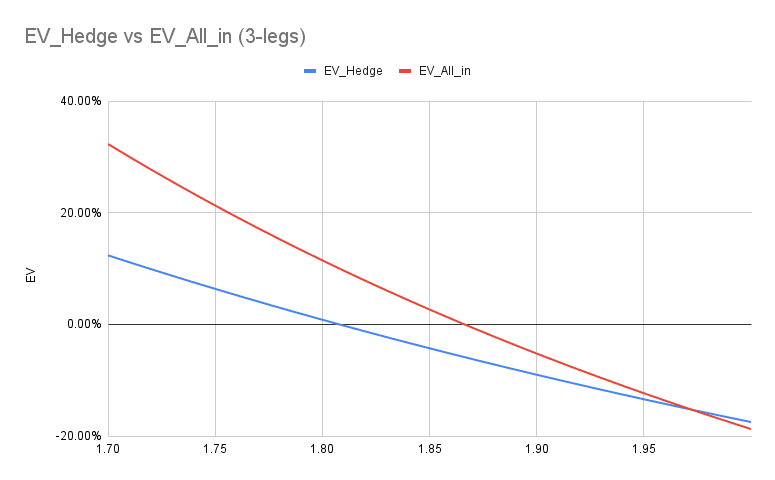
We can see the All-In curve crosses the x-axis at 1.866 and the Hedge curves at 1.808. It is quite clear that for all the times where EV is positive, you get more EV playing All-In.
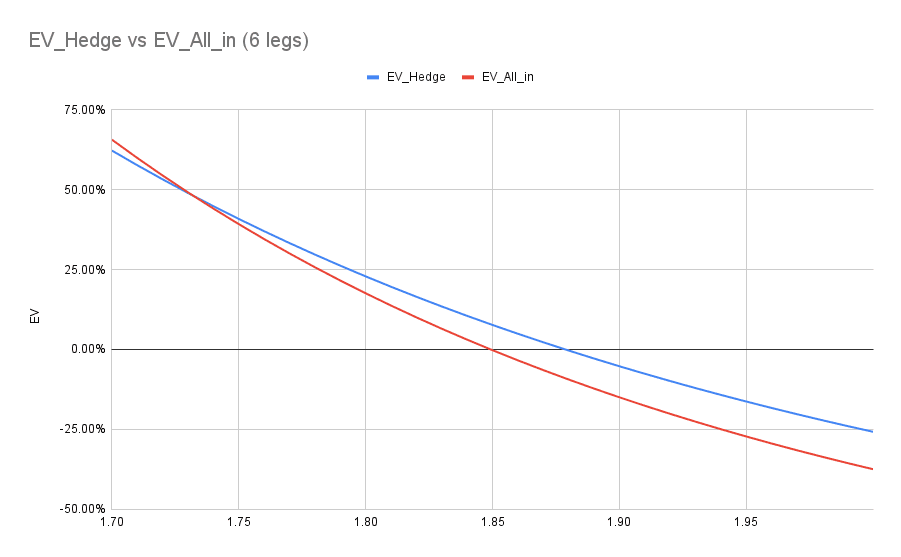
For the 6-leg Pick’Em it’s a different story. The Hedge curve sits above the All-In and provides more value. The EV will only shift in the favour of the All-In option if the average fair odd price of each leg in the pick’em is less than 1.732 (this will rarely be offered in Pick’Em)
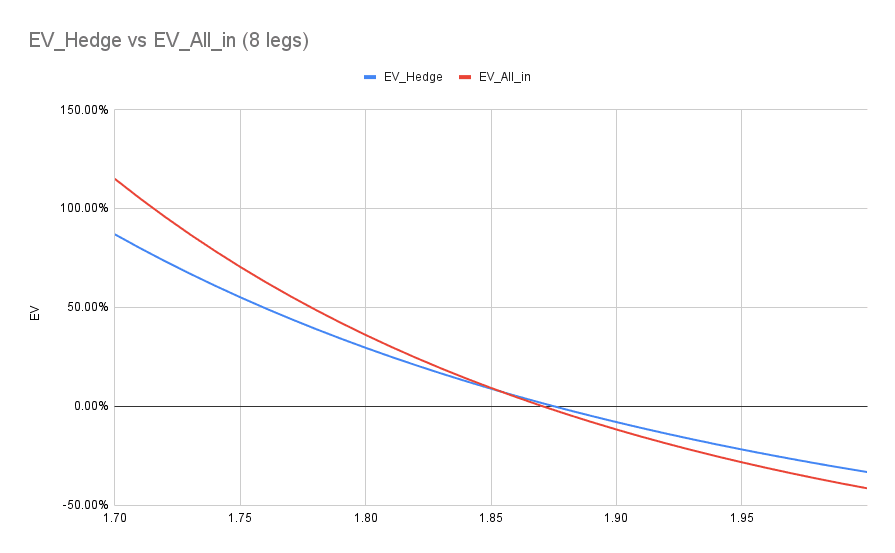
Although the threshold odds for the 8-leg Pick’Em is larger when hedged compared to All-in, you can see from the graph that the EV is almost always higher playing All-in. In fact, mathematically you would only play an 8-leg hedged when the average fair odds of ach leg in the Pick’Em is between 1.875 and 1.854. And even still, if you are playing this Pick’Em you would only be getting a few percent of EV, so it’s not worth it.
Because All-In bets offer a large payout, it has a steeper curve. Every small improvement in win probability has a big impact on your expected return. This is opposed to hedging where the payout is spread out across the probabilities so t is less sensitive to changes in price.
If you want to strictly follow always playing the most mathematical profitable option, here is the optimal playing strategy:
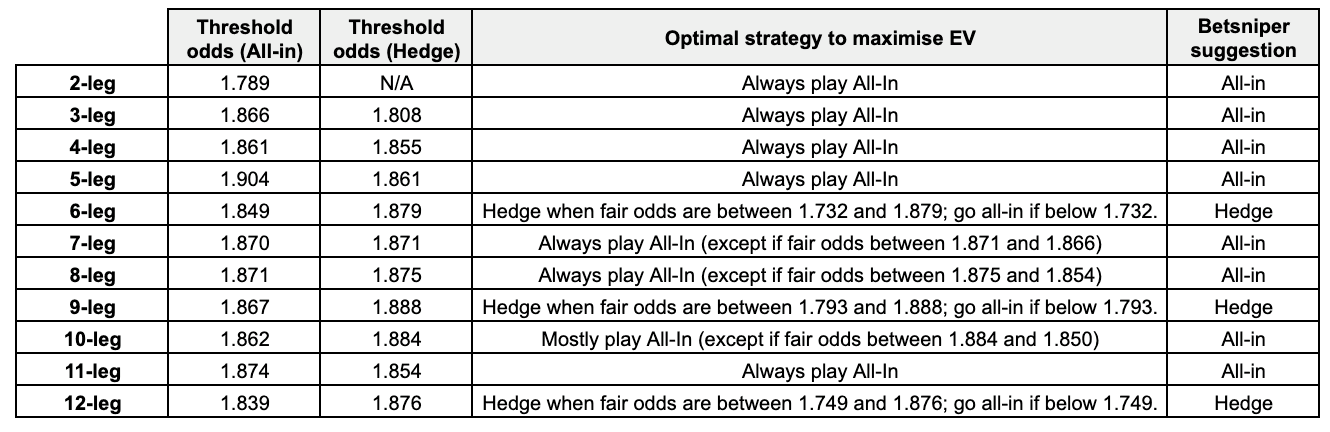
There are only three times where it would be advantageous to play hedged, 6-leg, 9-leg and 12-leg Pick’Ems. The value does shift over to All-In eventually but at a price where you probably won’t find many legs.
Otherwise, if you want to maximise your EV, you are better off playing All-In.
Note: This does not mean playing hedged Pick’Ems are negative EV, it’s just that the All-In Pick’Em offers more EV. Hedge Pick’Ems are still positive EV as long as you beat the threshold odds
Does it really matter? How big is the EV difference?
Although we are talking about small differences in prices, when we are playing these bets, our goal is to get as much expected value on our side. Every cent matters.
Let’s compare the difference in EV for a 5-leg Pick’Em. We will convert the odds into percentages:
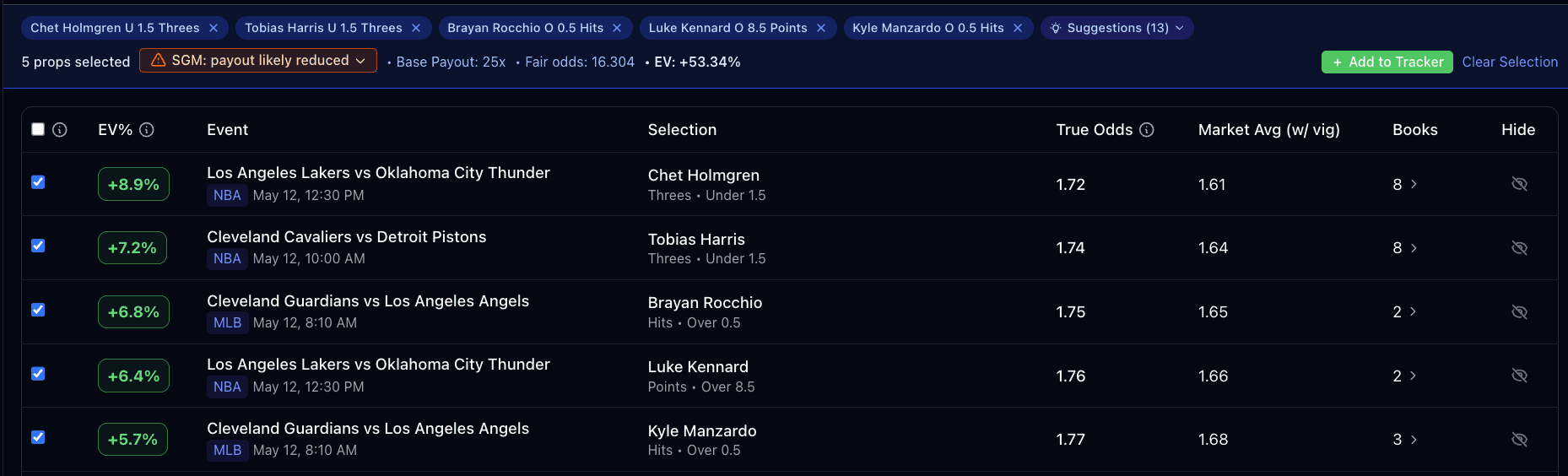
The Betsniper tool will automatically calculate the EV for you. For this 5-leg Pick'Em, the EV is 53.34%.
The EV of this hedge would be 23.76%. We have a calculator where you can see the EV for the Pick'Em when hedged.
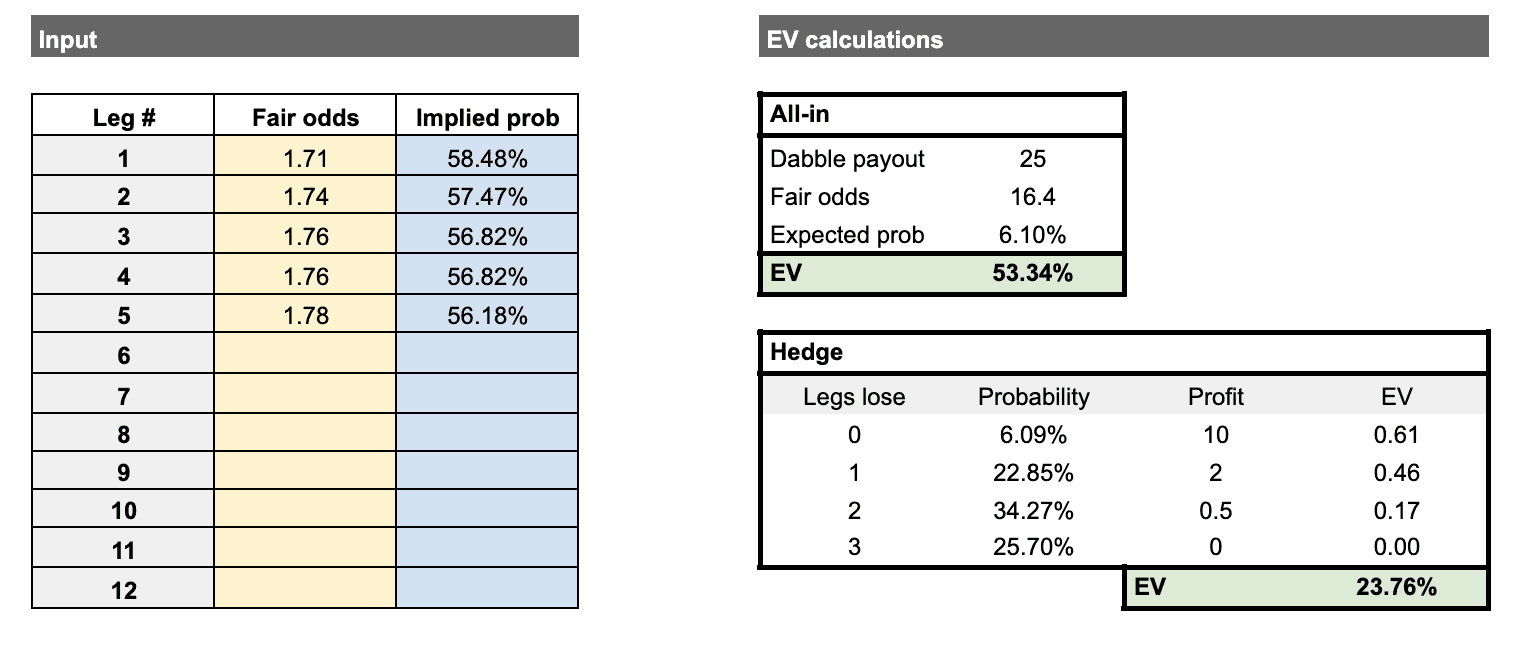
Both these bets have a positive expected return. But by playing the All-In bet, you get way more EV. However, the big difference between these bets will be the variance in results.
By playing the hedge option, you are leaving a ton of upside on the table.
Our thoughts
From my perspective, when I am betting, I am always in it for the long-game. So that means, I am ruthlessly trying to extract as much EV as possible on every bet. I will always play the option with more EV. That is a personal decision. From the POV of maximising profit, it is the right decision.
But your situation, circumstance and risk tolerance may be different. It’s a trade-off between risk and reward.
Hopefully, now you understand a bit more about the maths behind Pick’Em and have the tools to make educated choices for yourself.
Some additional insights comparing the threshold probabilities
You should never play the 3-leg hedged Pick’Em, they present terrible value
The 5-leg All-in Pick’Em offers great value and you would be taking away lots of your EV if you play these as hedged
This is the Pick’Em variation that offers the most positive expected value for us
Anything larger than a five-leg pick’em and the variance is so high that to see the benefit of the expected value you will need to be playing serious volume
If you do ever play these pick’ems just follow our optimal strategy if you want to maximise the expected value
How I play Pick’Ems:
When you are starting off and looking to build a bank roll, stick to playing 3-leg All-in as the variance is manageable
Once you are comfortable and understand the risks, can start playing 5-leg All-in Pick’Ems (I would skip 4-leg Pick'Ems as the reward is not worth the risk)
Unless you enjoy the lottery style wins, I would avoid playing anything above 5-leg
At the moment, the Dabble offering in Australia does not have the volume to make 6-leg+ plays make sense
If I ever did play a 6-leg Pick’Em, I would hedge it as you get a lot more EV





Learn how to become a profitable punter with our guide
We have put 20+ years of betting knowledge into one guide to help you become a better punter as well as share why each Betsniper tool exists, how to use it and the best strategies you can implement today with the Betsiper tools!

Co-founder
I've been betting seriously for over a decade, ever since I realised you can actually make money from sports betting. I studied Economics and Finance at the University of Melbourne and funded my entire time there through betting. Over the years I've become obsessed with building tools and taking a mathematical, strategic approach to the markets. I've poured that experience into building Betsniper - the ultimate companion tool for the smart punter. I now spend my time educating others on how to think about betting strategically, discovering new strategies and ultimately making as much money as possible from sports betting.


Get access to cutting-edge technology as well as a helpful community to help you start making smart decisions when you are betting.


