
Use the market itself to find a fair price, remove the vig, and bet the bookmaker prices that beat it.
Watch the Top-Down EV video


Racing
How to Read Horse Racing Betting Odds
Learn how to read horse racing betting odds in Australia. Discover simple ways to calculate payouts and implied probability, understand fixed and tote prices, and compare odds across bookmakers.

Whether you're new to punting or you've backed horses for years, odds can still trip you up. So what are you looking at, and how do you work out your payout?
Basically, odds are the market's way of letting punters know how likely a horse is to win and how much you'll get back if it does. Once you can read it, the rest becomes easier.
Why You Need to Know How to Read Horse Racing Odds in Australia
Knowing how to read horse racing odds helps you:
Spot when a horse is priced too short or too long
Calculate your potential return before placing a bet
Work out the probability implied by a horse's price
Compare win and place markets properly when you're betting each way
Recognise when a runner has firmed or drifted in the market
Compare prices between bookmakers
Understand how scratchings, betting activity and race conditions can change the market
Understanding Australian Horse Racing Betting Odds
In Australia, horse racing odds are usually in decimal odds. Once you understand that, calculating implied probability or working out exactly how much a winning bet pays won’t be a problem.
This section covers all of the basics you need to know:
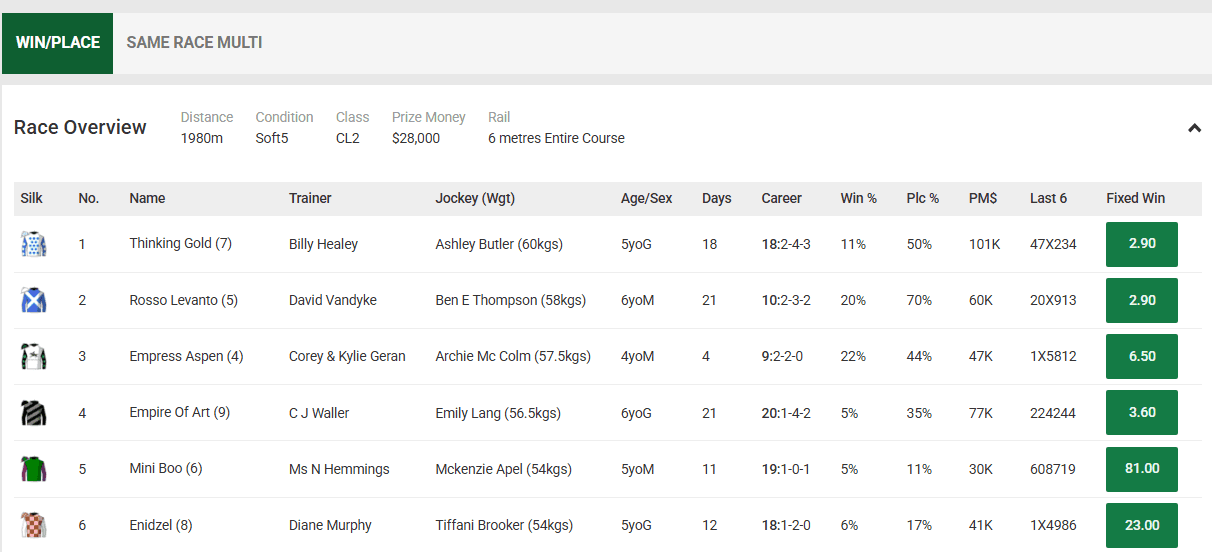
How to Read Decimal Odds
This is the default when it comes to betting odds in the Australian market. The decimal number is the total return for every $1 you stake, including the stake.
If a horse is priced at 5.00, a $10 win bet would return:
$10 × $5.00 = $50
That $50 total return is made up of your $40 profit and your $10 stake.
Types of Horse Racing Odds
Here are some of the most common types of odds in horse racing.
Fixed odds
Fixed odds are the simplest form of horse racing prices. If you back a runner at 4.00 odds and it drifts out to 6.00 by the time the race starts, you're still paid at 4.00. In Australian markets, fixed-odds racing bets generally only apply to Win and Place. Exotics like quinellas, exactas and trifectas aren't offered at a fixed price by most bookmakers.
Tote odds
In a tote bet, your stake goes into a pool with everyone else backing the same type of bet on that race, and the dividend is calculated after the tote takes its cut. Once the race is done, the final dividend amount is shared among winners. This means the Tote amount displayed can change before the race. Exotic bets like quinella, exacta, trifecta, and quaddie all use the tote only.
Top Fluc
Top Fluc, short for Top Fluctuation, gives you the highest official fluctuation recorded during the betting period. For example, if a runner fluctuates between 4.20, 4.60 and 4.40 odds, a qualifying Top Fluc bet would use the highest fluctuation (4.60 in this case). The exact availability and rules depend on the bookmaker and race.
Starting price (SP)
Starting Price, usually shortened to SP, is the price used to settle certain bets when a predetermined fixed price has not been taken. The difference is that an SP bet doesn’t give you the same price certainty as a fixed-odds bet. Betting SP means you don't know your actual price until the race starts.
How to Calculate Horse Racing Betting Dividends
The basic formula is:
Total return = stake × decimal odds
To calculate your actual profit:
Profit = stake × (decimal odds - 1)
Let’s say a runner is priced at 4.20 odds and you stake $25.
Your total return is $25 × 4.20 = $105
Your profit would be $105 - $25 = $80
Your profit is $80.00, and the other $25.00 is just your stake coming back to you.
With decimal odds, bigger numbers mean the less likely the market thinks that horse is to win, and the bigger your payout if it does.
Win and Place Dividends
Win bet: A win bet only pays if your selection wins the race.
The return is simply the stake × odds.
Place bet: A place bet pays out if your runner finishes within the paid positions. How many places get paid and at what fraction of the win price depends on the number of runners on the field.
8 or more runners: 3 places are paid, at roughly 1/4 of the win odds
5, 6 or 7 runners: 2 places are paid, at roughly 1/3 of the win odds
Fewer than 5 runners: win only; no place market is offered
Implied Probability and Horse Racing Odds
Every price has an implied probability. Here’s how to get it:
Implied probability = 1 ÷ decimal odds × 100
So a horse at 2.00 comes out as: 1 ÷ 2.00 × 100 = 50%
And a 10.00 roughie comes out as: 1 ÷ 10.00 × 100 = 10%
Bookmaker’s Margin
In most markets, when you add up the implied probabilities of all the runners in a race, the total is often more than 100%. The extra is the margin (often called the overround, the vig or the juice) which the bookmaker builds into the market. On a full horse racing field, it often reaches between 115% and 140%, sometimes more.
The bigger the overround, the bigger the advantage is for the bookmaker.
Reading Odds Fluctuations
A fluctuation is a movement in a horse's odds. In horse racing, odds move, and they probably move more than most sports markets. A horse can open at 6.00, drift to 9.00 as the morning goes on, then firm hard into 4.00 in the final few minutes before the jump.
A move in price is actually useful information. A runner that's firming (shortening in price) is attracting money, sometimes from informed sources close to the stable. A runner that's drifting (lengthening) is likely being ignored or actively laid off by the market.
Still, this doesn’t necessarily guarantee that a runner is going to win. Markets can move because of new information, betting activity, scratchings or changes in the amount of money available at different prices.
Factors That Affect Horse Racing Betting Odds
Horse racing odds aren't set randomly. There are several factors that can influence the price of a runner.
Betting activity
The most obvious factor is money entering the market. When there’s a lot of betting support for a horse, bookmakers may shorten its price, while prices drift when there’s less demand.
Horse form
Recent performances are a major part of how markets assess a runner. Punters and bookmakers consider factors such as:
Recent finishing positions
Quality of opposition
Race distance
Class of race
Margin from the winner
Track conditions
Barrier position
Track conditions
Australian racing uses official track ratings to describe the condition of the surface. The scale goes from Firm to Heavy, with Good and Soft conditions between those extremes. Some horses perform better on wet tracks, while others are better off on dry ground. A change in weather can affect prices, particularly when rain alters the expected conditions shortly before the race.
Barrier draw
Where a horse jumps from is important as well, particularly over shorter distances or on tracks where the rail favours one side.
Jockey and trainer
The jockey-trainer combination can also influence the market. A jockey with a great track record, a change in tactics or a trainer with a strong reputation in a particular race type can all attract attention from punters.
Field size and race quality
More runners means more competition, which generally spreads the market thinner across more realistic winning chances. Also, a horse dropping into an easier race could attract support.
Scratchings
When a runner is withdrawn or scratched from the race, the whole book has to reform around the field that's left. A late scratching, especially of a leading fancy, can massively shorten the remaining favourites.
Comparing Odds From Different Bookmakers
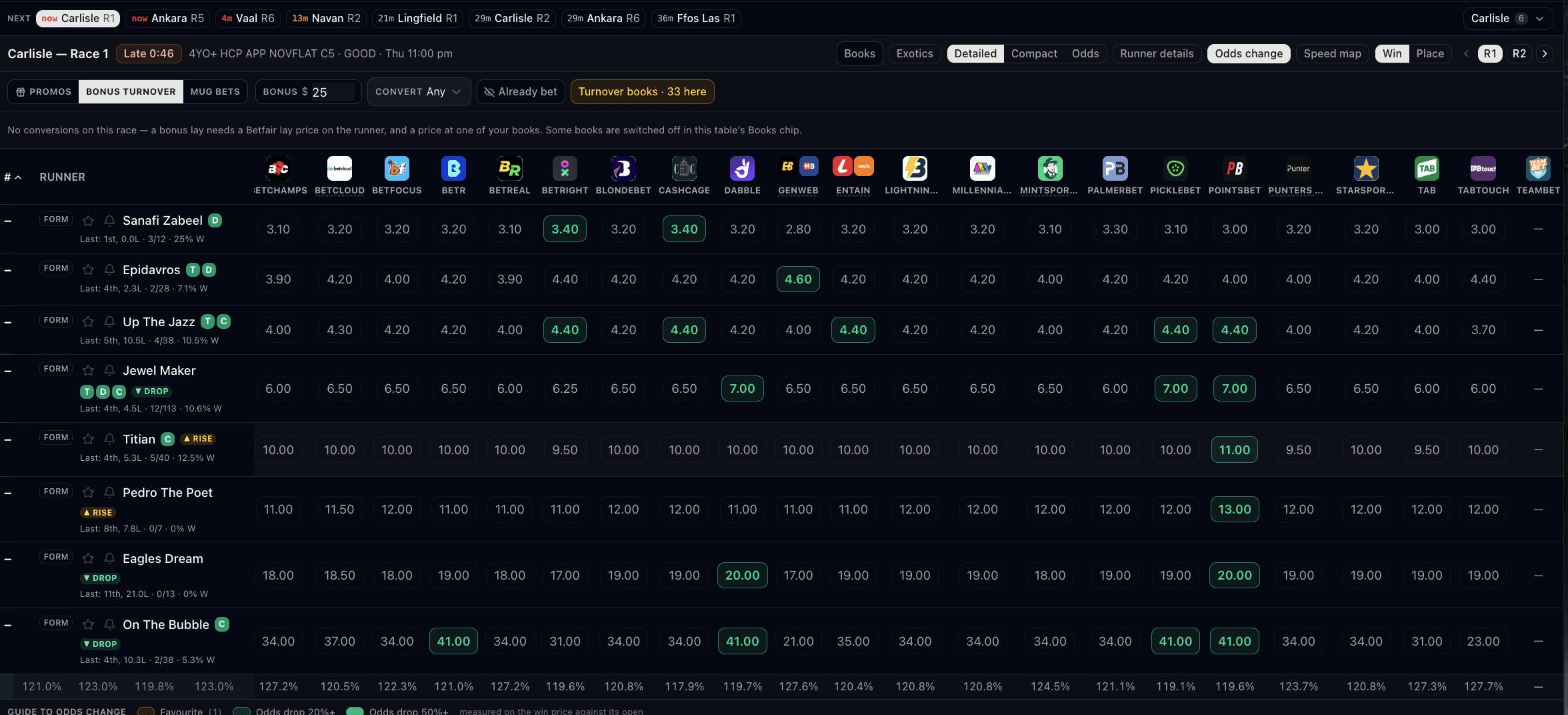
Shopping for the best odds is where reading odds actually turns into making better decisions with them. It’s rare to find two bookmakers with the same price for the same runner in the same race. That difference between them adds up over multiple bets.
That’s why checking different bookmakers to find the best odds is a big deal when it comes to betting in general. But doing this manually can be slow and tiring. In horse racing, it’s even more frustrating when you're checking several races close to jump time. This is why tools like BetSniper’s Odds Comparison are so important. It pulls live prices from Australian bookmakers and puts them together so you can compare them in one place.




Learn how to become a profitable punter with our guide
We have put 20+ years of betting knowledge into one guide to help you become a better punter as well as share why each BetSniper tool exists, how to use it and the best strategies you can implement today with the BetSniper tools!

Co-founder
I've been betting seriously for over a decade, ever since I realised you can actually make money from sports betting. I studied Economics and Finance at the University of Melbourne and funded my entire time there through betting. Over the years I've become obsessed with building tools and taking a mathematical, strategic approach to the markets. I've poured that experience into building BetSniper - the ultimate companion tool for the smart punter. I now spend my time educating others on how to think about betting strategically, discovering new strategies and ultimately making as much money as possible from sports betting.


Get access to cutting-edge technology as well as a helpful community to help you start making smart decisions when you are betting.


