


Racing
How to Use the BetSniper Horse Racing Tool
Learn to use BetSniper's Horse Racing tool: promos, bonus turnover, mug bets, arbs and EV betting explained, plus how to read every page and screen.

Horse racing is one of the most popular betting markets in Australia. While sports betting is growing rapidly, racing still dominates total wagering, with over $20 billion staked each year.
But betting on racing is very different to sport. Many of the EV betting methodologies we use for sport don't map neatly onto racing, so our approach has to adapt. That said, the core principles still carry over, we can take what we've learned on the sports side and apply it in a way that fits how racing markets actually behave.
What racing offers is a huge volume of promotions and constant opportunities to turn over bonus bets. This is one of the fastest ways to build your bankroll and is a great asset to anyone who wants to make some money from the bookmakers.
Why is horse racing different to sports betting?
If you're coming from sports betting, racing looks familiar on the surface but there are some significant differences that are important to understand.
Large fields
A typical sports market is a two-way head-to-head: one side or the other. These markets are super easy to understand because we can easily devig them and get a sense of their implied probabilities. A horse race is 8, 12, sometimes 16+ runners all competing in the same market which makes it harder to estimate implied probabilities of runners.
Crazy odds fluctuations
Sports prices tend to drift gently or have sudden moves on the announcement of news. Racing prices move hard and fast, and they move right up to the jump. A horse can open at $6, drift to $9, then firm into $4 in the final few minutes. Prices are reshaped by late money, by scratchings (when a runner is pulled, the whole book has to re-form around the remaining field), and by the constant tug-of-war between firmers (shortening) and drifters (lengthening). The market is genuinely alive in a way most sports markets aren't. This opens up lots of value opportunities if you are quick enough to snipe it.
Sharp money arrives late
This is one of the biggest structural differences. In racing, the sharpest, most informed money, professional punters, syndicates, stable connections, comes steaming in during the final minutes before the jump. The market is at its most uninformed early and its most efficient right at the off. Although similar patterns happen in sport, the magnitude is much larger in racing.
Massive juice in the market
Every betting market carries a built-in margin, called the overround (or "the vig"/"juice"). It's the amount by which all the implied probabilities in a market add up to more than 100%. A fair two-way coin-flip would be $2.00 / $2.00 (100%); a real bookmaker prices it more like $1.91 / $1.91, which sums to ~105% — that extra 5% is their margin, and it's what you're fighting to overcome to be profitable.
We have put together a more in-depth blog explaining what the bookmaker margin is
In racing, that margin is far larger. Across a full field, the overround often sits at 115–140%+. The more runners, the more margin the bookie can bake in. Margins will also vary between different books for the same race.
This matters enormously for EV betting: a bigger overround means the "fair" price of every runner is buried under more juice, so a bookmaker's fixed price has to be significantly out of line before it's actually good value.
High overround is the single biggest reason raw +EV betting is harder on racing than on a tight two-way sports market. It’s also why bookmakers love punters who bet on horses as there is so much margin for the bookmakers to play with.
Betfair as the sharp market
Betfair is often regarded as one of the better references for true horses racing odds (where there is enough liquidity). Fed by high liquidity, especially at the jump, the exchange price (and the Betfair Starting Price) is widely treated as the sharpest fair-value signal in racing. In fact, Australian corporate bookmakers frequently price off Betfair themselves.
Fixed odds vs the tote
In sport, you almost always bet at fixed odds, the price you take is the price you get. Racing gives you a choice. You can take fixed odds, or you can bet into the tote (parimutuel), where all the money goes into a pool and the final dividend isn't known until the race is settled, your return depends on how everyone else bet. There's also "top fluctuation" or best-of-day pricing, where operators offer the best price a runner reached during a window. These extra pricing options exist because racing has multiple parallel markets running at once, and each behaves differently, which creates opportunities that simply don't exist in a single-price sports market.
For the purpose of this article and use with Betsniper, we will always be betting fixed odds
Exotic bet types
Sport is mostly win/place, with a limited set of props. Racing has a whole family of bet types with no real equivalent in sport, quinellas, exactas, trifectas, first fours, quadrellas, and other multi-leg "exotics" where you're predicting combinations across one or several races. These pools behave very differently from straight win betting and open up their own strategic angles, though they also come with their own complexity and margin.
What Is Betfair?
Betfair is a betting exchange, and understanding how it differs from a traditional bookmaker is key to understanding how BetSniper prices value.
Betfair is an essential part of the horse racing betting experience. Sign-up today!
Exchange vs traditional bookmaker
When you bet with a normal Australian bookmaker (Sportsbet, Ladbrokes, TAB), you're betting against the house. The bookie sets the odds, takes your bet, and profits from the margin baked into their prices. A betting exchange works completely differently. Instead of setting odds and taking the other side, the exchange acts as a marketplace, matching bettors against each other rather than against a bookmaker. Think of it more like a stock exchange.
Because Betfair is a peer-to-peer exchange, you're getting true odds set by fellow punters, not the odds a sportsbook dictates. That's what makes the exchange price such a useful reference.
Betfair prices move extremely quick, much more than you would ever be used to on a sportsbook.
Back vs Lay
An exchange gives you two ways to bet.
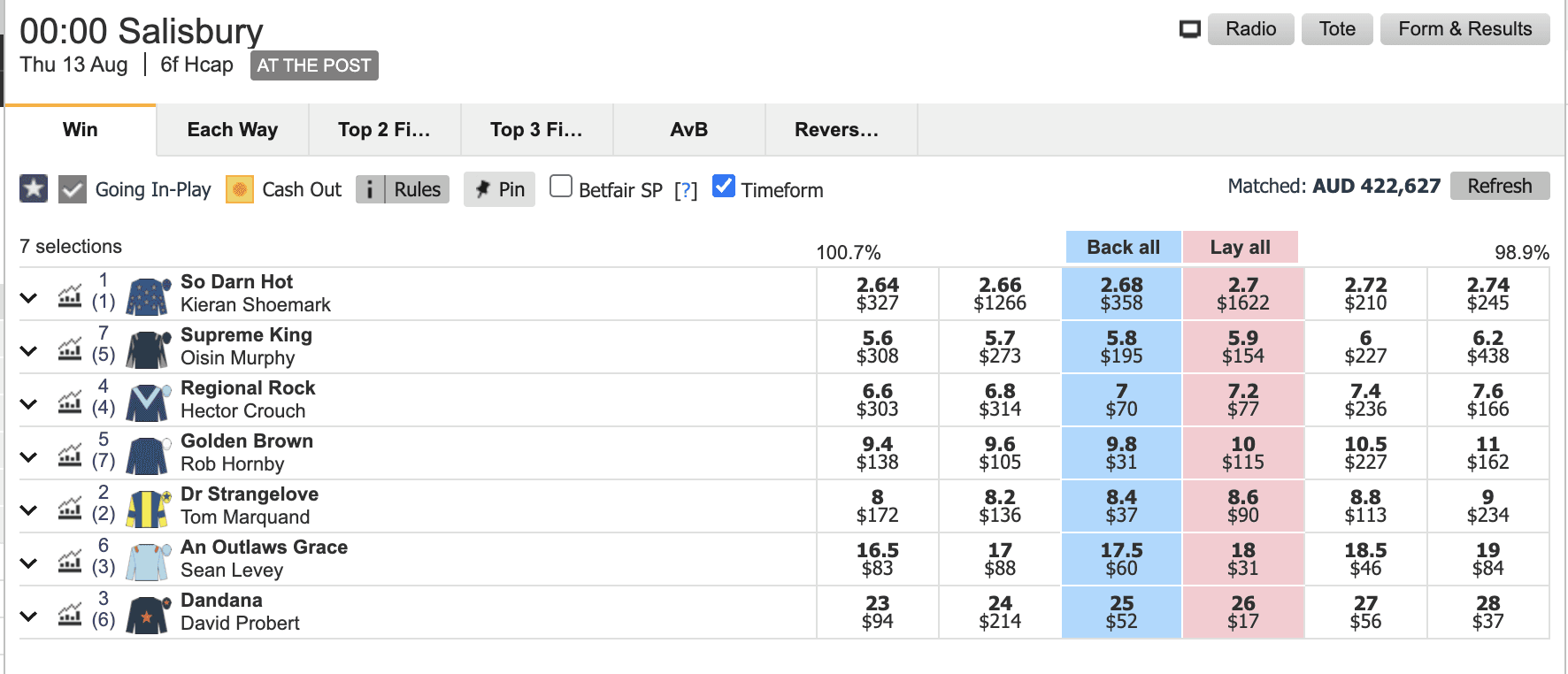
A back bet (blue column) is betting that an outcome will happen.
A lay bet (pink column) is betting against an outcome i.e. effectively acting as the bookmaker yourself or betting on every other outcome but the one you choose.
If you lay a horse, you win if it doesn't win the race. This is what makes an exchange two-sided: for every backer there's a layer taking the other side, and the price is simply where those two.
Betfair also display two numbers. The number in bold is the actual odds available. And the number underneath is the amount of liquidity available at that odd. The numbers either side of the back and lay column are what liquidity is available at worse prices.
The Maths of laying
When you lay, you can think of yourself as a bookmaker accepting a bet for that runner
When you put a lay bet you will have two outcome:
If you win, your winnings equal the stake you layed: how ever much you layed a horse is how much you will win
Your liability — this is what you put up, and what you lose if your horse wins. Liability scales with the odds: liability = backer's stake × (odds − 1).
So the key mental shift from backing: when you back, your stake is fixed and your potential winnings vary with the odds. When you lay, it's the reverse, your winnings are fixed at the backer's stake, and it's your liability that swings with the price. The longer the odds, the more you have to risk to win that same amount.
Here are two lay bets, both where you accept a $100 backer's stake:
Example 1 — Laying a favourite at $2.00
You lay the horse for $100 at odds of $2.00.
Liability = $100 × (2.00 − 1) = $100.
If the favourite loses (any other runner wins): you win the $100 stake, minus commission. At 8% AU racing commission, you keep $92.
If the favourite wins: you pay out $100.
You're risking $100 to win $92.
Example 2 — Laying an outsider at $11.00
You lay the horse for the same $100 at odds of $11.00.
Liability = $100 × (11.00 − 1) = $1,000.
If the outsider loses (very likely): you win the $100 stake, minus commission — again $92 kept at 8%.
If the outsider wins (rare, but it happens): you pay out $1,000.
Same $100 to win, but now you're risking $1,000 to win $92. The upside is identical; the downside is ten times larger.
Note when you lay higher odds you need to have that amount of money in your Betfair account
What is BSP (Betfair Starting Price)?
For racing, the single most useful number the exchange produces is the Betfair Starting Price (BSP). BSP is a special order type on the exchange: instead of taking a price now, you commit your stake to be matched at the price Betfair's algorithm determines the moment the race starts, using the weighted balance of back and lay money in the market at that instant.
BSP is, on average, the closing line. By post time, the market has absorbed all the informed money, late plunges, stable moves, scratchings, the lot, and BSP reflects that final consensus. This is why it's such a clean read on a runner's true probability, and why beating BSP consistently is the gold-standard measure of a profitable bettor. If you can regularly take prices that beat BSP, that is a very strong sign that you have found an edge.
The one caveat to keep in mind: the final BSP only exists at the jump. In the lead-up you're working off the live exchange price or Betfair's projected BSP as a real-time proxy. Although not as strong as the final BSP, this still serves as a very good benchmark particularly in liquid events.
The Betfair commission
Since there's no margin in the price, Betfair charges commission instead, and this is where Australian racing gets its own rules. Every market has a Market Base Rate (MBR), the percentage deducted from your profit on winning bets, and it's charged on your net winnings per market, not on every individual bet, if you lose money on a market, you pay zero commission.
The commission is not flat and changes from race to race. The commission does have an impact on your strategies and estimated winnings so it is always important to plug your commission into the tool so you get accurate calculations.
To check the exact rate on a given market, click the rules button on any Betfair event.

Why liquidity varies and why it's a real issue in Australia
An exchange only works if there's money on both sides to match your bet. In deep markets, bets match instantly; in thin ones your bet may sit unmatched or only partially fill. This is why the exchange and BSP are razor-sharp in big, liquid races and much noisier in small country meetings. The BSP benchmark is much stronger when there is more liquidity.
Exchange liquidity is falling but still sufficiently high for the larger Australian meets. When you are betting, you should always take note of the amount of liquidity in the market and on the specific runners.
If you want to become a profitable punter on horse racing in Australia, you need to have a Betfair account. Sign-up today!
How to be a profitable punter on horse racing
There are lots of successful horse racing punters out there. They definitely have their own ways of finding EV, often with very complex models and research. But finding pure top-down EV on horse racing is difficult.
If you are unfamiliar with top-down EV betting, we have a complete guide where we go over everything you need to know.
While there will be some top-down EV betting opportunities, the best opportunities will be taking advantage of the plethora of horse racing promotions that are offered by bookmakers.
We can use the market average price de-vigged to give a good estimation of true price. If you can find odds greater than that, you can find positive EV betting opportunities. Further, there are opportunities everyday where you can arb on Betfair because the back price >>> lay price.
But where the real money and edge lies is with promotions. In order to overcome the massive juice applied on markets, promotions allow us to wrestle some of that edge back when used smartly.
A boosted price can turn a fair or even slightly negative runner into a clearly +EV bet.
A money-back-if-it-loses offer removes downside on one side of the wager. Bonus bets, turned over correctly, convert to cash at a predictable rate regardless of the underlying price. The entire edge comes from the promotion.
Nowadays, racing is the sport where bookmakers give the most promotions. These come in all shapes and sizes, but are very easy to extract positive expected value.
Using the Betsniper odds screen
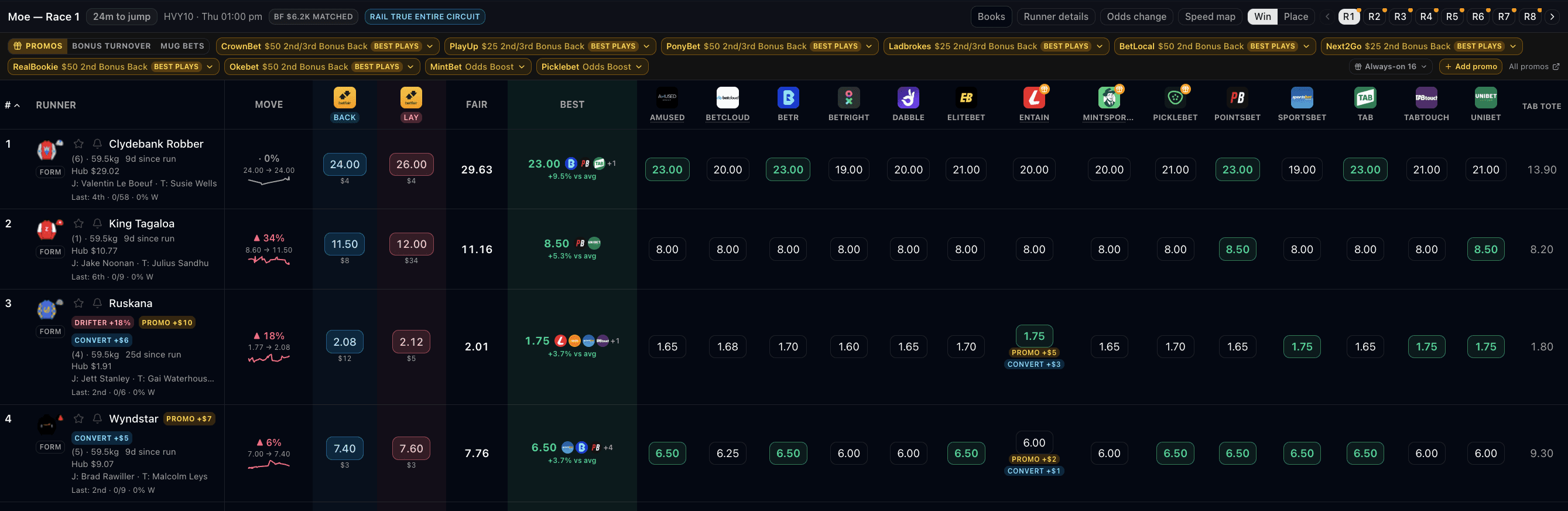
When you open the tool you land on the odds screen which shows a single race laid out row by row, one runner per line, with every bookmaker's price shown side by side. Here's how to read it, working from the top down and left to right.
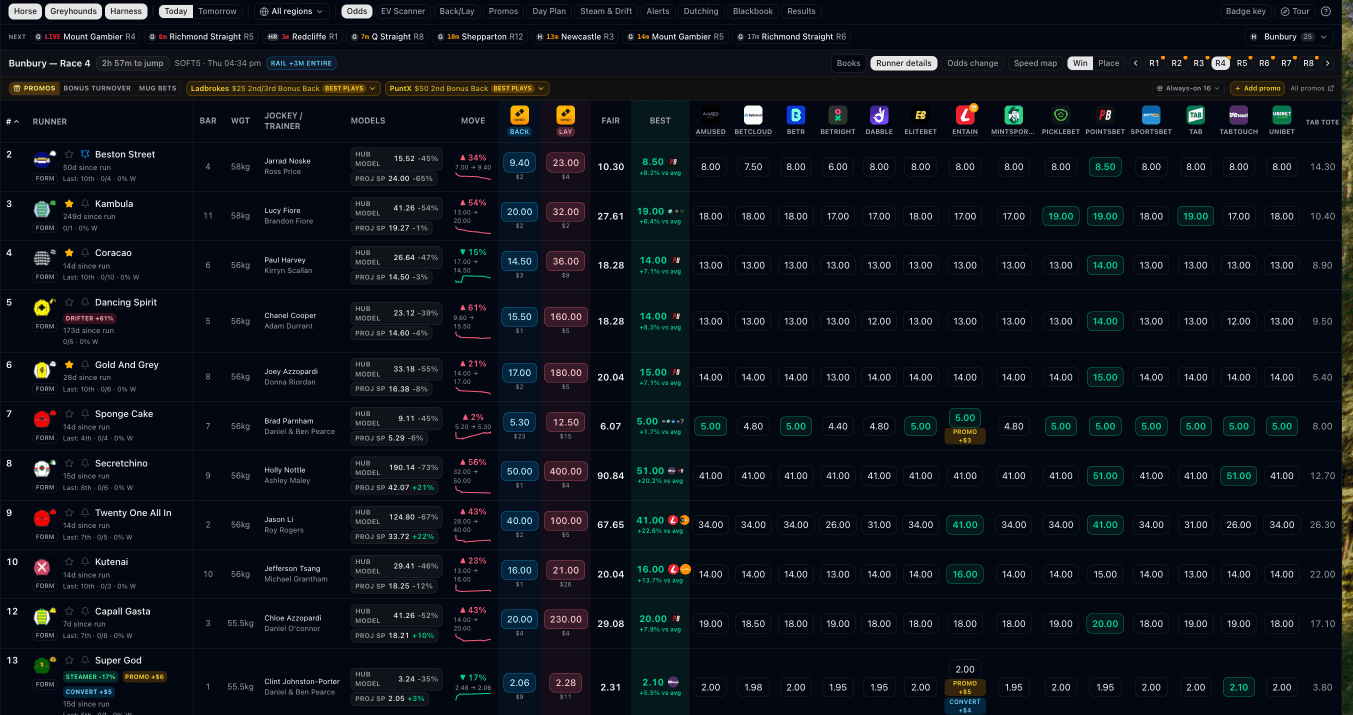
Here is how to read the top navigation section of the odds screen
Across the very top you choose the racing code: Horse, Greyhounds, Harness and the day, Today or Tomorrow, with an All regions filter to narrow by location.
Alongside sit the main views: Odds (the default screen you're on), EV Scanner, Back/Lay, Promos, Day Plan, Steam & Drift, Alerts, Dutching, Blackbook and Results.
Just below is the "NEXT" jump bar: a live queue of upcoming races across all meetings with a countdown to each jump
Underneath this tells you the meeting and race number (Moe — Race 1), time to jump (12h 23m), the track condition and going (HVY10, i.e. Heavy 10), and the rail position.
On the right you can flick between Win and Place markets, jump to any race number (R1–R8+), and open Runner details, Odds change and Speed map.
Under this is the three betting modes (we will cover this in detail below)
Here is how to read the odds section:
Each row is one runner, and the left block carries the form: saddlecloth number, horse name, barrier, days since last run, jockey and trainer, and recent form (last finish, career record, win %).
Then come the four columns that matter most for value:
BACK / LAY (Betfair) — the exchange prices, back in blue and lay in red, with the liquidity available at each shown beneath (e.g. $1, $23). This is your sharp reference.
FAIR — market average devigged using the shin method
BEST — the best available price across all bookies, with the book(s) offering it and how far it beats the average (e.g. +10.0% vs avg). Green means you're getting a price above fair — a value signal.
To the right of those, every bookmaker column (Betr, Sportsbet, TAB, Unibet and the rest) shows that book's price for the runner, with the best price in each row highlighted green so value jumps out at a glance. The far-right TAB TOTE column shows the tote dividend for comparison against fixed odds.
The footer row is easy to miss but tells you a lot: the MARKET % (overround) for each column. BetSniper's fair market sums to a true 100.0%.
Three betting modes
On the odds screen, we have three betting modes you can toggle between.
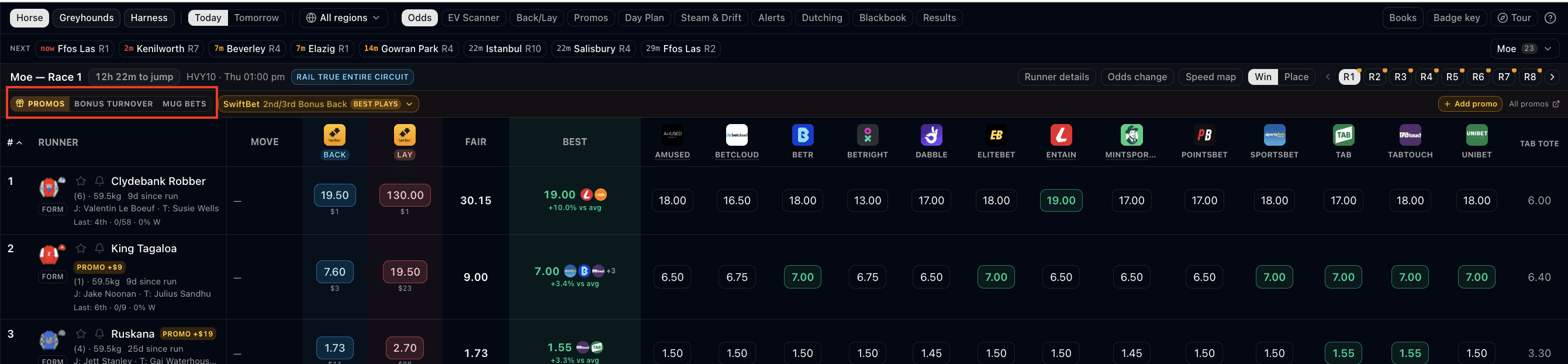
Promos: extracting value from bookmaker promotions (bonus back, price boosts, money-back specials); how the tool surfaces qualifying races
Bonus turnover: turning bonus bets into cash efficiently (targeting the right odds range to maximise conversion); what the optimal strategy looks like
Mug bets: placing low-key "normal-looking" bets to stay under the radar and keep accounts healthy; why this matters for longevity
1. Promos
This is the tab to use if you have promotions and you are looking to take advantage of them.
Loading in the promo
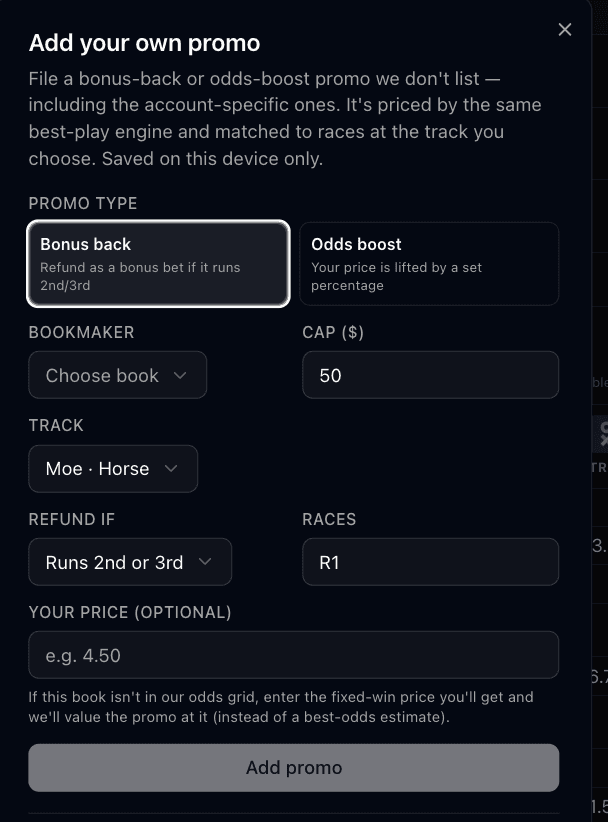
BetSniper loads in the current bookmaker promotions automatically, so the offers running across today's races are already there to select. But some promos are account-specific. Those you can add manually via + Add promo, so the tool models your personal offers exactly the same way as the public ones.
When you add a custom promo, you can set the type, which bookmaker, track and details of the promotion so we can calculate the EV of the bet depending on the odds of that bookmaker.
Setting your inputs
The EV calculation will depend on the settings you input in the left-hand console
Bonus $ — the amount your stake is refunded as if the promo triggers
Keep % — how much of a bonus bet you can realistically convert back to cash (e.g. 80%). The more money you can retain in your bonus bets, the more profitable this strategy is. A good aim is nothing lower than 75%
Reading the probabilities
For each runner the tool shows the probability of 1st and the probability of 2nd/3rd. These are fair probabilities, derived from the consensus fair price, so they're your genuine chances rather than a bookie's margin-loaded implied number.
The two strategies

There are two ways you can play the promotion:
1. Punt it straight
Determine fair odds and win probability
Punt the promotion with expected return driven by both the win and the 2nd/3rd bonus-back trigger
E.g. for Ruskana at PonyBet here's what happens with a $50 bonus bet on the 2nd/3rd Bonus Back:
Punt your $50 at $1.70 for Ruskana to win
Fair chances: 41% to win, 41% to run 2nd/3rd
If it wins, you collect the bet; if it runs 2nd or 3rd, your $50 comes back as a bonus, which you convert at 80%
Expected value ≈ +$9.28 on your $50 (+18.6% of stake)
2. Lay it off
What happens before the race:
Pull in the Betfair lay price (these move quickly, especially near the jump)
Calculate the perfect amount to lay to hedge the position
You lock in a small qualifying loss and you're now hoping it runs 2nd or 3rd
What happens after the race
If horse wins
Win your promotion bet but lose your liability on Betfair
Your net position is the qualifying loss
If horse loses (but places)
Lose your bet but win your position on Betfair but net position is the qualifying loss
Get a bonus bet that you can convert at 80%
If horse loses (but not places)
Lose your bet but win your position on Betfair but net position is the qualifying loss
This takes a bit more time and you usually pay a small tax for capping your downside. In the worst case scenario, you only lose your qualifying loss. Often you can keep this under $5 i.e. 10% on a $50 promotion if the back and lay prices are close enough to each other.
E.g. for Ruskana at PonyBet with a $50 bonus bet:
What happens before the race:
Punt your $50 at $1.70 to win
Lay Ruskana at Betfair at $2.14 for $41.26 where liability is $47.04
Locked in your qualifying loss of $12.04
What happens after the race
If your horse wins -> fair probability = 50%
Win your bet at the bookmaker = $50 x ($1.70 - 1) = $35 profit
Lose your liability at Betfair = -$47.04
Net position = $35 - $47.04 = -$12.04
If your horse loses (but comes second or third) -> fair probability = 41%
Lose your bet at the bookmaker = -$50
Win your stake back at Betfair minus commission = $41.26 - ($41.26 x 8% commission) = $37.96
Win a $50 bonus bet that we can convert at 80% = $50 x 80% = $40
Net position = -$50 + $37.96 + $40 = $27.96
If your horse loses (but not places) -> fair probability = 9%
Lose your bet at the bookmaker = -$50
Win your stake back at Betfair minus commission = $41.26 - ($41.26 x 8% commission) = $37.96
Net position = -$50 + $37.96 = -$12.04
Expected net position (factor in probability of each outcome)
Expected profit = (50% x -$12.04) + (41% x $27.96) + (9% x -$12.04) = $4.33
The trade-off between them is: back-only carries more upside but more variance; back-and-lay smooths the outcome because you cap your downside. You're sacrificing some expected value for consistency.
Track bet
Once you've picked your play, the Track column on the right lets you add the bet directly.
From there BetSniper tracks the bet's EV and, for the two-legged play, tracks the lay as well, so your promo activity is monitored and tracked.
Promo badge on odds screen
When there is a listed promotion for a bookmaker and there is a good betting opportunity you will see a badge appear underneath the runner. It has a label and a number which indicates the expected amount of EV you can win from this play.
The “Punt it” strategy is the yellow badge
The “Lay it off” strategy is the blue badge
2. Bonus turnover
Once you get bonus bets, we need to know how to extract maximum value from them. Horse racing is one of the best way to turnover bonus bets and convert them into cash.
Setting your inputs
Two inputs at the top drive everything:
Bonus $ — the size of the bonus bet you're converting (e.g. $50).
Convert — set the min threshold needed to convert at
We recommend aiming for a min conversion of 75%. A lot of your edge comes from how well you can convert your bonuses. On busy racing days, these opportunities will be easy to find
The two strategies
Similar to promos, there are two strategies:
Punt it straight
Determine fair odds and win probability
Punt the bonus with expected return being the bonus amount x actual odds x fair win probability
This strategy works best at higher odds as we are able to convert more value from the bonus bet. You won’t win the bet every time, but over a long enough time period, you will realise the expected profit.
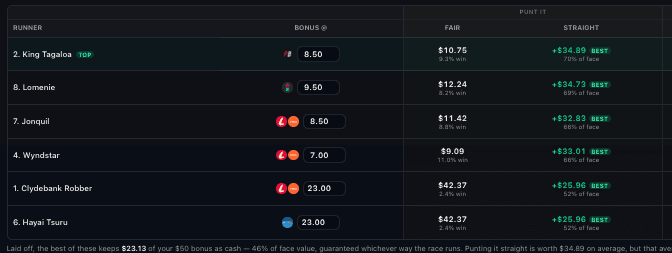
E.g. for King Tagaloa at Pointsbet here is what happens with a $50 bonus bet:
Punt your $50 at 8.50 for King Tagaloa to win
We expect King Tagaloa wins 9.3% of the time based on fair odds
Expected return = 8.50 odds x 9.3% win probability x $50 bonus bet = $34.89
This is converting 70% of the $50 bonus bet
Lay it off
Pull in Betfair lay price (this move quickly, especially close to the jump of races)
Calculate perfect amount to lay to hedge position
Get fixed payout no matter if your horse wins or lose
If horse wins
Win your bonus bet
Lose your liability on Betfair
If horse loses
Lose your bonus bet (which was free)
Win your stake back (minus commission) on Betfair
This strategy takes a bit more time and you usually will pay a small tax for certainty. Lay prices can also fluctuate very quickly so you need to be quick to lock in exactly what you want.
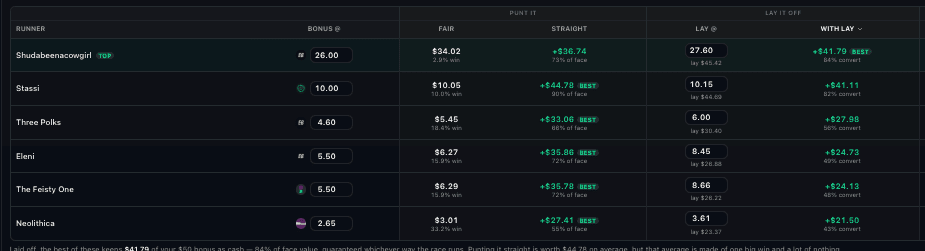
E.g. for Shudabeenacowgirl at Elitebet here is what happens with a $50 bonus bet:
Punt your $50 at 26 for Shudabeenacowgirl to win
Lay Shudabeenacowgirl at Betfair at odds of 27.60 for a stake of $45.52 and liability of $1,210.83 (you need this amount in your Betfair)
Guaranteed payout of $41.79, no matter which bet wins
Shudabeenacowgirl wins
Elitebet profit = 26 x $50 - $50 bonus bet = $1,250
Lose Betfair liability of $1,210.83
Profit = $1,250 - $1,210.83 = $41.79
Shudabeenacowgirl loses
Lose bonus bet on Elitebet (which was free)
Win $45.52 stake back on Betfair minus commission = $41.79
To see these payouts in more detail, you can use out free Betfair Bonus Turnover calculator.
Which strategy should I use?
If you are seeking to optimise your profit, you should never lay on Betfair. Although there are rare occasions where laying on Betfair has higher expected value.
But the real question to ask, is how long are you going to do this strategy for? If this is just the occasional bonus bet you are turning over, it might make more sense to hedge it with Betfair. But if you think you will be converting bonus bets consistently, then you should just punt it. Let’s actually look at some the numbers - how many bets until variance is on your side.
Let’s use the following example:
$50 bonus bet
Back odds of 9
Fair odds of 10 i.e. 10% win probability
Expected conversion is 80% of the bonus bet value i.e expected profit of $40
If you do this once, there is only a 10% chance you will win the bet. So most likely you will not realise the gains, you'll turn the bonus over and walk away with nothing, and that will happen roughly nine times out of ten.
Now do it repeatedly, and watch what happens to your return per bet. Early on it's wildly unstable. You may have extreme luck and over perform or more likely lose a lot of bets and have no returns. But your expected profit grows with every bet placed, while the random swings only grow with the square root of the number of bets. So the noise shrinks relative to the edge, and your realised return per bet steadily funnels in toward the true $40:
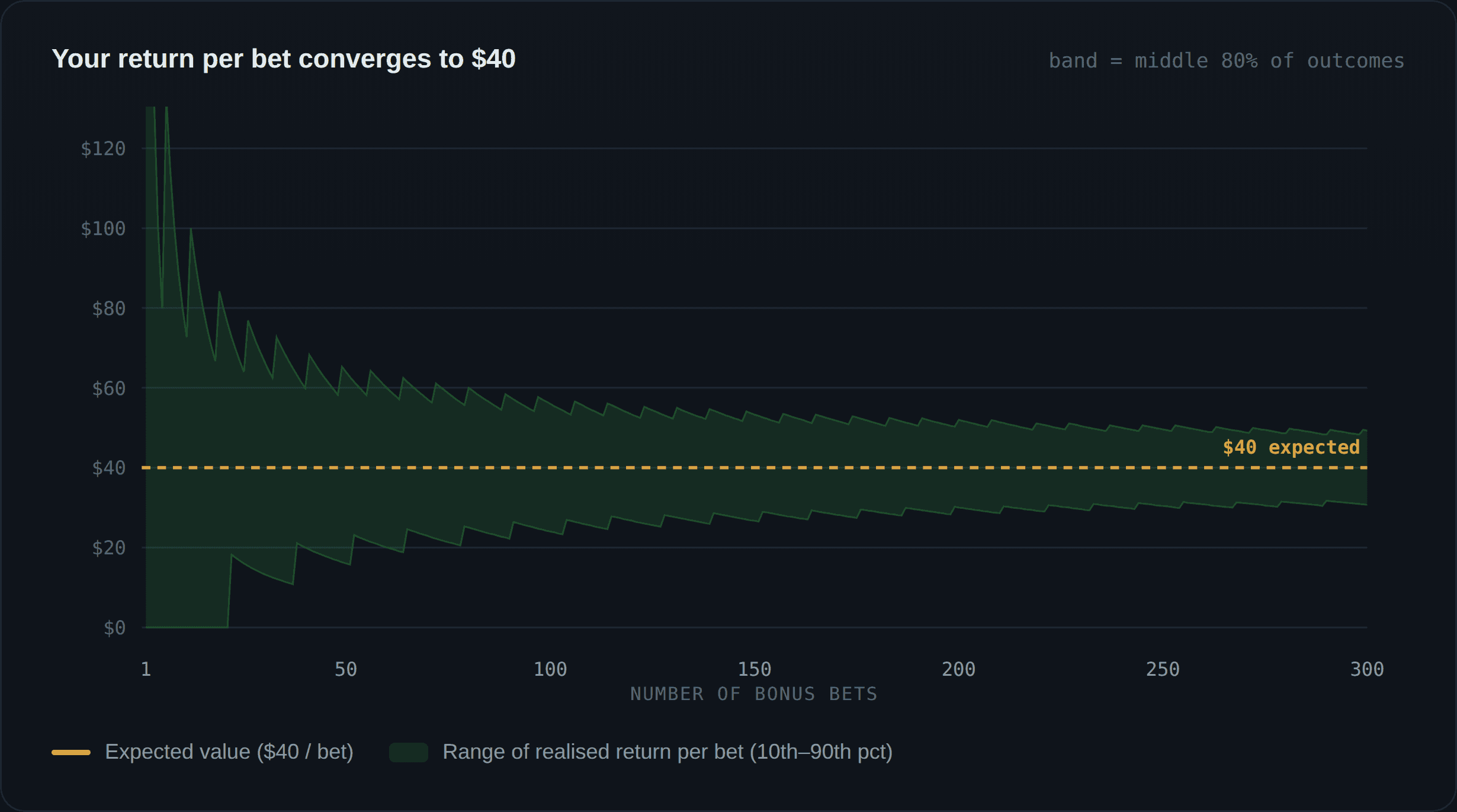
After ~20 bets, you've very likely won at least once — the chance of a complete blank has fallen to around 12%.
After ~30 bets, that's down to ~4%, and your realised return has tightened noticeably around expectation.
After ~50 bets, being in profit is near-certain, and your per-bet return is clustering close to $40.
After a few hundred bets, almost every realistic outcome sits within a few dollars of the full $40
Because of the nature of the payouts i.e. in this example either $0 or $400, the range of outcomes will be a range. But over enough bets, it will hover around $40 on average.
Track your bets
When you click the data in the “Straight” or “With Lay” column, you will be able to add straight to your bet tracker.
If you punt it straight the bet will be tagged as “Bonus Turnover - Punt”. If you lay it, both bets will be tagged as “Bonus Turnover - Lay”.
Convert badge on odds screen
When there is a good turnover opportunity on a given race, a blue badge will appear below the runner in the appropriate column for the right bookmaker.
3. Mug bets
This is a bit different to the other two tabs. Not every bet you place should be chasing a promo. If this is all you do, you will quickly lose your promotions which is very costly. Mug bets are essentially normal bets to make your account look like a regular punter.
What the screen shows

Mug Bets mode strips a race back to its true prices. For every runner you see the fair price and win probability, and what it actually costs you to back it, both straight and laid off. Because you can see fair value against the bookie's price, you can also see exactly how much juice is loaded onto each runner. The goal here isn't to win; it's to turn over at the lowest possible loss.
Two inputs drive it:
Stake $ — how much you want to put through (e.g. $50).
Max cost % — the most you're willing to lose to place the bet. We'd suggest not going beyond ~5%, but it depends how hard you're priming the account.
The two strategies
Like the previous tool, we have two options:
We can “Punt it”. We just back the runner and we show the expected loss. The payout is not fixed. You may win the mug bet and collect the full amount. Or you may lose the bet and lose your full stake. But risk-adjusted based on the fair price, we calculate how much you can expect to lost on that play.
Or the other option is to “Lay it”. In this example, you put that bet on with the bookie and then you lay it at the same time with Betfair. This gives you a fixed payout.
Let’s walk through the example in the screenshot above. Here is what happens with a $50 bet
Punt it → put $50 on Wyndstar at Lads/Neds with a 13.4% chance of winning
Expected value = (Probability bet win x payout) + (Probability bet loses x Stake)
Expected value = (13.4% x $50 x 7 odds - $25 stake) + 76.4% x -$50 stake
Expected value = -$3.01
You won’t actually realise -$3.01 but this is the weighted outcome. You will either win the bet and profit $300 or lose the bet and lose your $25 stake.
Lay it → put $50 on Wyndstar at Lads/Neds and lay $50.58 at Betfair at lay odds of 7 and liability of $303.47
If Wyndstar wins
Win your bet on Lads/Neds for $300 payout
Lose your $303.47 liability on Betfair
Net result = -$3.47
If Windstar loses
Lose your $50 bet on Lads/Neds
Win your Betfair stake back (minus commissions) = $46.53
Net result = -$3.47
When you lay the bet, you get a fixed outcome no matter what happens.
This is calculated in the tool live, but you can also use our Qualifying Bet Calculator.
Why low odds are your friend here
The key principle for mug betting is that a fixed loss percentage hurts far more at long odds than short. A 5% cost on a $1.80 runner is a small, low-variance turnover, you'll get your stake back the vast majority of the time and bleed only a little. The same 5% cost on a $10 shot is far worse for your bankroll: you lose the whole stake 90% of the time and rely on rare wins to average out, so the swings are brutal even though the "cost" looks identical on paper.
Track your bets
When you click the data in the “Straight” or “With Lay” column, you will be able to add straight to your bet tracker.
If you punt it straight the bet will be tagged as “Mug Racing - Punt”. If you lay it, both bets will be tagged as “Mug Racing - Lay”.
Other profitable strategies without promotions
Not all the strategies on the horse racing page revolve around promotions. There are strategies that you can use that do not use promotions.
+EV bets
As discussed earlier in this article, true top-down EV betting opportunties can be difficult to find for horse racing, but this does not mean they don’t exist.
For every race, we display the fair odds, which is the market average of the prices de-vigged using the Shin method.
A small green EV badge will appear on the odds screen when there are odds that are greater than the fair price. E.g. see Landsdowne on Betright.
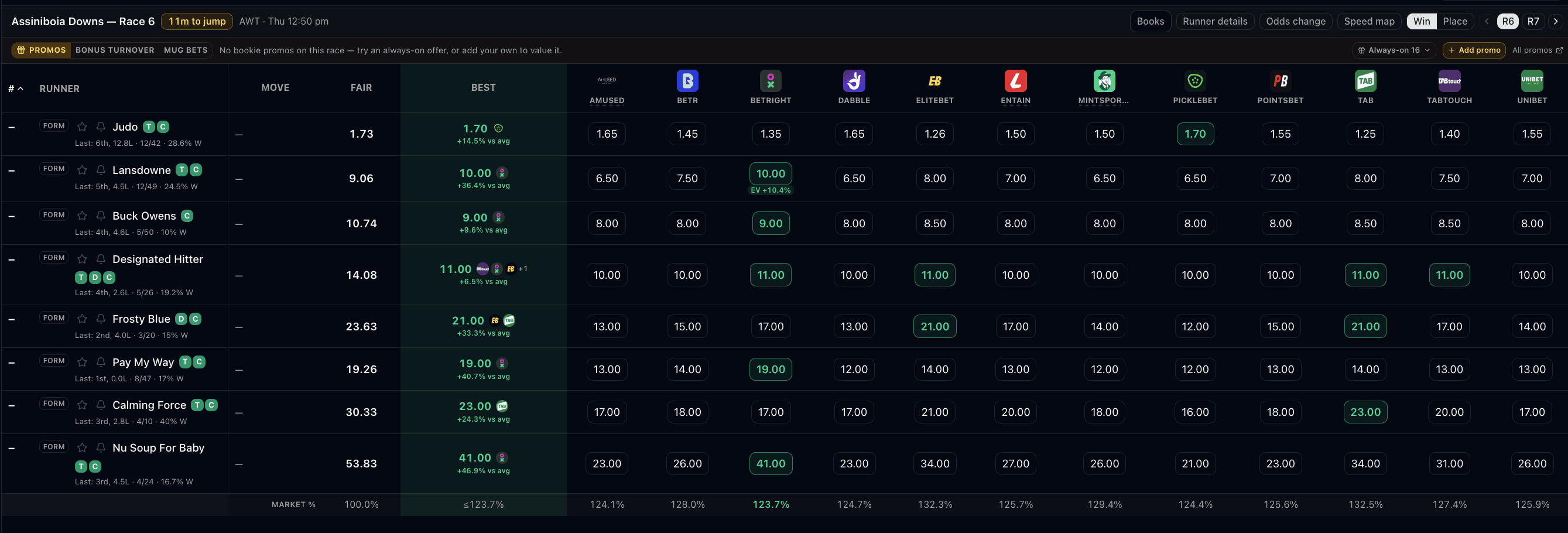
For EV betting in racing, you want to make sure the market is liquid enough as well as bet as close to the start of the race as possible as that is where prices are there most firm .
Arbs
Occasionally the odds screen will flag an arb (short for arbitrage) — a green ARB badge on a runner, like Sarah's Belle (+0.9%) and Scotch Rocket (+5.0%) in this race. An arb is a locked-in profit: you back the runner with the bookie and lay it on Betfair, and because the bookie's price is higher than the Betfair lay price (even after commission), you come out in front whichever way the race runs.
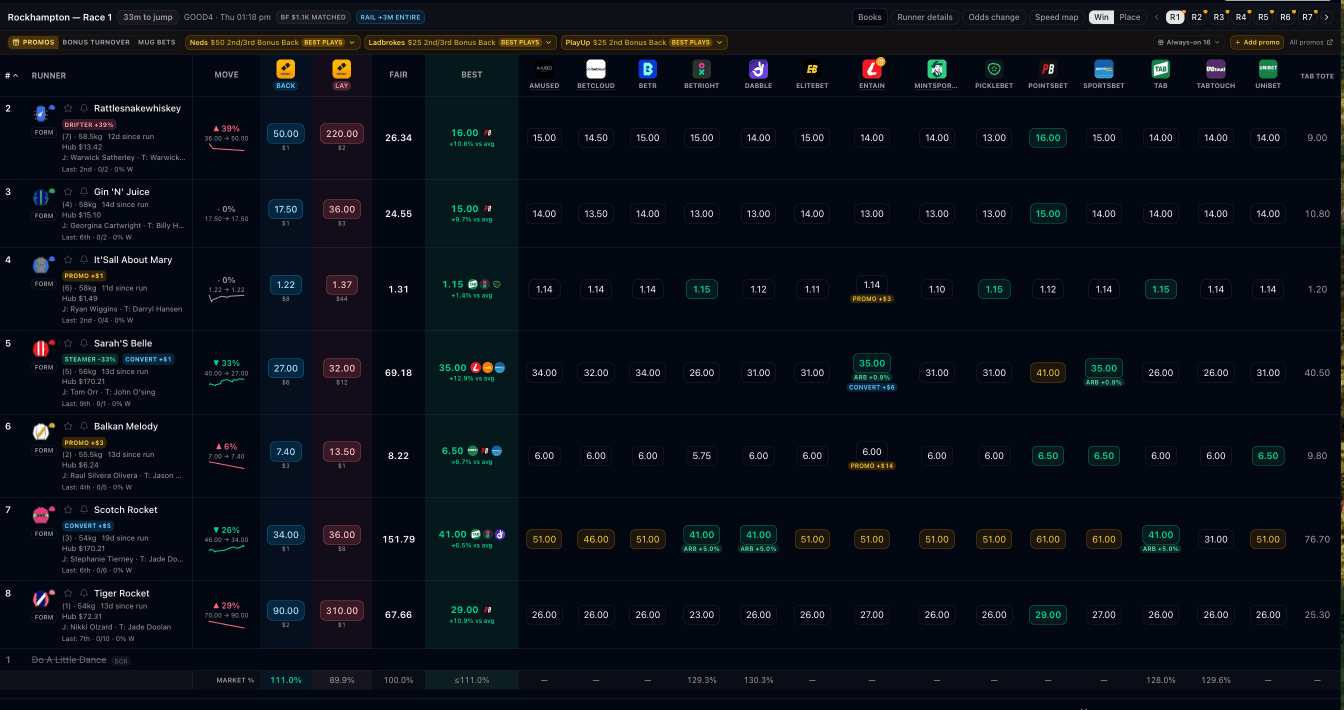
You can then click the badge on the odds screen and it will give you a breakdown of what is happening:
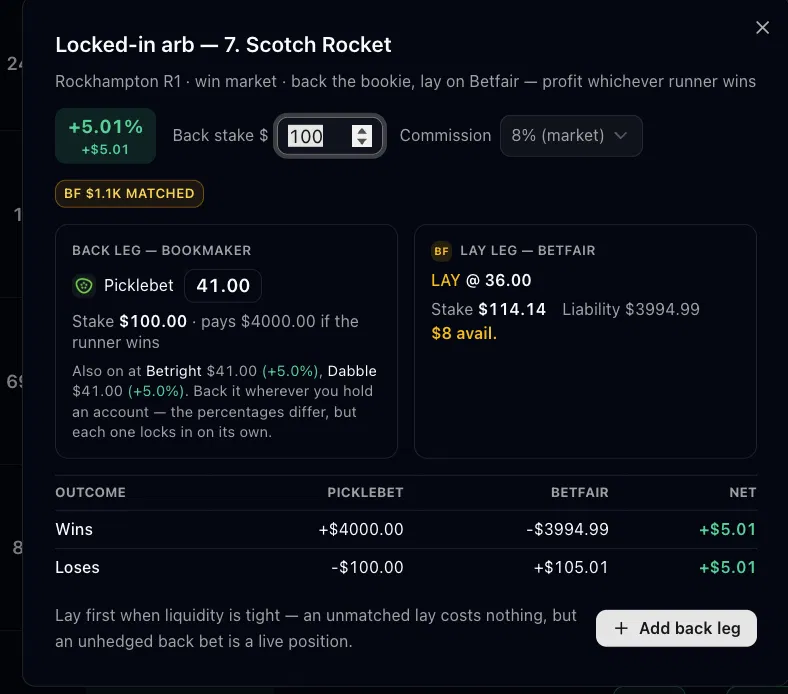
Take the +5.0% arb on Scotch Rocket:
Back leg (bookie): $100 on Scotch Rocket at $41.00 with Picklebet — pays $4,000 if it wins.
Lay leg (Betfair): lay at $36.00 for a stake of $114.14, carrying a liability of $3,994.99 (you need this in your Betfair account).
Note in this example, there is only $8 available at 36 so you would not be able to do the full amount
The outcome, either way:
If it wins — collect +$4,000 from the bookie, lose $3,994.99 on Betfair → +$5.01
If it loses — lose your $100 bookie stake, win $105.01 on Betfair (after commission) → +$5.01
Same profit regardless of the result — that's the arb. And because the same $41.00 was available at Betright and Dabble too, you could place the back leg wherever you hold an account; each one locks in on its own.
Two things worth knowing
Lay first when liquidity is tight. An unmatched lay costs you nothing, but an unhedged back bet is a live position, if your lay doesn't fill, you're exposed. On Scotch Rocket there was only $8 available at the lay price, so this is a real consideration: lock the lay, then place the back.
Commission matters. The profit is calculated after Betfair commission (8% market rate here). A raw price gap that looks positive can evaporate once commission is applied, which is exactly why the tool computes the arb % net of it rather than off the headline prices.
Arbs are rare and usually thin (small margins, limited liquidity), but they're genuinely risk-free turnover when they appear, and like mug bets, they're useful activity that keeps your account looking natural. You can size any arb yourself with our Qualifying Bet Calculator.
Other tools on the horse racing page
EV Scanner
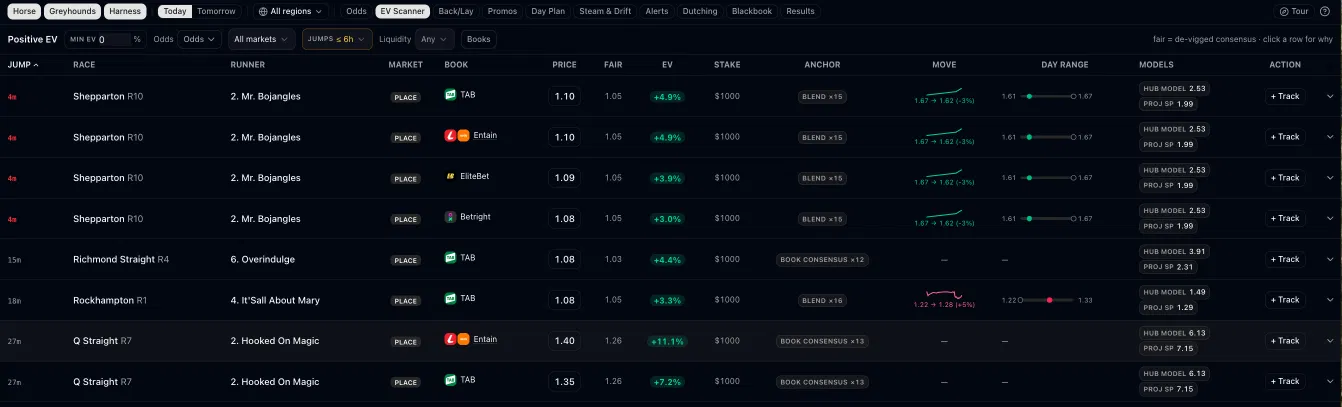
The EV Scanner pulls every positive-EV opportunity across all races into a single ranked list, so instead of checking races one by one you see the whole board at once.
Each row shows the runner, the book offering the price, the price itself, the fair odds, and the resulting EV% — with the strongest edges surfaced first.
The EV is measured against an anchor, the fair-value benchmark shown in that column:
Book Consensus: de-vigged market average
Blend: market average with the Betfair exchange midpoint for a sharper read
You also get the MOVE (how the price has drifted or firmed), the DAY RANGE, and the underlying MODELS (the Hub model and projected SP) feeding the number.
Across the top, a set of filters lets you narrow the board fast — minimum EV %, odds range, market type (win/place/all), jump window, liquidity, and specific books, so you can dial in exactly the kind of opportunity, timeframe, and market depth you want and ignore everything else.
Back/Lay
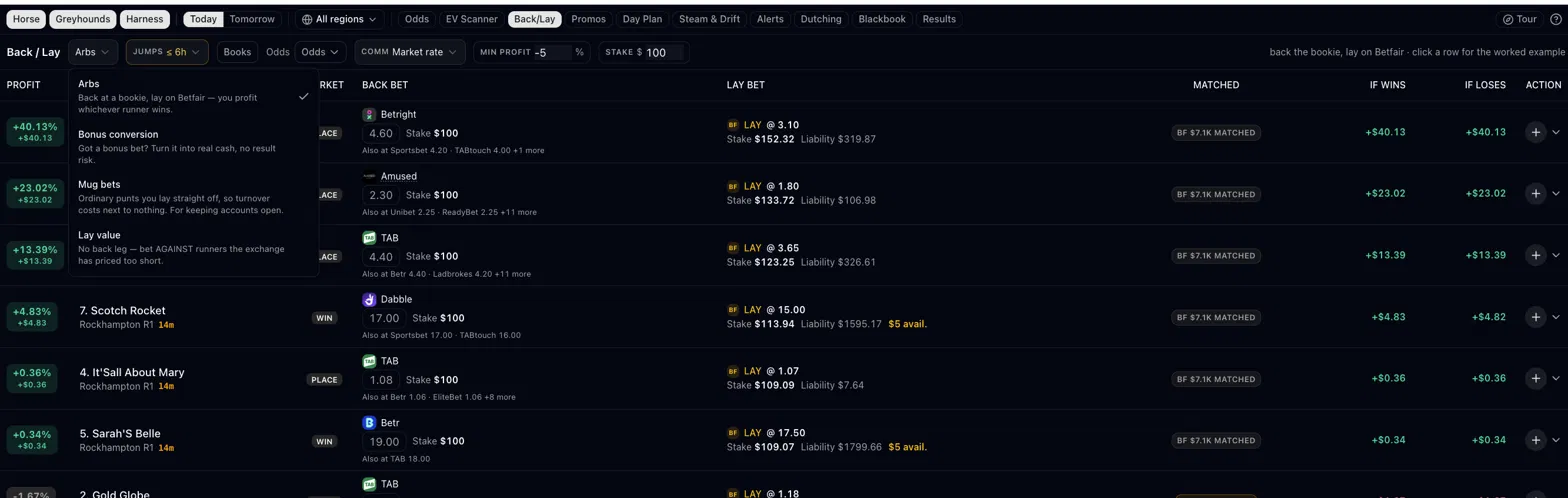
The Back/Lay page is showing all the opportunities that involve using Betfair.
Each row shows the runner, the back bet (bookie and price, with other books offering the same price listed underneath), the lay bet (the Betfair price, the exact lay stake, and your liability), and what you net if it wins and if it loses, so you can see the locked-in result both ways at a glance. It's the same back/lay engine throughout, just pointed at four different jobs, which you switch between with the mode dropdown:
Arbs: back at a bookie, lay on Betfair, and profit whichever runner wins, a pure locked-in edge.
Bonus conversion: you've got a bonus bet and want to turn it into real cash with no result risk (the lay-off version of bonus turnover).
Mug bets: ordinary punts you lay straight off, so turnover costs next to nothing, for keeping accounts open and healthy.
Lay value: no back leg at all, you're betting against runners the exchange has priced too short
Across the top, the filters let you tune the board fast — the mode, the jump window, specific books, an odds range, the Betfair commission rate (so profit is calculated net of it), a minimum profit % threshold, and your stake — and every stake, liability, and payout on the page recalculates around those settings.
As always, watch the liquidity: some rows show only a few dollars available at the lay price. These are usually not worth it and will move quickly.
Promos
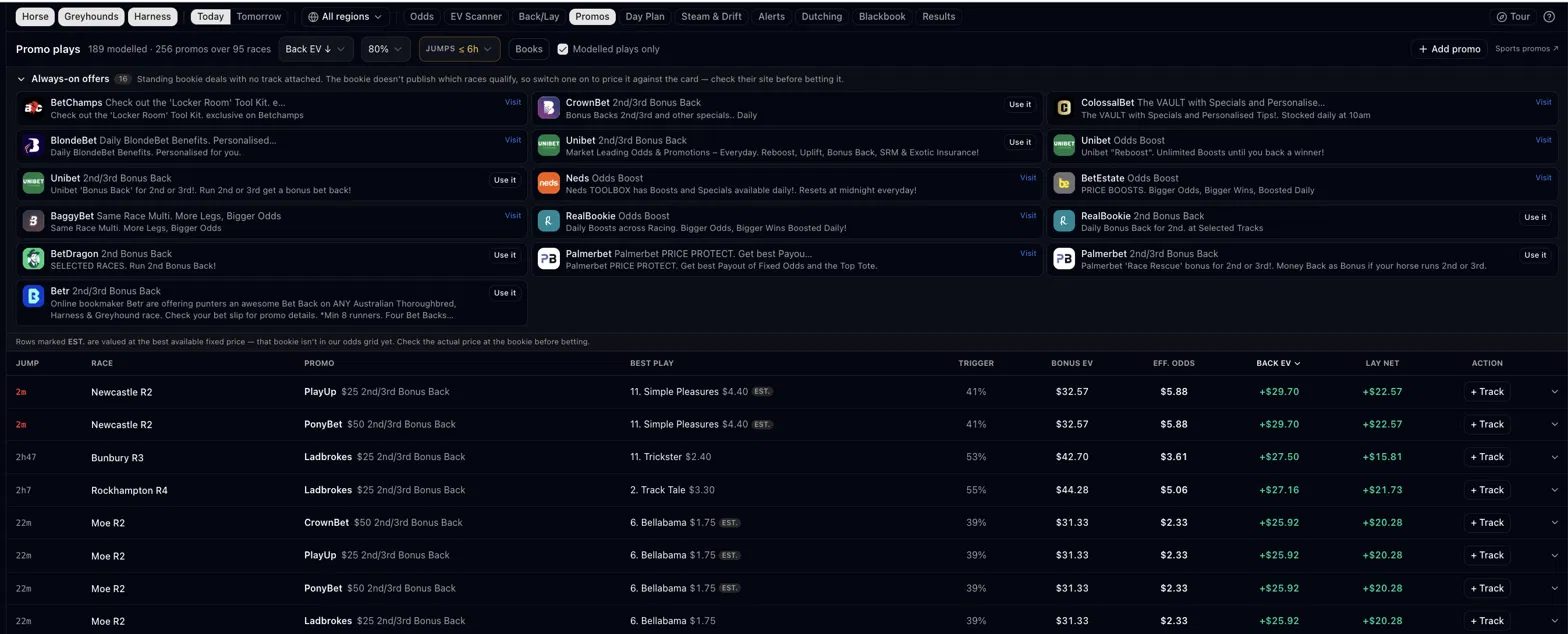
The Promos page is the whole-board view of every promotion running across the day.
At the top sit the Always-on offers: standing bookie deals. Alongside these you can + Add promo to model your own account-specific offers.
Below that is the ranked list of upcoming races with a live promo opportunity. Each row shows the jump time, the race, the promo, and the best play for it, along with the numbers that matter — the trigger chance (how often the qualifying result lands), the bonus EV, the effective odds, and the value both ways: Back EV if you punt it straight and Lay net if you hedge it off on Betfair. + Track sends any play to your bet tracker. Rows marked EST. are valued at the best available fixed price because that bookie isn't in the odds grid yet, so confirm the actual price before betting.
Across the top, the usual filters narrow it down fast, sort order (Back EV, Lay net, etc.), the keep % assumption for bonus conversion, the jump window, specific books, and a Modelled plays only toggle to hide anything the tool can't yet put a number on.
Day Plan
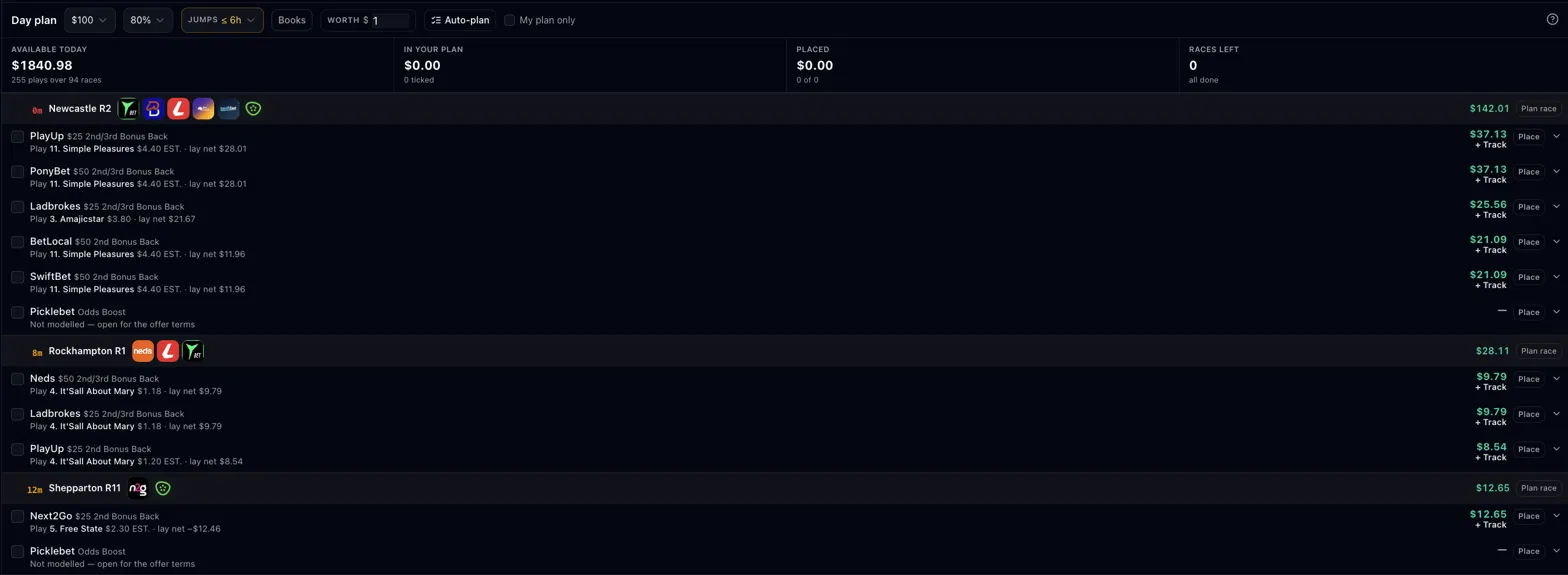
The Day Plan turns the whole day's promos into a running to-do list, ordered by jump time so you can work through them race by race as they come up. The header tracks your progress: the total value available today ($1,840.98 across 255 plays over 94 races here), how much is in your plan, how much you've placed, and how many races are left, so you always know what's still on the table and what you've banked.
Below that, races are grouped in time order, each with its own promos listed underneath. Every row shows the offer, the recommended play (runner and price), the lay net if you're hedging, and the value it's worth, with a checkbox to tick it off and + Track to log it. Rows marked EST. use the best available fixed price because that bookie isn't in the grid yet. Auto-plan builds the optimal run through the day for you in one click.
Across the top the usual controls apply — stake, keep %, jump window, books, a worth $ minimum to hide low-value plays, and a My plan only toggle so you can strip it back to just the bookies and promos you actually use, turning the full board into a personal, ordered schedule for the day.
Steam & Drift
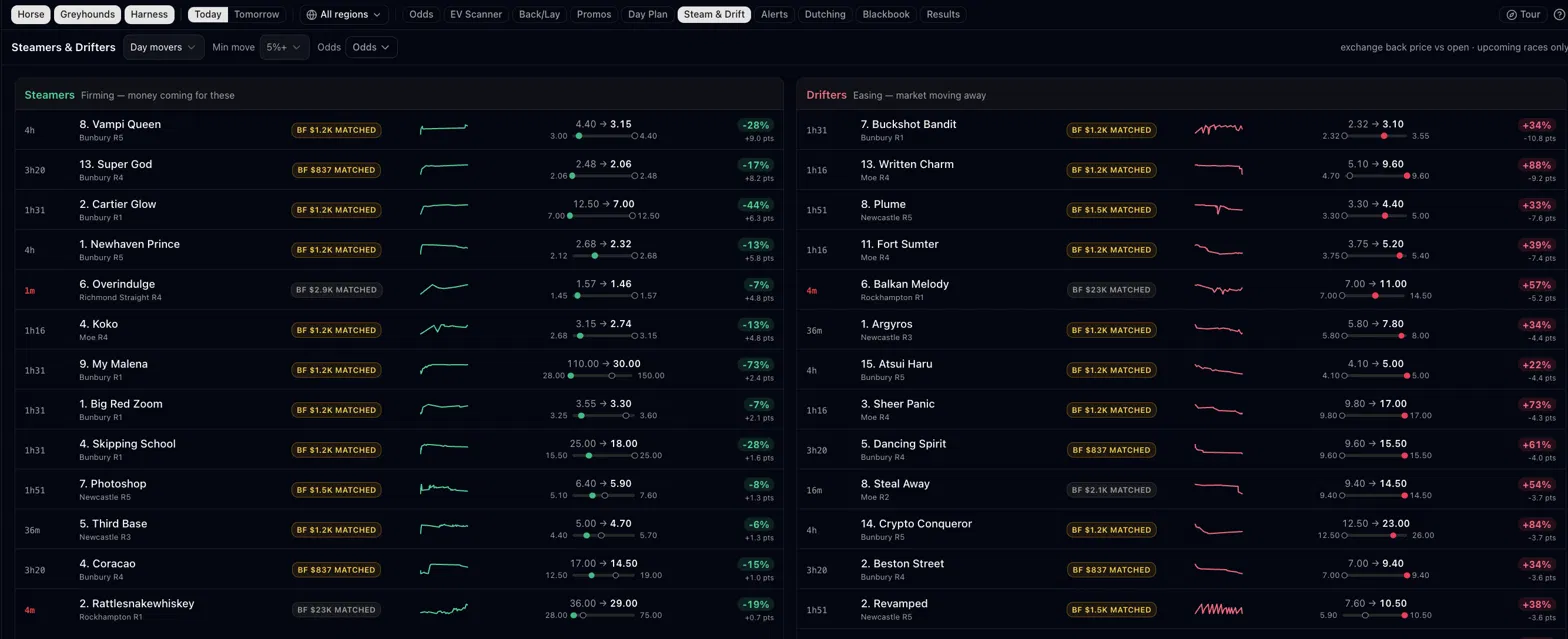
The Steam & Drift page tracks how the market is moving, using the Betfair exchange back price versus the open to show where money is flowing across upcoming races. It splits the board into two columns:
Steamers: runners that are firming, i.e. shortening in price as money comes for them (Cartier Glow, 12.50 → 7.00, a 44% move here). A steamer is the market backing a horse in.
Drifters: runners that are easing, i.e. lengthening as the market moves away (Written Charm, 5.10 → 9.60, +88%). A drifter is money walking away from a horse.
Each row shows the runner, a price sparkline charting the move through the day, the open → current prices with the size of the shift, and the exchange liquidity (matched volume) so you can gauge how much money is actually behind the move, a big move on thin volume means far less than the same move on a deep market. Because racing's sharpest money tends to arrive late, these moves are one of the more informative signals available near the jump.
Across the top the filters let you tune what you see: the mover type (day movers, or a tighter recent window), the minimum move threshold (5%+ here) to cut out noise, and an odds range, so you can focus on only the significant shifts in the price bracket you care about.
Alerts
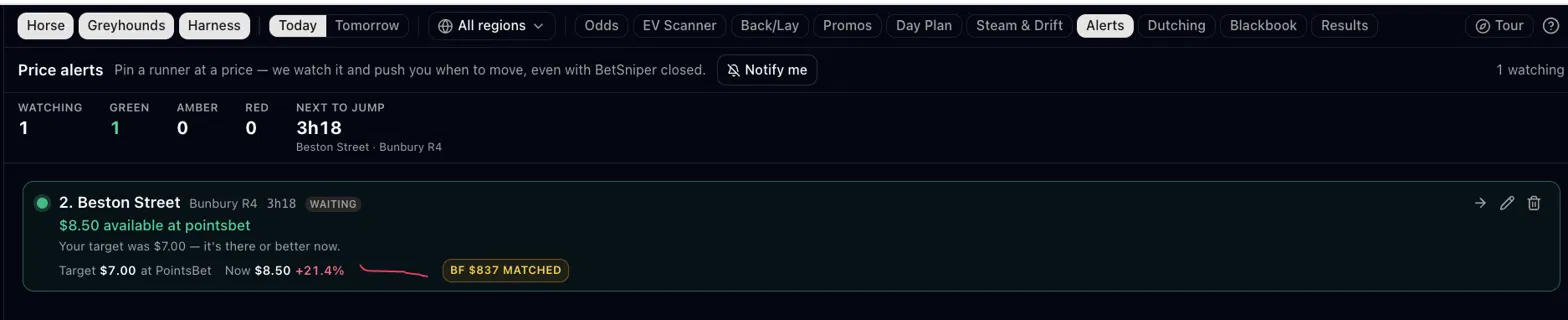
The Alerts page lets you pin a runner at a target price and have BetSniper watch it for you, when the price hits your target or better, it pushes you a notification.
The header gives you a live status count: how many alerts you're watching, and how many are currently green (target hit — go), amber (getting close), or red, plus the next to jump so you know which watched race is most urgent. Each alert card shows the runner, the race and time to jump, your target price and the bookie you set it at, and the current best price with how far it's moved.
In this example Beston Street was pinned at $7.00 and is now $8.50 at Pointsbet, +21.4%, so the alert has gone green and it's there or better. From the card you can jump straight to the race, edit the target, or delete it.
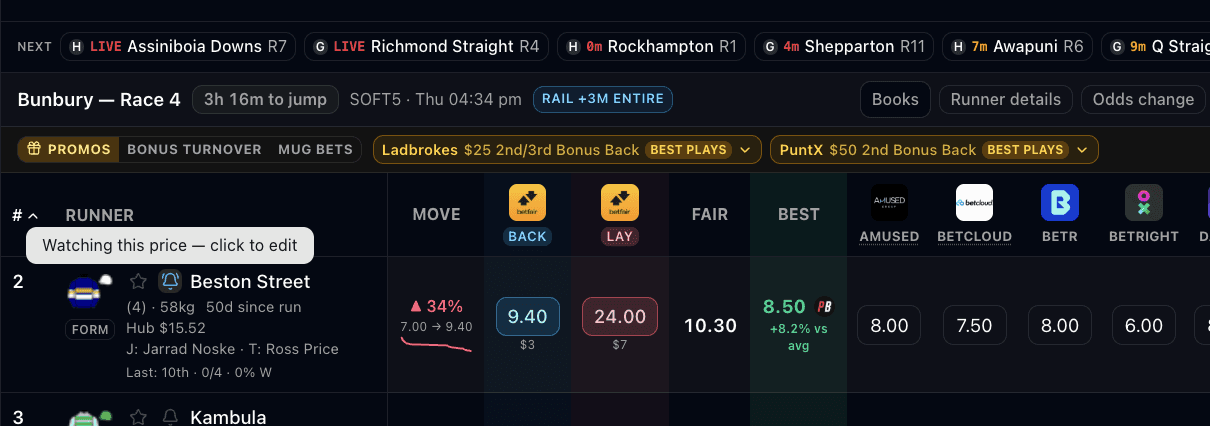
Alerts need to be set from the odds screen using the bell button.
Dutching
The Dutching page backs every runner in a race, each at its best price across all books, with stakes split so that whichever runner wins, you get the same return. When the combined market prices out to under 100%, that guaranteed return is greater than your total outlay, a true arbitrage, profit locked in no matter the result.
These are rare. But with the number of books pricing the same market, sometimes there are inefficiencies. Because true arbs are so scarce, it's worth widening the threshold to see near-arbs (100–102%) as well.
Blackbook
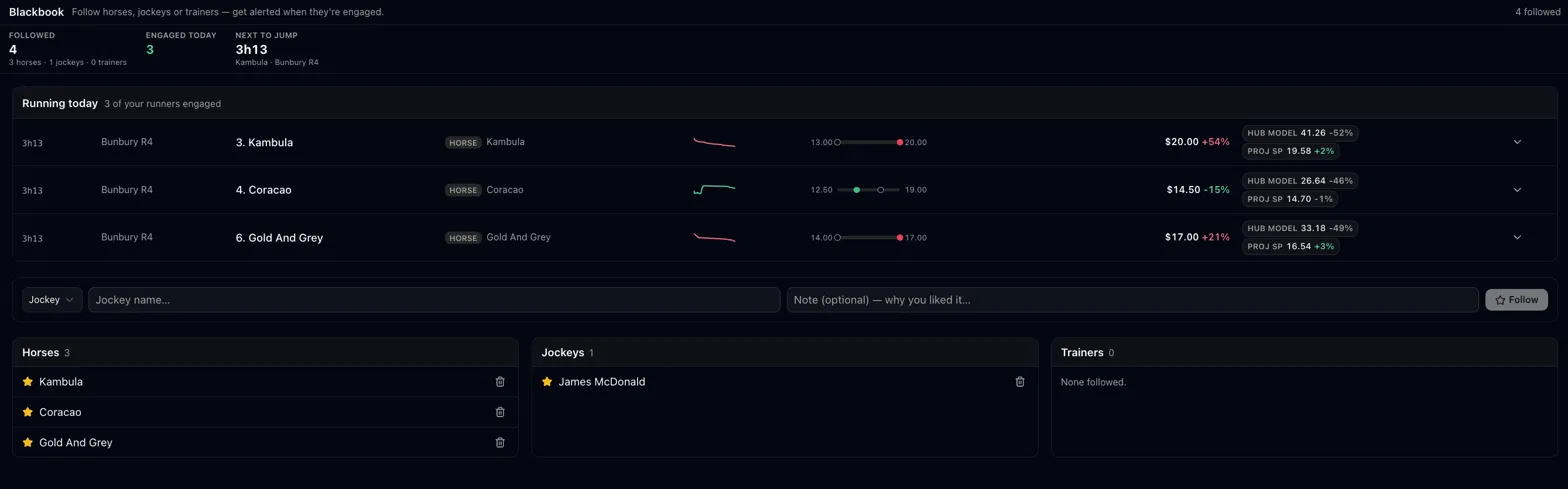
The Blackbook is your personal watchlist, follow specific horses, jockeys, or trainers and get alerted whenever one of them is engaged in an upcoming race, so the runners you care about come to you rather than you hunting for them across the card.
The header tracks what you're following (4 here — 3 horses, 1 jockey, 0 trainers), how many are engaged today, and the next to jump among them. Below that, Running today lists each followed runner that's in action, with the race and time to jump, a price sparkline and open → current move, the current price with how far it's shifted, and the underlying models (Hub model and projected SP with the edge to the market), so the moment one of your runners is racing, you can see whether the market's for or against it at a glance.
To add one, pick the type (horse, jockey, or trainer), type the name, add an optional note on why you liked it, and hit Follow. Everything you're tracking sits below in three lists — Horses, Jockeys, Trainers — each removable with a click, so your blackbook stays exactly as curated as you want it.
You can also add to your blackbook from the main odds screen
Results
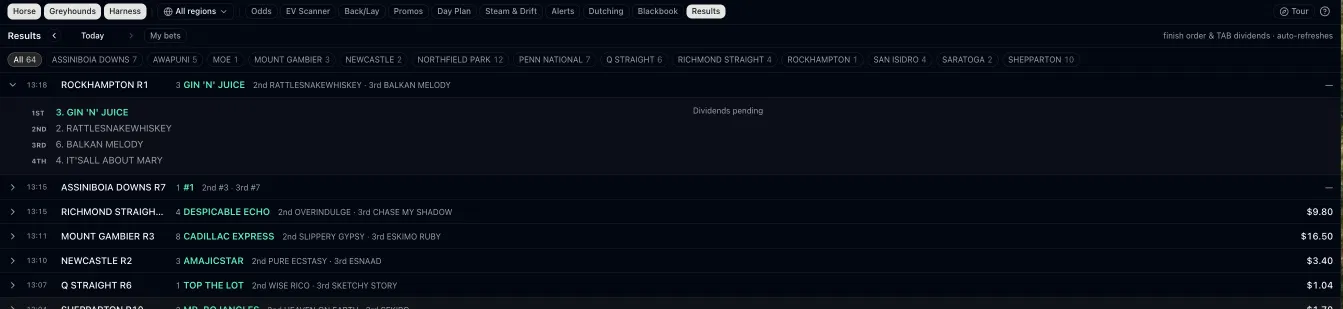
The Results page shows the results form each race.
Races are grouped by meeting along the top (with a count of races settled at each), and each row shows the race, the winner, and the placegetters.
The My bets filter narrows the page to just the races you had action in, so you can run down your own results rather than the whole card.
Some final pieces of advice
Timing matters: The closer you get to the jump, the more money flows into the market. That volume does two useful things: it sharpens fair odds discovery (the fair price is only as good as the money behind it, and it firms up as the race approaches), and it deepens the Betfair markets you're relying on to lay and to anchor value.
Check liquidity before you bet. Especially on the exchange. If there's little money available at the price you want, the market can move sharply the moment you (or anyone else) tries to get set, and thin markets are exactly where fair odds are least reliable.
Odds are constantly moving. Racing prices fluctuate right up to the jump. A price or an edge you see now can be gone in seconds. If you are trying to hedge with Betfair you really need to have both screens open and know exactly where to go.
Check your Betfair balance first. This trips people up constantly. When you lay, your liability is often much larger than the stake, laying a runner at long odds can tie up hundreds or thousands of dollars even for a modest lay. Make sure the funds are actually sitting in your Betfair account before you go to place, or the lay won't match and you'll be left with an unhedged position.
Prices and promos are per-account. Some of the best offers are account-specific, and prices vary bookie to bookie, the tool models what you can actually get, so add your personal promos in rather than assuming the public feed is the whole picture.
Protect your accounts. Don't only ever fire on promos and boosted runners, mix in mug bets so your betting looks natural even if you lose a bit here and there. Getting restricted or promo banned is the single biggest threat to doing this profitably over the long run.
Play the long game. As we covered, the edge shows up over volume, not on any single bet. Expect losing runs, size sensibly, and let the maths do its work across hundreds of bets rather than judging it on the last handful.




Learn how to become a profitable punter with our guide
We have put 20+ years of betting knowledge into one guide to help you become a better punter as well as share why each Betsniper tool exists, how to use it and the best strategies you can implement today with the Betsiper tools!

Co-founder
I've been betting seriously for over a decade, ever since I realised you can actually make money from sports betting. I studied Economics and Finance at the University of Melbourne and funded my entire time there through betting. Over the years I've become obsessed with building tools and taking a mathematical, strategic approach to the markets. I've poured that experience into building Betsniper - the ultimate companion tool for the smart punter. I now spend my time educating others on how to think about betting strategically, discovering new strategies and ultimately making as much money as possible from sports betting.


Get access to cutting-edge technology as well as a helpful community to help you start making smart decisions when you are betting.


