


Top-Down Betting
Everything You Need To Know About Top-Down Betting
Learn top-down EV betting from scratch. This complete guide covers how fair odds are calculated, the four BetSniper tools, staking, variance and account longevity, everything you need to bet with a mathematical edge instead of guessing.

We have been betting for a combined 20+ years and top-down betting is the best strategy we have ever used. We have tried every different method to make money. We have a lot of success but also some big fails (for more on that you can check out my punting journey). But nothing comes close to top-down EV betting in terms of how much risk you take vs how much money you can make. And none of this is using promotions.
In this guide, we will cover everything you need to know about top-down betting and how to implement this betting strategy with Betsniper.
What is Top-Down Betting?
There are two ways to try and beat a bookmaker.
The first is bottom-up. You build your own model. You pull in player stats, injury news, weather, travel schedules, whatever you think matters, and you produce your own price for a market. Then you compare your price to the bookmaker's and bet when yours says there's value.
The problem with bottom-up is obvious once you say it out loud: you're trying to out-price companies with hundreds of quantitative analysts, live data feeds, and billions of dollars of turnover telling them when they're wrong. To be able to do this consistently is very hard.
Top-down flips the problem around.
Instead of trying to work out the true price yourself, you let the market do it for you. Bookmakers are very good at pricing. Their odds already contain nearly all the information you'd spend months trying to model. So rather than compete with them, you use their prices as your benchmark, strip out the bookmaker's margin, and you're left with a clean estimate of the true probability.
Then you go shopping. You scan every other bookmaker and look for anyone offering a price better than that true number.
That's the whole idea:
Use the market to calculate the fair price. Bet anywhere the price is better than fair.
The reason this works is that with millions of prices posted every day across dozens of Australian bookmakers, they can't all be right at the same time. We are identifying inefficiencies in the market and taking advantage of it.
Nothing here requires you to know anything about the sport. You don't need a view on whether a player will have a good night. You need to understand how markers are priced, why bookie prices are generally efficient and believe this is where you can find the edge.
The one thing that changes between our four top-down EV betting is how the fair price gets calculated. We will cover this when we go through each top-down EV methodology.
The trade-off you're accepting: top-down betting doesn't win every bet, or every week. It wins on margins, across volume, over time.
If you want certainty on individual bets you should consider arbitrage betting. Top-down EV has a higher long-run return but you have to sit through the swings to collect it.
Why Top-Down EV Betting Works
The logic above sounds almost too simple. And in some part. It’s the truth. It is very simple. But we will go into more depth to explain why this works.
Odds Are Just Probabilities
Odds look like payouts. They're actually predictions.
Every set of odds is a bookmaker telling you how likely they think something is. To read the prediction, flip the odds:
Implied probability = 1 ÷ decimal odds
Odds | Implied probability | What the book is saying |
|---|---|---|
1.50 | 66.7% | Happens two times in three |
2.00 | 50.0% | Coin flip |
3.00 | 33.3% | Happens one time in three |
5.00 | 20.0% | Happens one time in five |
Once you see odds this way, the whole game changes shape. You stop asking "will this win?" and start asking "is 40% the right number for this?".
And a bet is profitable when the price you're getting implies a lower probability than the true one. If something genuinely happens 50% of the time and someone's paying you at 2.10, a price that implies 47.6%, you're being overpaid. Do that repeatedly and you win.
To be clear, you will still lose that bet 50% of the time. But you are getting paid out at 2.10 so you will be profitable in the long-run.
You can run any price through the implied probability calculator if you want to check your intuition.
We need to also overcome the bookmaker margin
Although essential to bookmaking and prices, most people have no idea about the margin bookmakers put on odds.
This is often referred to the vig, the juice, the hold or simply the margin.
Take a market where both sides are genuinely 50/50. A fair price on each side would be 2.00, bet $100, get $200 back when you win, break even over time.
In reality, that is not what you get offered. Because if you did, the bookmaker has no edge. What you will see on markets like this is 1.90 vs 1.90.
Add those up as probabilities: 1÷1.90 = 52.6%, twice, is 105.2%. The bookmaker has priced a market that adds up to more than 100% certainty. That extra 5.2% is the margin — the vig, the juice, the hold. It's the bookmaker's cut, and it's built into every single price you'll ever see.
This is why casual punting is a losing game. It's not bad luck. You are starting every bet several percent behind, and no amount of picking winners fixes a structural disadvantage that applies to every bet you place.
So the first job of top-down betting is stripping that margin back out.
The process is called de-vigging, and for a two-way market it's done in four steps:
Convert each price to implied probability (1 ÷ odds)
Add them together, you'll get something above 100%
Divide each one by that total, which scales them back to 100%
Convert back to odds (1 ÷ adjusted probability)
Run our 1.90 / 1.90 example through it:
52.6% and 52.6%, totalling 105.2%
52.6 ÷ 105.2 = 50.0% each
Back to odds: 2.00 and 2.00
The margin is gone. 2.00 is the fair price, sometimes called the true price or the no-vig price. That number is what every top-down bet gets measured against.
Bet at 2.10 when fair is 2.00 and you have an edge. Bet at 1.95 and you don't, no matter how confident you feel about the outcome.
In practice you'll never do this by hand the fair odds calculator does it instantly. BetSniper does it across every market automatically. But you should understand it, because everything downstream is just this calculation repeated at scale.
One technical note: the simple method above splits the margin evenly across both sides, which works fine on even-money markets but systematically overprices favourites and underprices longshots. So in Betsniper, we use the Power method instead, which raises each implied probability to a fitted exponent rather than scaling them all by the same factor, removing proportionally more margin from the longshot side and giving you a fair price that holds up across the full odds range.
There's more detail in our piece on bookmaker margin and calculating the fair price.
Wisdom of the Crowds
The principle is old and well-tested but is pivotal to understanding top-down betting.
Ask enough informed people to estimate something and the average of their guesses lands remarkably close to the truth, closer than almost any individual guess. Individual errors point in different directions and cancel each other out. What's left is signal.
Betting markets are close to an ideal version of this. Every bookmaker in the market is a well-resourced business with strong commercial incentive to price accurately, a book that's persistently wrong gets picked off by sharp money until it isn't. And they're not copying each other's homework; they run different models, weight different inputs, and react to news at different speeds.
So when you take the average price across every book pricing a market, remove the margin, and treat the result as the true probability, you're using a genuinely strong estimate, better than any one bookmaker's number in isolation.
The crowd only works if the crowd is big enough. With less references, the fair odds estimate is less robust and has a larger error bar surrounding it. The more books pricing a market, the better this estimate will be.
Finding fair odds with benchmarks
The easiest way to identify a profitable bet is with a benchmark. Find a reliable one that represents fair price, and being a profitable punter becomes simple: bet anything priced better than your benchmark says it should be.
Which means the quality of your edge relies on the quality of your benchmark. Some punters build their own prices from scratch; most use the market in one form or another. There are three common types:
The market average. Every book pricing the market, averaged and de-vigged. Broad, robust, hard to fool. The default, and what Positive EV uses.
A single sharp book. One bookmaker's price, de-vigged. Narrower but sharper — you're trading the crowd's breadth for one specialist's accuracy. This is Benchmark EV.
A custom set. Two or more books of your choosing, averaged or weighted. Useful when you know a specific group of books is strong in a specific market.
The reason bookmaker prices work as a benchmark at all is that some books are very good at pricing and others aren't. A bookmaker's job is to price as close to the true probability of an event as possible. Any book that drifts from that gets taken advantage of, because its skewed prices are exactly what sharp money hunts for.
Most books we punt on in Australia are what you'd call soft bookmakers. They react slower to news, run much larger holds, and limit or ban any sign of a winning punter. That combination is why they're beatable, but it's also why, for a benchmark, you generally want to look elsewhere. Point a good benchmark at these soft books and their prices become a reliable read on fair value, and the mispricings are easy to spot.
The Proof
Let’s walk through some numbers to show some proof.
First, let’s start with a single bet. You find a player prop at 2.05. The de-vigged market consensus says fair is 2.00, a true probability of 50%.
Your edge is the gap between what you're paid and what you should be paid: 2.05 ÷ 2.00 = 1.025, so 2.5% EV. That's the number BetSniper shows next to every bet, and it means the same thing every time: expected profit per dollar staked, over the long run.
Let’s say you place this bet 1,000 times at a $100 stake.
At a true probability of 50%, you'll win about 500 and lose about 500.
500 wins × $105 profit each = +$52,500
500 losses × $100 each = –$50,000
Net: +$2,500 on $100,000 turned over a 2.5% return
You didn't need to win more than half your bets. You won exactly half, which is precisely what should happen, and you still profited, because when you won, you were paid slightly more than you should have been.
Now the honest part. That $2,500 does not arrive smoothly.
We ran this exact scenario through a Monte Carlo simulation, 2.05 odds, 2.5% edge, 1,000 bets and the results are worth sitting with:
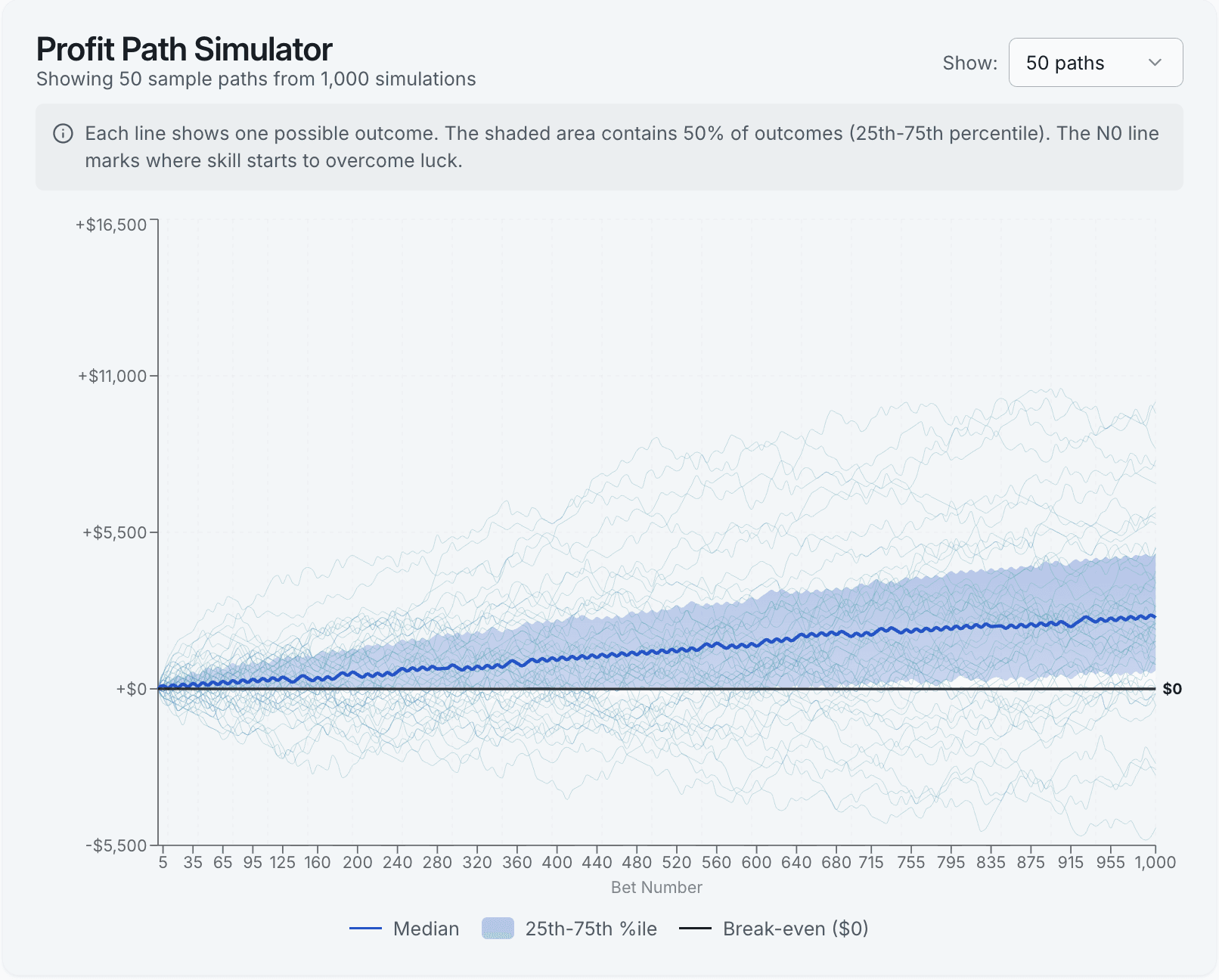
The expected maximum drawdown is 32 units. At some point across those 1,000 bets, you'll be 32 units below your high-water mark.
The chance of a drawdown of 25 units or worse is 65%.
The chance you end up returning 5% instead of 2.5%, doubling expectation, purely through good luck, is about 21%. Variance cuts both ways, and it means your realised ROI over any short stretch tells you almost nothing.
We ran this experiment on our EV betting simulator. If you are going to get into top-down EV betting, you have to understand variance. We talk about variance in detail later on in this guide.
But what you can see from the graph is that in 75% of instances (the shaded blue area), it’s a slow and slightly bumpy road up and to the right (profit).
Does it hold up in the real world?
The maths is only as good as the fair-price estimate behind it. So we track it. Every bet the platform flags gets recorded, and every one gets checked against its result, we have hundreds of thousands of bets across all four tools and we know that each strategy works.
Between us we've profited over $100,000 using these strategies, and we've watched a lot of customers do the same:
$100 to $10,000 in two months — built off a small starting bankroll on Pick'Em
165 units over eight months — a full season of consistent volume
100 units of profit — on the standard top-down tools
25 units from one month — what a first month can look like
Casual punter to $5,000 profit — someone starting from zero strategy
Clueless punter to over $500,000 in winnings — my journey from no clue to making a lot of money
500 units from 6 months of betting - Betsniper user never heard of top-down betting until our strategy call and then went all in on the strategy
The thing worth taking from this section isn't a number. It's that a small, repeatable edge plus enough volume plus enough patience is a system that works.
The 4 Top-Down EV Betting Methodologies
In this section, we will do a brief overview of each top-down EV methodology.
1. Positive EV
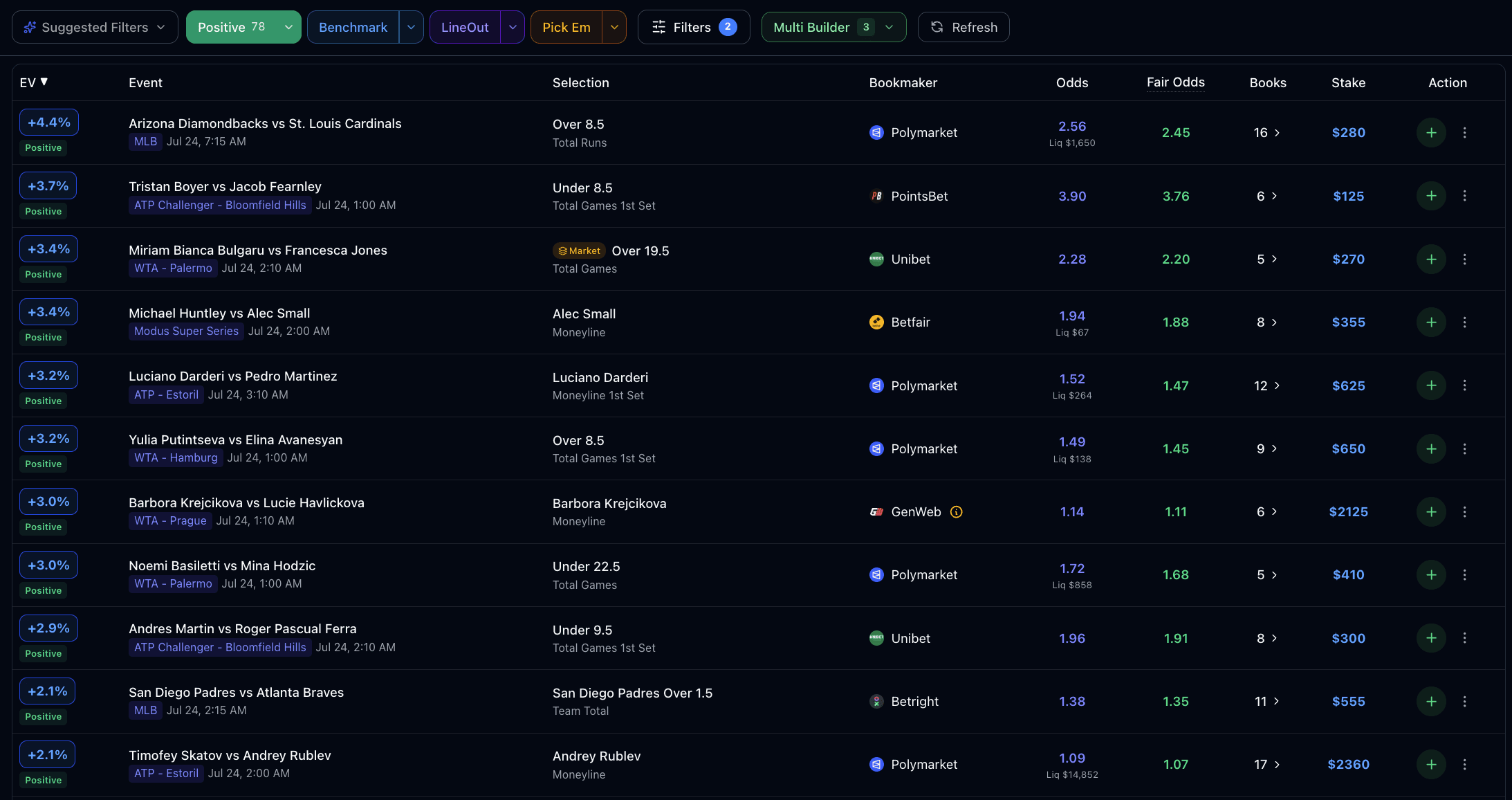
How the fair odds are calculated?
Our Positive EV tool is the classic approach to top-down betting. You take all the prices in the market, calculate the average, de-vig the market average using the Power method. That de-vigged price is the fair price. This is the wisdom of the crowds approach we spoke about earlier.
The more books pricing the market the better the reference.

Recommend filters
Our recommended filters can be auto-applied using the “Suggested Filters” button. For Positive EV, our recommendations are:
Minimum books ≥ 6 - enough references for a robust true price
EV% ≥ 2% - enough margin to make it worthwhile and provide some margin of safety
Odds < 3.00 - variance is much easier but if you are comfortable with the risk, can play longer odds
Hold < 8% (only accessible via the “Filters” button) - avoid betting on markets that have high margins
Starting time < 3 hours - you can definitely look further out but that opens up more risk
What results should I expect with Positive EV betting?
Positive EV is a great option because there is high volume across all different sports, so you are able to get a lot of volume down.
Below is a heat map that show you how Positive EV betting results change when the number of books increases as well as the EV%.
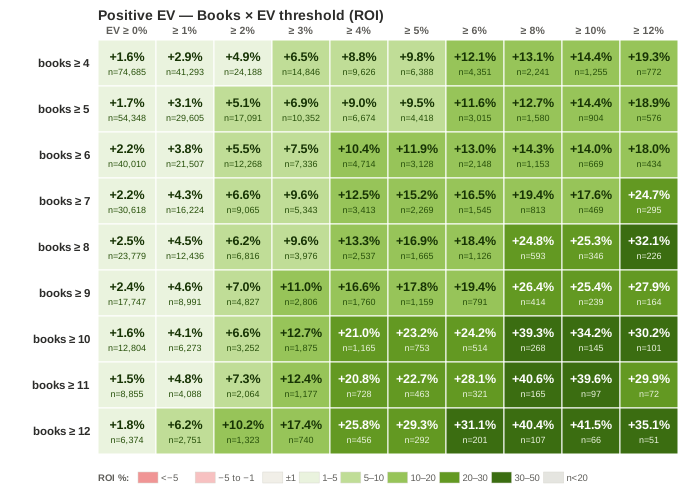
As you can see there is a clear pattern. As the number of books increases and EV% increases, your return gets better
Check out our guide for Positive EV betting
2. Benchmark EV
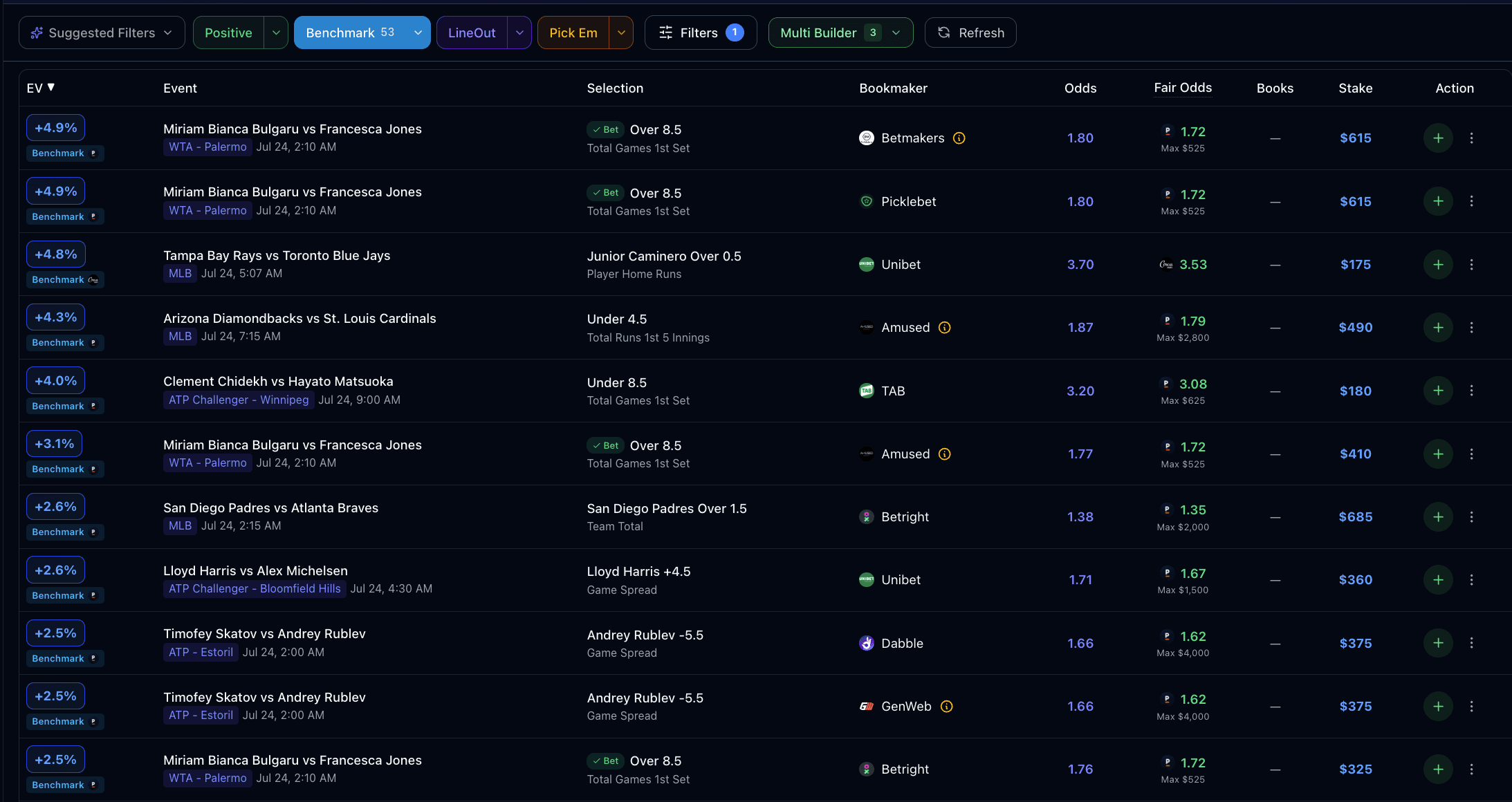
How the fair odds are calculated
Instead of the whole market, we use a single sharp book, de-vigs its price, and treats that as the truth. Every other bookmaker is then measured against it.
Sharp books earn that status by accepting large bets, running tight margins, and not banning winners, which forces their prices to be accurate. Pinnacle is the best-known example. Being wrong costs them money in a way it doesn't cost a book that simply limits anyone who beats them.
Not every price from a bookmaker is sharp. There are certain bookmakers that specialise in certain markets. We are constantly monitoring sharp bookmakers and testing out new edges. But when you find a sharp reference, their price is good enough to give you an edge.
In the Betsniper benchmark tool, there are actually three ways you can create the benchmark:
A single sharp book.
Average de-vigged price of two or more books.
Weighted average de-vigged price of two of more books
Recommended filters
We have three recommended benchmark filters. They serve different purposes:
Pinnacle for match and total markets
Sportsbet for NBA player props
Circa for US sports
This is super key. Just because a bookmaker is sharp, does not mean they are sharp for every sport or every bet. You need to only use a bookmaker as a benchmark if they are confirmed sharp for that market.
Similarly, you want to bet as close to the match as possible but within 3 hours is fine. For player props, especially when lineups are changing a lot like NBA, the best strategy is to bet within 30 minutes of the match. This is where prices have settled and you can be more confident in your EV.
All odd ranges are fine, but the lower the odds the less variance you will experience. And you want to give yourself enough EV for a margin of safety (at least 2%)
For Pinnacle, we also publish the max stake or the limit they are accepting on a market. When Pinnacle are more confident in their price, the limit goes up. The limit can be seen as a proxy for Pinnacle’s confidence in the market.
What results should I expect with Benchmark EV betting?
We are always tracking our benchmarks to ensure they hold true. When we get new news, we will always update our users and tools. At the same time, we are always tracking for new edges as well.
Here are the tracked results for Pinnacle bets where odds are less than 4 and EV ≥ 2%:
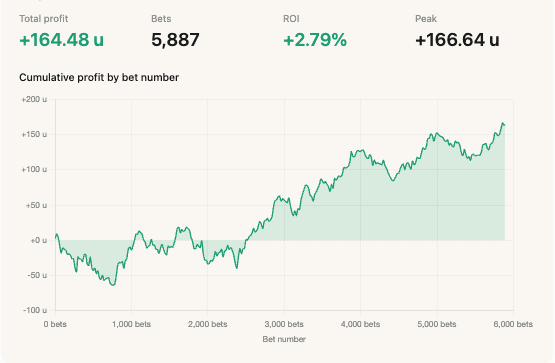
You can see as your EV% increases, so does your return. But the number of opportunities quickly decreases as well:
EV% >= | Bets | W | L | Profit | ROI | Avg odds |
|---|---|---|---|---|---|---|
≥ 2% | 5,780 | 2,767 | 2,952 | +169.90u | +2.94% | 2.30 |
≥ 3% | 3,716 | 1,755 | 1,924 | +214.07u | +5.76% | 2.39 |
≥ 4% | 2,499 | 1,180 | 1,297 | +257.26u | +10.29% | 2.47 |
≥ 5% | 1,761 | 845 | 898 | +250.59u | +14.23% | 2.52 |
≥ 6% | 1,236 | 593 | 627 | +213.59u | +17.28% | 2.57 |
≥ 7% | 877 | 448 | 414 | +232.21u | +26.48% | 2.58 |
≥ 8% | 653 | 343 | 298 | +200.50u | +30.70% | 2.60 |
≥ 10% | 410 | 228 | 171 | +170.50u | +41.59% | 2.61 |
Here are the tracked results for Circa as benchmark against US props where odds are less than 4 and EV ≥ 2%:
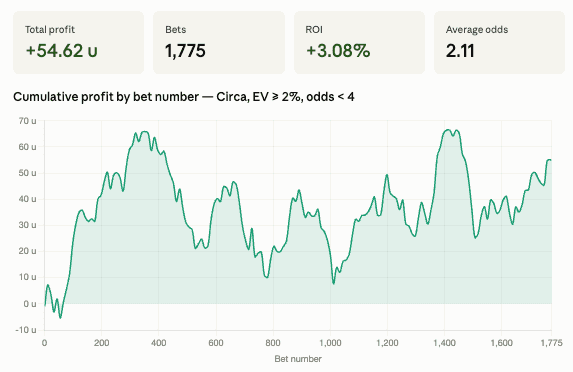
You can also see, as the EV% increases, so does your ROI:
EV% >= | Bets | W–L | Win % | Avg Odds | Avg EV | Flat P&L | ROI |
|---|---|---|---|---|---|---|---|
2% | 1,775 | 911–864 | 51.3% | 2.11 | 4.04 | +54.62 | +3.08% |
3% | 982 | 494–488 | 50.3% | 2.15 | 5.34 | +28.24 | +2.88% |
4% | 636 | 323–313 | 50.8% | 2.20 | 6.36 | +40.89 | +6.43% |
5% | 407 | 193–214 | 47.4% | 2.23 | 7.44 | +1.87 | +0.46% |
6% | 239 | 123–116 | 51.5% | 2.28 | 8.88 | +28.93 | +12.10% |
7% | 163 | 89–74 | 54.6% | 2.27 | 9.97 | +26.77 | +16.42% |
8% | 98 | 57–41 | 58.2% | 2.26 | 11.60 | +25.50 | +26.02% |
Here are the tracked results for Sportsbet as benchmark against NBA player props where odds are less than 4 and EV ≥ 2%:
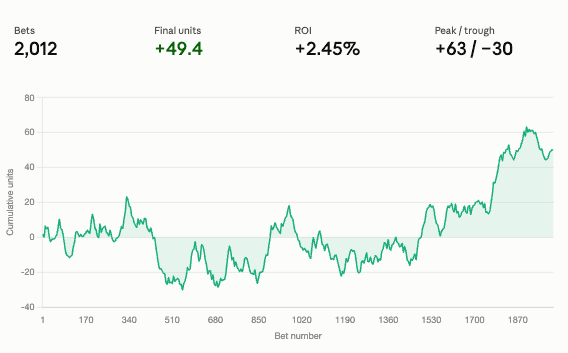
NOTE: NBA results were only being tracked right at the end of the season, we have data from previous years but will be able to provide further updates in 2026/27
3. Line Out EV
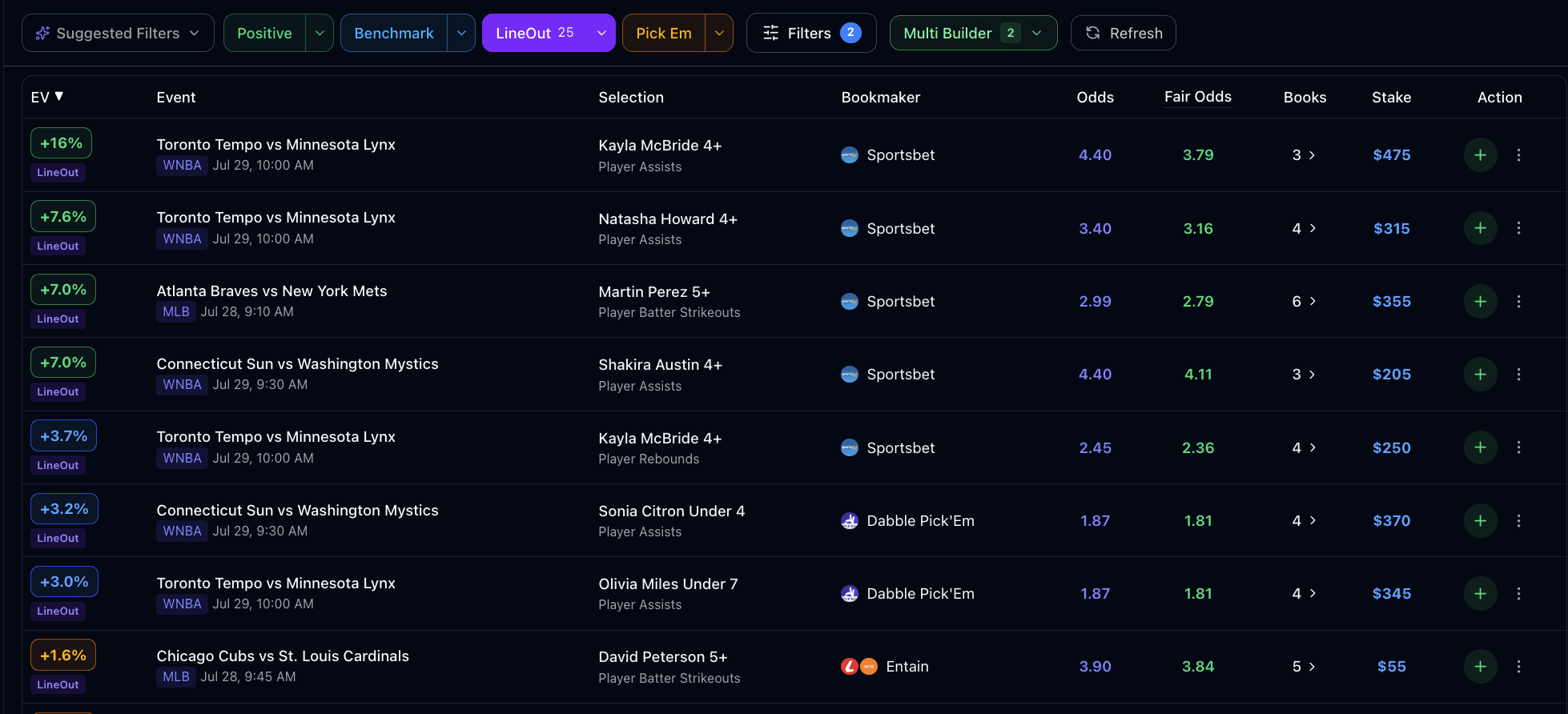
Positive EV and Benchmark EV compare bets that are like for like. With Line Out EV it finds value when a bookmaker prices a different line to the rest of the market. Everyone's at Over 20.5 disposals; one book is at Over 19.5. There's nothing to compare that price to directly, so the other tools can't touch it.
Positive EV and Benchmark EV can only flag a bet when there's a matching price to measure against. But plenty of sports don't have deep alternate-line markets e.g. AFL, MLB, and the more niche NBA stats often have books pricing just one line each. In those markets, a book typically prices its main line, but does not mean there can’t be value there.
Traditional EV methods miss these entirely because there's no reference at that line. Line Out builds the reference itself, which is why it surfaces value the other tools structurally can't see.
How the fair odds are calculated
We use the Positive EV base to start i.e. with the de-vigged market consensus. That gives us a fair price at the consensus line, the point where most books are pricing the over/under. That's our anchor.
Then we work out what it's worth to move off that line. This is where our own models come in: for each sport, we've built custom distributions from bookmaker data and player stats that tell us exactly how much a single stat is worth at that point on the curve. Move from 20.5 down to 19.5 and we know precisely what that extra disposal should cost, so we can price the book's specific line and flag it when their price beats fair.
Two things make this more than simple arithmetic:
The relationship isn't linear. A stat is worth much more near the projection than out in the tails. Moving a line from 20.5 to 19.5 doesn't shift the price the same amount as moving from 30.5 to 29.5 or from 20.5 to 17.5. Our distributions account for that curve; and is constantly being improved as we feed it more live bookmaker data.
Every sport and player is modelled separately. Disposals, strikeouts and rebounds have completely different distributions, so each gets its own model.
The idea is we are trying to normalise lines and see if there are any price discrepancies we can take advantage of.
Recommended filters
The key setting is how many books you require pricing the consensus line, and it changes by sport, because reference depth changes by sport.
Filter | Setting | Why |
|---|---|---|
Books pricing (deep markets, e.g. NBA) | ≥ 6 | Enough references for a confident consensus line |
Books pricing (thin markets, e.g. AFL, MLB, WNBA) | ≥ 4 | These sports rarely have 6, 4 is sufficient |
EV% | ≥ 2% | Standard buffer for model error |
The principle behind the book count is the same either way: you want a clear consensus line that most books agree on, and then one book sitting off it. That's the setup Line Out is built to catch.
In terms of timing, you want to bet as close to the match as you can. Player props are far more sensitive to late swings than main markets, they're where books take smart money and adjust hardest, so a late scratch or lineup change can move a line sharply. For any sport prone to last-minute news, waiting until near the start is the safer play.
What results should I expect with Line Out EV betting?
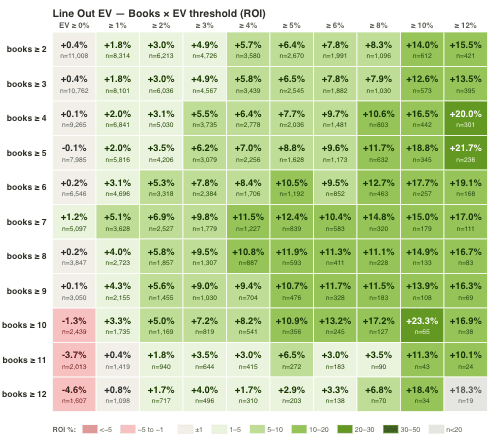
We only released our Line Out EV model in mid-2026 but still have thousands of bets we have resulted following this strategy.
The following results are all taken within one hour of the match starting.
You can see there is a clear trend in ROI improving when you increase the number of books as well as increase the EV%. Even at lower number of books the strategy is still profitable but, we still recommend wanting more consensus books to feel confident in the edge.
4. Pick’Em EV
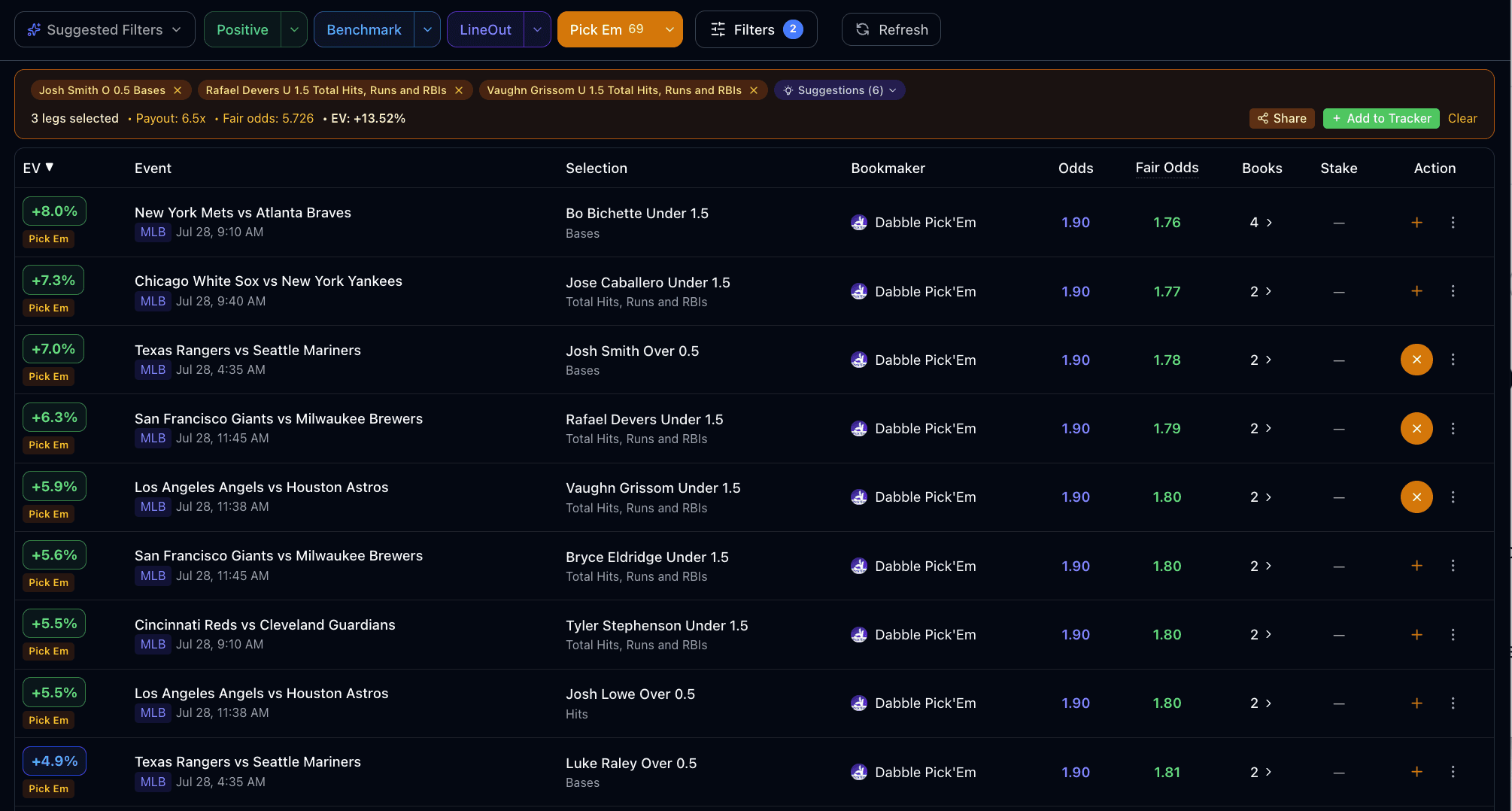
Dabble's Pick'Em is a different kind of product from everything else in this guide. Instead of betting into a bookmaker's odds, you pick a set of player over/unders, each one a leg, and get a fixed payout based on how many you include. Two legs pays 3.2x, three pays 6.5x, five pays 25x, and up. It's the first product of its kind in Australia, modelled on US platforms like PrizePicks and Underdog.
Dabble also offer you an option to hedge, where you can get a partial payout if one of your leg loses. If all of your legs win you also take a lower payout. We have run the calculations, and it’s almost never a good idea to hedge your Pick’Ems. We won’t go too deep into the Maths here, but if you want to see a deep-dive we have shared all the calculations in our guide.
It's built for retail punters, pick a few overs, see a big multiplier, and for the average punter that ease is exactly the trap. Multiplying legs together hands the operator more margin with every leg you add. But the same fixed-payout structure that makes it a bad deal for casual punters is precisely what makes it beatable for a disciplined one.
How the fair odds are calculated
Although there are no odds, we can calculate the effective odds because there is a fixed payout.
Take the 3-leg. It pays 6.5x, and to break even each leg has to win about 53.56% of the time, which is odds of 1.867.
1.867 x 1.867 x 1.867 = 6.5x
So every leg in a 3-leg Pick'Em is effectively priced at 1.867. Any selection whose true price is shorter than that is positive EV.
In this context, we can calculate the true price in multiple ways:
Positive EV calculation: de-vigged market average
Benchmark EV calculation: you can select one or multiple books de-vigged
Depending on what Pick’Em you play, the EV of each leg will differ as the threshold odds will differ. Here is the Pick’Em EV specific filter:
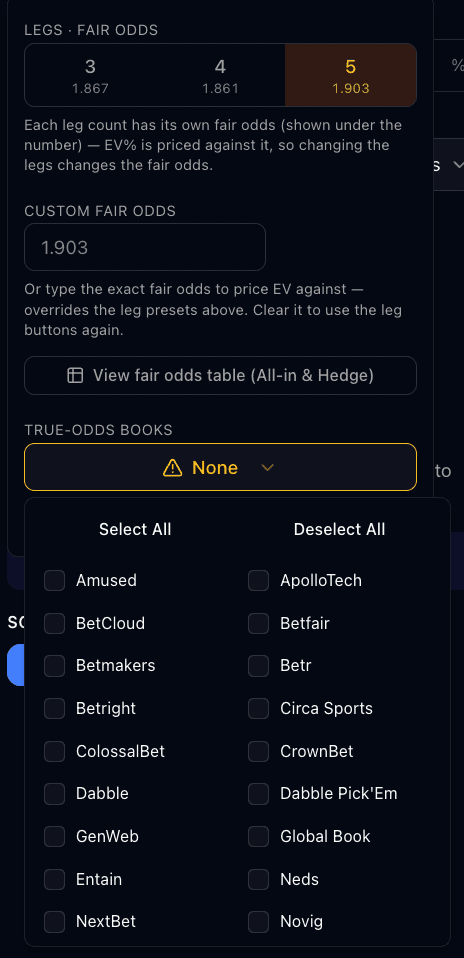
You can quickly select 3-leg, 4-leg and 5-leg as your true price or set it as custom one. If you look further down you can also build your own benchmark selecting which odds you want to include.
One of the differences with Pick’Em EV and Positive EV is in their Pick’Em EV we are trying to find odds lower than the fair value, whereas with Positive EV we want odds higher than the fair value.
Here are the pay-outs you get depending on the number of legs in your Pick’Em as well as the odds required to beat in order to be profitable.
Legs | Dabble payout | Threshold odds (all-in) | Win rate needed |
|---|---|---|---|
2 | 3.2x | 1.790 | 55.87% |
3 | 6.5x | 1.867 | 53.56% |
4 | 12x | 1.861 | 53.73% |
5 | 25x | 1.903 | 52.55% |
6 | 40x | 1.849 | 54.08% |
7 | 80x | 1.870 | 53.48% |
8 | 150x | 1.870 | 53.48% |
9 | 275x | 1.867 | 53.56% |
10 | 500x | 1.862 | 53.71% |
11 | 1000x | 1.874 | 53.36% |
12 | 1500x | 1.839 | 54.38% |
Because Pick’Em EV is never singles, out EV is always on the multi. To calculate the fair price of the multi, we just multiply the fair prices together (assuming they are from seperate matches). This number will be our Pick’Em fair odds. And then the EV is difference between that number and the fixed payout from Dabble.
Let’s look at a live example:
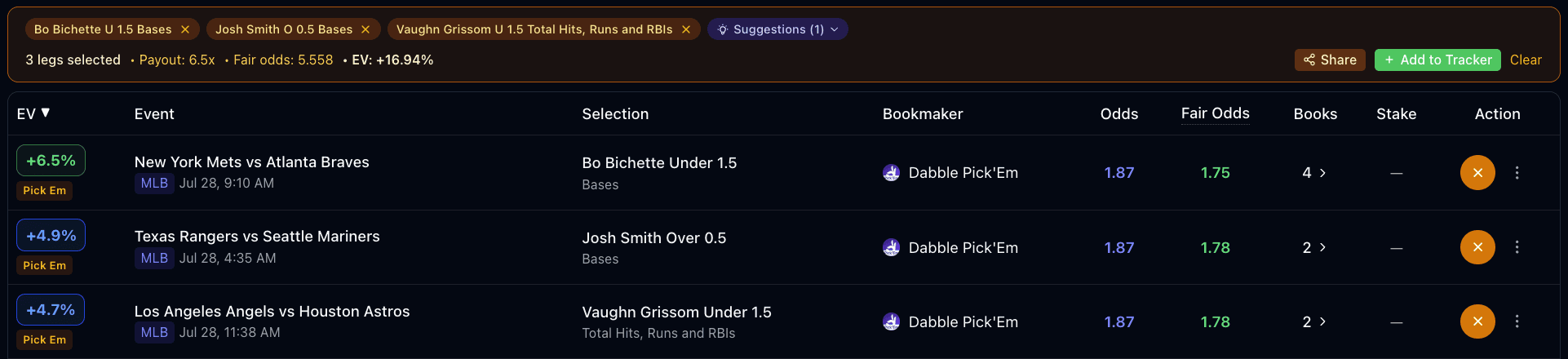
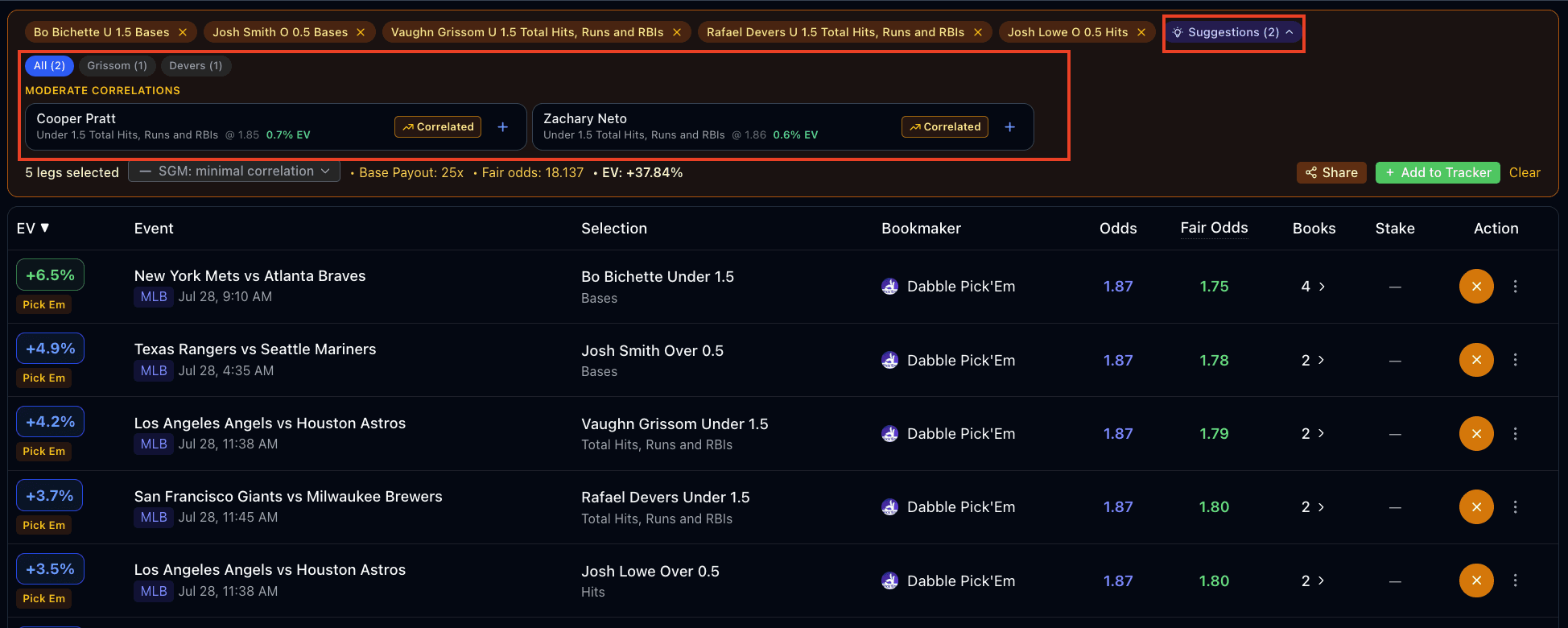
I have set the odds for a 3-leg Pick’Em at 1.87. We have three legs:
Bo Bichette Under 1.5 Bases at fair odds of 1.75
Josh Smith Over 0.5 Bases at fair odds of 1.78
Vaughn Grissom Under 1.5 Hits, Runs and RBIs at 1.78
This is a 3-leg Pick’Em so the odds are 6.5. Our fair odds for this bet is 1.75 x 1.78 x 1.78 = 5.558. This gives us 16.94% EV. These numbers get calculated live for you at the top of the page. This makes it really easy to see the impact of adding or removing legs on your edge.
A note on legs from the same game (advanced)
One thing to watch once you're comfortable: legs from the same game. Dabble requires you to include players from at least two opposing teams, so you can't build a Pick'Em out of a single side, but you can still combine multiple players from the same match. That matters because those legs are often correlated.
Dabble sometimes accounts for this and sometimes doesn't. When it recognises the correlation, it adjusts the payout down, and at that point the threshold odds shift, so a play that looked +EV may no longer be. When it doesn't adjust, and the legs are positively correlated, that correlation works in your favour: you're getting the standard payout on outcomes that are more likely to occur together than the fixed price assumes, which puts extra edge on your side.
As a rough guide, MLB will almost always re-price correlated legs, whereas in sports like NBA and AFL you can frequently add correlated legs and still get the same payout. To help with this, we surface suggested legs that flag combinations worth looking at.
This is definitely a more advanced strategy but something you can begin to look at once you master Pick’Ems.
Recommend filters
You can see you get by far the most value by playing a 5-leg Pick’Em from the payout table above. You only need to beat true odds of 1.903. The variance can be super high with 5-legs but it is by far the best deal. If you don’t feel comfortable with the high variance of 5-legs, we recommend going for 3-legs. It’s a good balance of value and variance. In our opinion, the 4-leg option almost serves no purpose, as you get worst value than 3-leg but double your variance so it’s not a good deal. We also don’t think playing higher than 5-legs is a good idea. The variance becomes very hard and you will need to do tons and tons of volume to overcome that.
In terms of number of books, like all the other EV tools, more is always better. For some sports (MLB, AFL), there sometimes are not enough references so you can take 4. But normally the recommendation would be 6. You can bet with less references, but there is a bigger error bar around the fair odds.
Benchmark strategies also work for Pick’Em. So for markets where Sportsbet are sharp, you can find value comparing Pick’Em lines to Sportsbet.
Regarding EV%, as we are playing multis, we are multiplying EV together. We would still recommend giving yourself a lower bar of 2% for maximising value. But you will always increase your overall Pick’Em EV even by adding in a leg at 1% EV.
What results should I expect with Pick’Em EV betting?
Pick'Em is genuinely one of the biggest edges available in Australian betting. But you have to be comfortable with the Maths. We are playing bets at much higher odds than our other tools, so the variance is going to be higher. The edge is big because the odds are long, and long odds mean you lose most of the time.
Even with a genuine, healthy edge, you are going to lose the large majority of your tickets, and if you don't know that number going in, you won’t give Pick’Em enough of a chance to work.
Let’s say you are getting a 20% edge on your 3-leg Pick’Em. This means you will have an ROI of 20%. Here's how often the ticket actually wins:
Play | Payout | Ticket wins | You lose | ROI |
|---|---|---|---|---|
3-leg all-in | 6.5x | ~18% of the time | 82% of the time | +20% |
5-leg all-in | 25x | ~5% of the time — about 1 in 20 | 95% of the time | +20% |
20% is an amazing return, but you will be losing a lot. It’s part of the strategy. Wins are rare, but the payout will compensate for that
On 3-leg, over a normal run of ~200 bets, your longest losing streak will typically be around 18 in a row. A 10-bet losing streak has a 13% chance of happening off any given bet.
On 5-leg, losing 20 straight is a coin-flip-ish 37%, and your typical worst run across 200 bets is ~46 tickets without a win.
Realistically, you for 3-leg Pick’Ems you can get lots of volume down at 10%+. For 5-leg Pick’Ems you can usually play a couple everyday at 30%+.
It’s very much a volume game and requires discipline and patience, we have users in Betsniper who have profited $10K in 2 months just from Pick’Ems.
Another user has profited over 129 units just with Pick’Em EV. You can see from his bet tracker that there are long periods of not much movement. But then you have some wins and you can make a lot of money. But every bet along the way was a good bet. You don’t achieve these results without the volume. A 50.8% ROI is objectively insane but it required patience and long periods of not a lot of movement.

How much should I stake on each bet?
Once you have profitable bets to make, the next question is how much to stake? Staking is very important for three reasons:
Managing your bankroll
Managing your risk
Balancing your account longevity
Understanding units
You will often hear punters refer to units in relation to betting.
There are two main strategies in relation to staking:
A unit is just your standard bet size, expressed as a percentage of your bankroll rather than a dollar figure. Almost everyone in betting talks in units instead of dollars, because it lets you compare results without knowing anyone's bankroll, "up 30 units" means the same thing whether you're betting $10 or $1,000 a go.
Often one unit = 1% of your bankroll. If your bankroll is $5,000, a unit is $50. We want to speak in units as it gives a much more accurate depiction of success as opposed. It strips performance of bankroll and make results much easier to compare.
In relation to staking, there are two main strategies:
Pro tip: you can set your bankroll in Betsniper settings
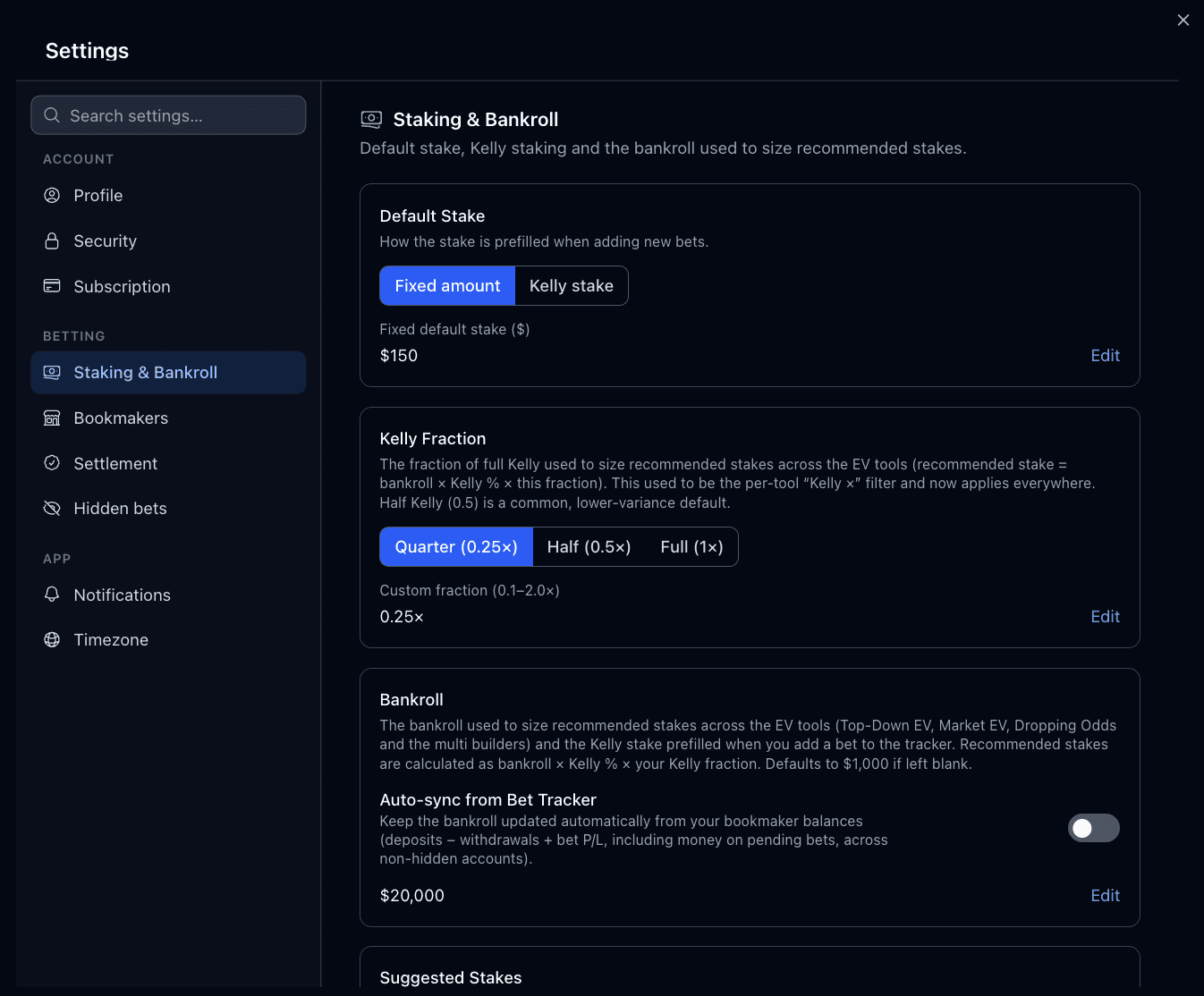
1. Flat staking
This is simplest method. You just stake a percentage of your bankroll. This should be 1-2% of your bankroll on every bet i.e. 1 or 2 units.
E.g if you have a $5,000 bankroll, then your stake should be $50 to $75.
This is quite a conservative strategy. The probability of burning through your bankroll on a bad run is very low. But also, you are able to get a lot of independent EV bets down per day. And that’s the goal with EV betting. You don’t want to load up on 10 bets at 10% of your bankroll. It is much better to get 100 independent EV bets on at 1% of your bankroll.
Our advice would be to scale down your stake as odds get higher. Anything about $3 odds, you can do a half stake.
Flat staking removes any decision making and also comes across as much more retail to the bookmaker as you are not differentiating stakes.
One downside is that you don’t factor in the EV%. But the EV% you see when you take the bet is the EV% at that exact time and that might not be the exact EV% at the close of the market. So you don’t want to over-index on this number as it is fluctuating.
2. Kelly Criterion
The other option, which is quite common is the Kelly Criterion (or just Kelly). Kelly is a formula that sizes each bet according to how big the edge is and how large the odds are, bet more when the edge is large, less when it's slim. It's mathematically the fastest way to grow a bankroll if your numbers are perfect:
f = (bp − q) / b
where b is the decimal odds minus 1, p is your win probability, and q is (1 − p). You don't need to memorise it, Betsniper has Kelly built into the tools, so you enter your bankroll and a multiplier and it sizes every bet for you. We also have a standalone Kelly Criterion calculator.
Here is what you need to consider. Full Kelly assumes your edge is exactly right. In top-down betting it never is, your EV is an estimate off the fair price, and it's constantly moving. We know it’s a good estimate because we have back-dated 100,000+ bets on this strategy. But the EV% is constantly in flux as prices in the market changes. The standard Kelly is also very aggressive and will have you frequently betting over 5% of your bankroll, which we would not advise.
If you are going to use Kelly, we recommend using a fraction of it, a multiplier of 0.25 or lower, and never stake more than 5% of bankroll on a single bet no matter what the formula says. Quarter-Kelly keeps most of the growth benefit while cutting the volatility and protecting you from your own estimation errors.
When Kelly is worth it: low-volume betting, where sizing each bet precisely actually moves the needle. When it isn't: high-volume betting, which is most top-down betting, where you're placing 15+ bets a day and the constant recalculation just slows you down and gets you caught.
If you are going to do Kelly, do not bet to cents and try and round your stakes to normal looking numbers. Bookmakers will see abnormal staking patterns and be much quicker to review your account.
When can I increase my stakes?
Once your bankroll begins to grow, you can decide to increase your stakes. But increasing you stakes doubles your volatility. So don’t do it too quickly into your top-down betting. But also don’t increase too much. You want to steadily build your bankroll and stake responsibly.
You do not get rich off any single top-down bet. A 2.5% edge on a $30 bet is 75 cents of expected value. The way this becomes profitable is playing lots and lots of these bets.
So the lever that matters is number of bets, not size of bets. Doubling your stake doubles your expected profit and doubles your swings, you've scaled the risk right alongside the reward and gained nothing in efficiency. But doubling your volume, finding twice as many good bets, doubles expected profit while the extra diversification actually smooths the ride. More independent bets is the only lever that improves return and reduces variance at the same time.
What do you mean by independent bets?
The key lever with top-down EV betting, is more volume → more compounding. Now the important refinement: not all volume is equal. The bets that do the most for you are independent ones, different games, different players, outcomes that have nothing to do with each other. That's what you're optimising for.
Why it matters comes straight from variance. A hundred bets across a hundred unrelated events smooth each other out, some win, some lose, the edge surfaces cleanly. A hundred bets riding on the same handful of games move together. That does not mean it’s not EV, but your experience with have much more variance. It’s the same total EV but a far bumpier ride. So the ideal is one bet per unique event, per unique player, spread as wide as you can.
In reality, this won’t always be possible, and you won't find enough independent edges to hit your volume. That is completely fine, but you need to be aware about how this impacts how you think about staking and your results. Let’s review a few different scenarios:
Multiple players in one match. You take EV bets on several different players in the same game. These aren't fully independent, they share the game state, but they're loosely connected at worst. Perfectly playable. Just know your exposure to that one match has gone up, so a single blowout game hits more of your bets at once. I would still play my normal unit, but be aware that you can have bigger wins and losses.
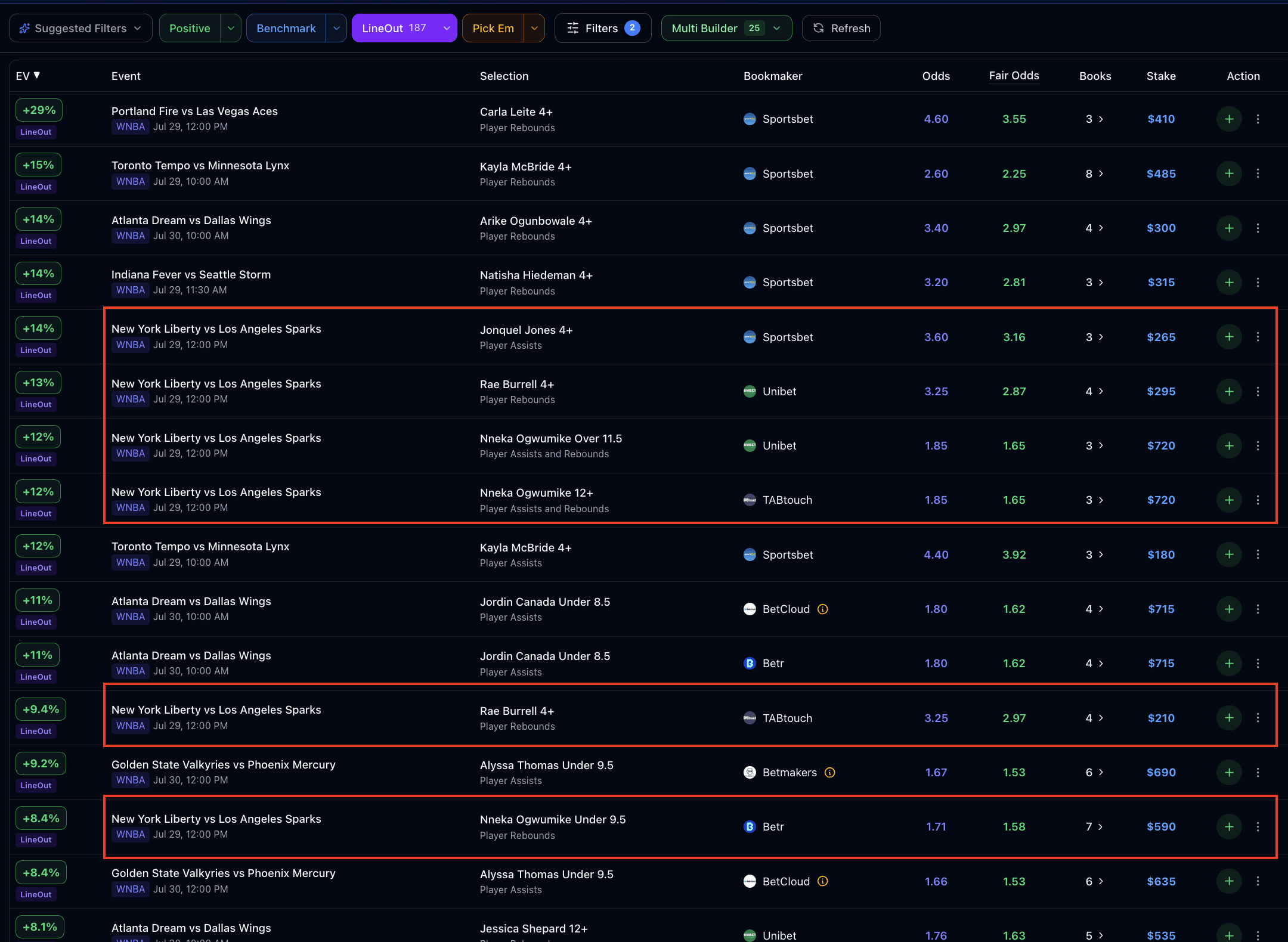
Multiple stats on one player. This is more direct exposure. If PointsBet has a player's disposal line out and it's +EV, the alternate lines and related stats on that same player are often +EV too. That's real edge, but it's concentrated edge: those bets largely win or lose together, so treating each as a full 1% unit stacks far more risk on one player than you intend.
Two sensible ways to handle it:
Scale down and cover. Take all the correlated bets, but at reduced stakes, so your combined exposure to that player is roughly one unit. You get breadth across the mispricing without over-betting a single outcome.
Take the main line only. Simply, just bet the primary line at your full stake and skip the alternates. You leave a little EV on the table for a cleaner risk profile.
Either is fine. What you want to avoid is flat-staking a full 1% on six correlated bets and calling it six bets of diversification.
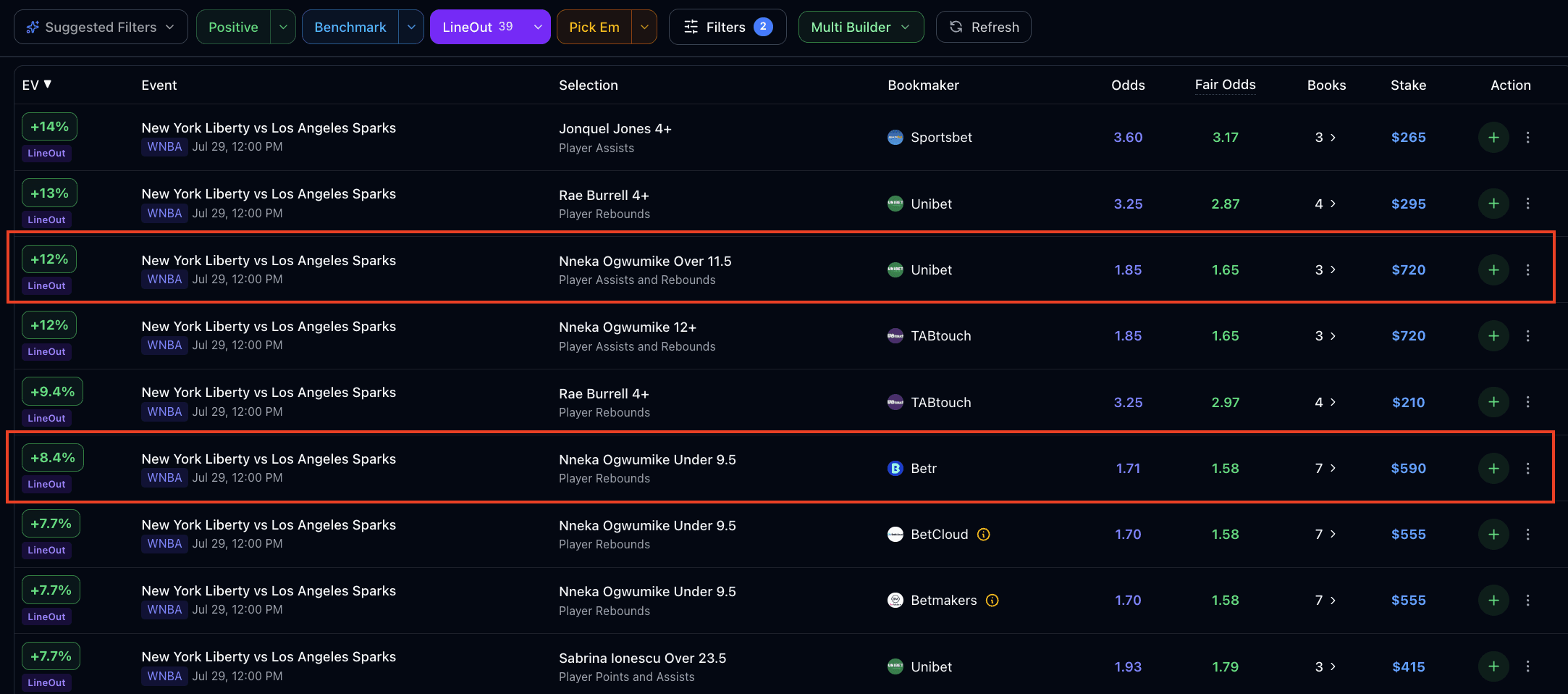
Bets on markets that are contradictory. Different tools will sometimes flag the same market both ways. These can both be positive EV if the price is sufficiently high. You want to avoid this as it just caps your upside. When bets conflict, the easiest strategy is just to take the highest EV and leave the other.
Staking and account longevity
Most Australian books are soft books, they limit or ban punters who look sharp. Come out the gates betting $500 on niche prop markets without warming the account up first, and you'll get banned fast.
This is a particular problem for top-down betting, because most of the edges are on prop markets, and props carry much lower limits than main markets. When a top-down edge does land on a match market, you can get far more money down safely. But most days you're working with markets that won't tolerate large stakes, so the stake has to stay modest whether you like it or not.
Two things to factor in beyond size:
Blend in with your own activity. Keep your top-down stakes consistent with the rest of your betting. An account that suddenly starts firing precise, edge-sized bets stands out; one that keeps betting the way it always has doesn't.
Books aren't equal. Some are far more generous with limits than others, and you'll have some accounts that are well-primed and others that are fresh. Both are worth weighing when you decide how much to put where, lean on the accounts that can take it, protect the ones that can't.
If your unit is less than $100, you do not need to worry too much about staking too large
All of which is why I prefer flat staking wins: consistent stakes are the healthiest thing for an account. Even sizing keeps you looking recreational, which keeps you open, which is what lets the edge pay out over the long run.
Keeping accounts alive is its own skill, warming them up, spreading turnover, knowing which books tolerate what. Our guide on turning over money in your betting accounts covers that side in detail.
Compounding returns
By managing our staking properly, we are able to recycle through our bankroll and create daily compounding returns. This is the amazing power of top-down EV betting.
We can easily, in a risk-adjusted way, get 50 units down per day. If I know in the long-run that is going to earn me 5%. If your unit is $10, that means betting $500 per day. This would suggest a bankroll of $1,000.
But what does that mean after a month. If you bet $500 everyday for a month, you have now bet $15,000. We know we earn 5% so our expected return is $750. Now if you extrapolate this to a whole year, you would be $182,500 and have an expected return of $9,125.
Same people will laugh at 5% and say you are better off putting your money in the bank. They fundamentally don’t understand that we are recycling our funds. We started off with $1,000. We were able to grow that into $180,000 of betting where we earned 5%.
What about variance?
This is the most important concept in relation to top-down betting and it is generally quite poorly understood. If you are going to implement a top-down betting strategy, you must have a very strong understanding of this term and how it impacts your betting.
When I speak to new top-down bettors, in the first month, these are the two most common things I hear:
"This is incredible, I'm way up, this works better than you said."
"This is broken, I've been losing for weeks, it doesn't work."
Both people are wrong, and they're making the same mistake. Both are reading a short stretch of results as if it tells them something about the strategy. It doesn't. The first person got lucky, the second got unlucky, and neither result says anything about their edge yet.
You will go on losing streaks
Not might. Will.
We showed the numbers back at the top of thus guide but a genuine 2.5% edge at 2.05 odds still has a 65% chance of a 25-unit drawdown at some point across 1,000 bets.
In fact, the more you bet, the more likely you will experience a massive drawdown.
The losing streaks are already priced into every number in this guide. All the results, all the backtesting all the testimonials all would have experienced downswings.
One of the most useful things to calculate with your top-down EV betting strategy is your potential drawdown. A drawdown is how far you fall from a peak before climbing back. If your bankroll runs up to 120 units, drops to 95, then recovers, you had a 25-unit drawdown.
So your drawdown might happen from your first bet or from when you have already profited 100 units.
A drawdown doesn't necessarily cost you money in the long run but it will test your nerve, and reinforces why a consistent staking plan is important. You can’t predict when the drwdown will happen.
Because drawdowns are predictable in aggregate, a simulation can put real numbers on yours before you ever place a bet. Four are worth knowing:
Expected maximum drawdown: the typical deepest trough across your full run of bets. For a 2.5% edge at 2.05 odds over 1,000 bets, that's around 32 units. This is the "how bad does it normally get" number, and normally is deeper than people expect.
Drawdown probability: the chance of hitting a drawdown of a given size. At those same inputs, a 25-unit drawdown has a ~65% chance of occurring.
Longest losing streak: the most consecutive losers you'll typically sit through. This is the one that feels worst, even when the dollar drawdown is modest, because it's the run that makes you doubt everything.
Time to recovery roughly how many bets it takes to climb back to a previous peak. Deep drawdowns don't reverse in an afternoon; they grind back over volume, which is why patience is a requirement and not a virtue.
Which is exactly what the EV simulator is for. Put in your edge, odds and stake, and it hands you your own drawdown figures. Knowing this number will help a lot when you experience a drawdown.
Here is an example my own personal example. If you look at my graph over the last 18 months it looks like a pretty straight path up and to the right. But that’s only because I have 10,000+ bets.
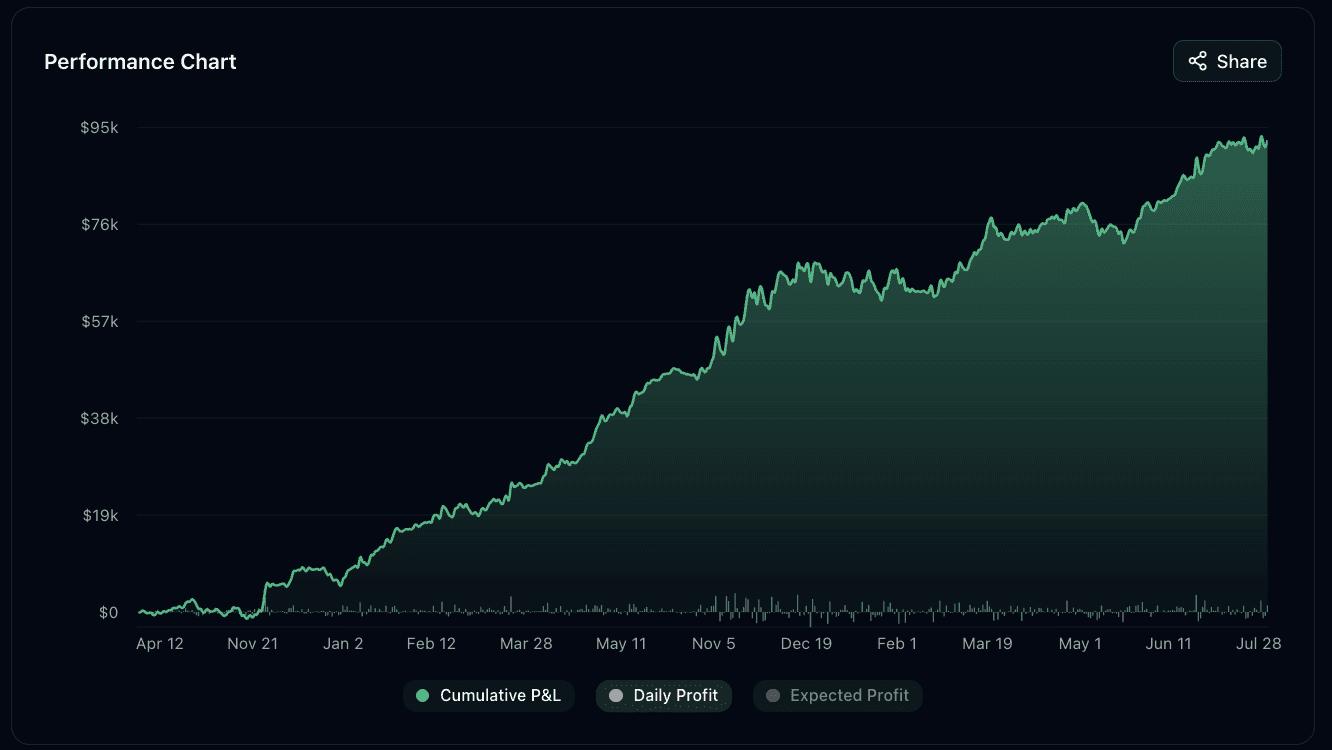
But in this journey, I have had some serious drawdowns.
In a 21 day period, over 813 bets, I went down 73.3 units ($100 per unit).
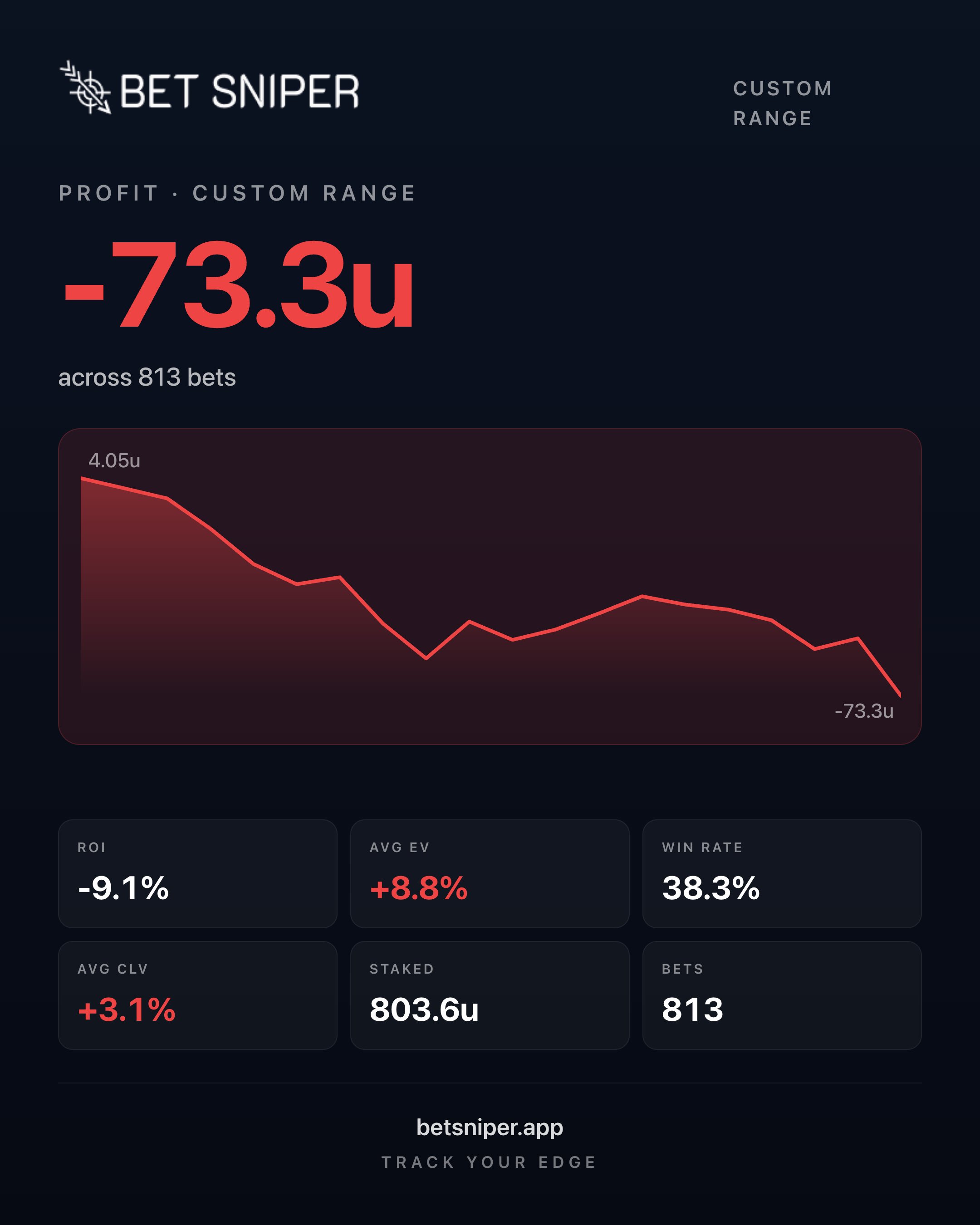

I could have easily let this rock my confidence. But I trusted the process and just kept true to the process. Based on my bankroll the probability of having a drawdown this big was 28.2%.
But as soon as I bottomed out, I went on a great run. over the next 20 days, all my losses were almost returned as I went up 73.2 units in 702 bets.
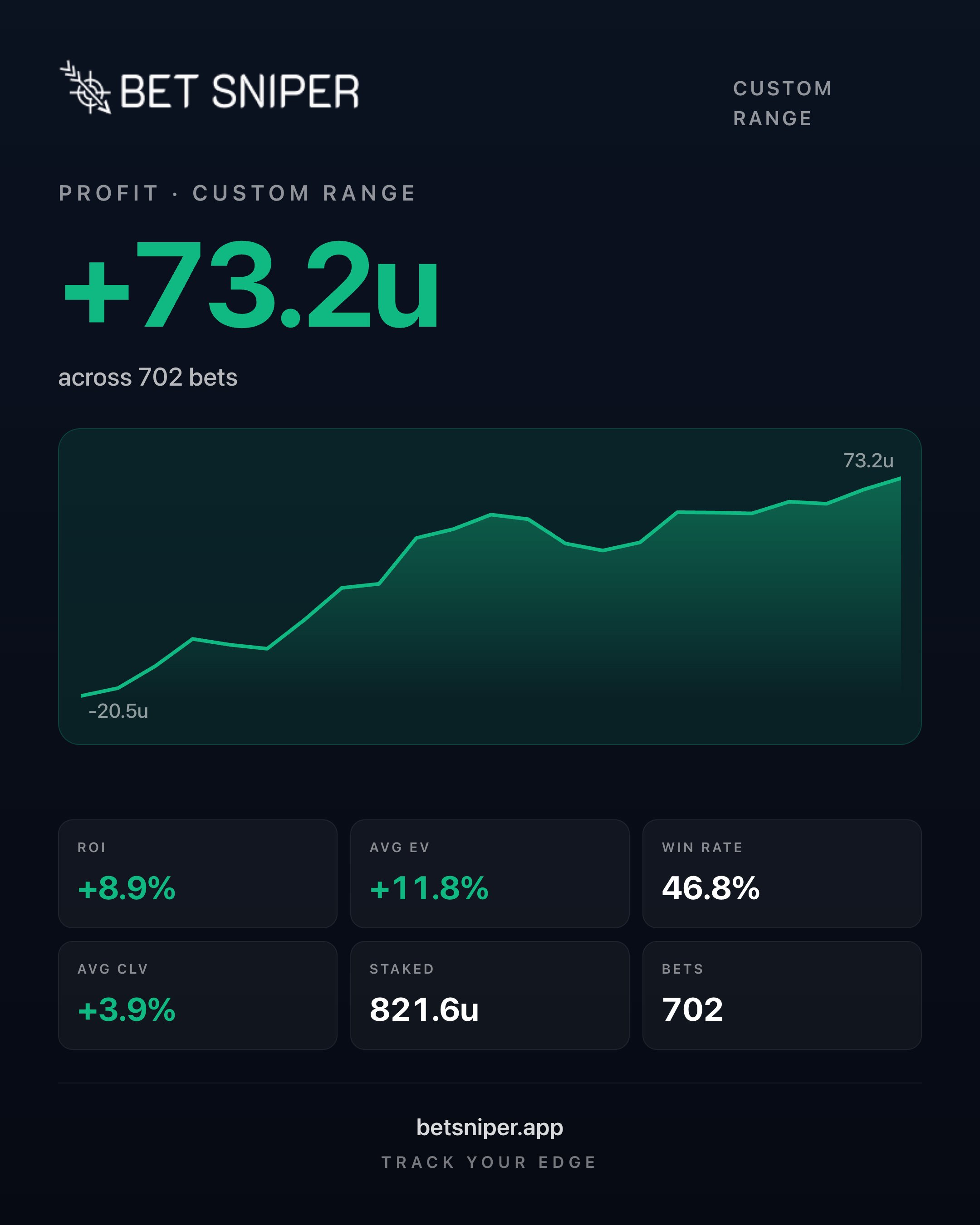
This is all part of top-down EV betting. It’s not a bug. It’s a feature. It’s important you understand this deeply.
Variance is predictable
Bet to bet, there is variance that we can’t predict. Even after hundreds of bets, there still may be big part of variance at play depending on size of edge and odds. But in aggregate, after thousands of bets we can have a very good understanding of where you will be going.
That's what a Monte Carlo simulation does, it plays out your strategy thousands of times over and maps the full range of outcomes. From the simulation we can put numbers on your likely deepest drawdown, how often you'll be underwater, and how wide your final result is likely to land.
In the short-run the distribution of results you can achieve is very wide. But over 5,000, they will cluster tightly around your true edge. This is the single most important idea in the section: variance doesn't shrink because your luck improves. It shrinks because volume dilutes it. More bets is the only thing that turns a wide, scary distribution into a narrow, reliable one.
What impacts variance?
You can have some control over the variance.
If you hold the edge constant, your variance will be much lower with lower odds. Neither is more profitable if the same edge. But your experience will be very different playing shorter odds.
We recommend playing odds below 3 to avoid very high variance. But there are still tons of top-down EV opportunities at odds greater than 3. They just have a much higher risk associated with them.
If you play multis, or Pick’Ems, your odds are naturally going to be higher. These strategies are much higher variance. You should adjust your stake and be patient. They often take a lot more volume to guarantee profit and get the edge on your side.
Further, the EV % itself will impact variance. Smaller edges will lead to bumpier results. But if you filter for edges that are too high, you will limit the amount of opportunities you can bet.
Before you start any top-down betting, we encourage you to use our free simulator so you can see how odds, bankroll and staking impacts your path.
The top-down bettor mindset
Everything in this section comes down to one mental shift: stop judging the strategy by short-term results. It's the wrong instrument for the job.
A good week doesn't mean you've cracked it. A bad month doesn't mean it's broken. Both are just variance, and reading either one as a verdict is how people talk themselves into quitting a winning strategy or into over-staking a lucky one right before it regresses.
These strategies are all backed with thousands of bets plus a mathematical reason. If you are going to pursue a top-down betting strategy you have to believe the strategy. So as long as you believe in the strategy, then it’s just a game of patience.
The punters who make this work aren't the ones who pick better. They're the ones who keep betting the same way through both the hot streaks and the cold ones, trusting the maths to surface over volume. That's the whole game: a small edge, placed consistently, enough times that variance runs out of room to hide it.
You will go on losing streaks. You'll also go on winning heaters that flatter you. Treat both the same.
How do you know if the strategy is working?
The most important thing is sample size**.** ROI over 50 bets is meaningless . The useful question is: how many bets before my results actually reflect my edge rather than luck? The simulator answers it with a number called N₀ — the sample size at which your expected profit overtakes your variance, the point where the signal reliably clears the noise. Below N₀, being up or down is mostly luck and your ROI isn't worth reading. So before you read any of your numbers, check them against N₀: if you're not past it yet, the honest answer to "is it working?" is you don't have enough bets to know.
For EV betting into liquid markets, a better judge of your edge can be your CLV (closing line value): whether the price you took beat the market's closing price. If you consistently bet better than the close, you're finding genuine value, and the profit follows over volume even if it hasn't yet. CLV tells you you're right before the results do, which is why sharp punters trust it more than their P&L. Alongside it, track realised EV vs expected, is your actual return converging on the EV% the tool flagged when you took the bet? Early on it'll be miles off in both directions; over a big enough sample, a strategy that's working pulls into line.
Recommendations to be a succesful top-down EV punter
These recommendations are general across all the different strategies:
Things to do
Bet as close to the start of the event as you can. Prices sharpen as the market matures, late news gets absorbed, lines settle, and your fair price is at its most accurate. This matters most in sports prone to late changes (NBA scratches, team news), so plan your betting day around when your best volume actually lands rather than firing early and wearing the price movement.
When you're uncertain, demand more references. More books pricing a market means a more reliable fair price. If a bet looks marginal or the market feels thin, raising your minimum book count is the simplest way to bet only the edges you can trust.
Manage your exposure to any one player or book. Too many bets on one player (correlated) or one match (abnormal results) concentrates your risk.
Stake consistently, in round numbers. Flat, boring, repeated stakes do two jobs at once: they let variance play out cleanly, and they keep you looking recreational. $50, not $48.60.
Consider multis for edge and account health. Combining legs increases your edge and, because multi bettors look recreational, is gentler on account longevity than firing precise singles all day. When you combine two independent top-down EV edges together, your edge compounds (but so does your variance). If account limits are your main worry, leaning toward multis is a legitimate way to play.
Take the highest-EV version of any bet. Same pick at two books, or the same market flagged by two tools, take the best price once.
Get comfortable before you scale. Bet under 3.00 odds, at recommended filters, until you've felt a real drawdown and kept going. Comfort with your strategy is extremely important before you can think about scaling.
Things to avoid
Don't bet to the cent, and don't bet too big. Oddly precise stakes ($47.30) scream "this person is calculating true prices" and get accounts reviewed fast. Oversized stakes get you limited and risk ruin in a normal drawdown. Round and modest on both counts.
Don't bet far out from the event. The earlier you bet, the more the price can move against you before the market settles. Yes, there are huge edges if you bet days before an event but it’s the easiest way to get limited.
Don't bet contradictory markets. When two tools flag the same market in opposite directions, both can technically be +EV, but betting both just caps your own upside. Take the higher EV and leave the other.
Don't judge the strategy by a short run. Fifty bets tell you nothing. Neither a hot week nor a cold month is a verdict. Trust the process and play volume.
How to use the tool
Although there is a lot of information to learn, implementing a top-down EV betting strategy is actually quite simple.
Start with the filters. Hit Suggested Filters for our tested settings, or build your own. Then work down the list from highest EV and get as many bets on as you reasonably can.
If you want to bet less, than you can increase the EV% threshold or increase the number of references you require.
You can also customise your filters based on whatever preference you have.
Add your bets to the bet tracker by clicking the + button. This will track your EV and CLV. Bets can be automatically settled as well.
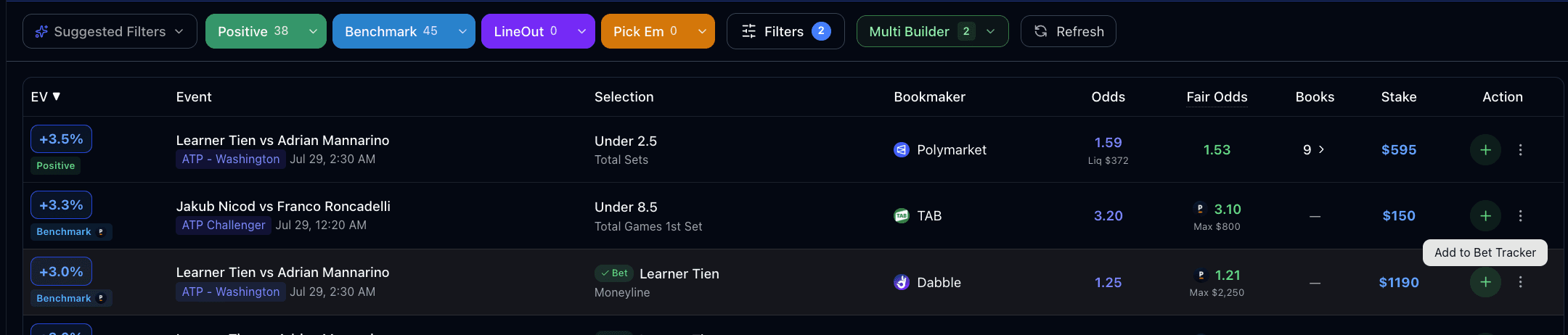
You can also easily track your multis from the top-down EV.
For a live demo of how to use the tool and the filters, please watch this video.
Your First 30 Days
Here is a plan you can follow to give you the highest chance of success in the first 30 days
Day 1: Set up before you bet. Read this guide end to end and watch the walkthrough video. Then book a strategy call with the BetSniper team to clear up anything you're unsure about. Feel free to also join the Discord and verify yourself where there is always good discussion. Make sure you have enough money deposited at the books so you are ready to jump on any edge you see.
Week 1 — Volume at low stakes. Turn on Suggested Filters and start working from the top of the screen down. Keep your stakes deliberately low while you learn the rhythm and get comfortable with the tool. This will not be about making money but rather understanding the process. Stick to Positive EV, Benchmark EV and Line Out EV to start, take every bet that meets your filters, and track all of them in the bet tracker.
Week 2 — Scale to a standard unit and broaden out. Once you get the hang of navigating the tool and have some results, you want to set your bankroll and you want to bring your stakes up to your normal 1% unit. This is also the week to explore the multi side: try a few multis, and have a go at building a Pick'Em so you understand how the fixed-payout maths and the added variance actually feel. Keep the volume up and keep tracking everything.
Week 3 — Plan your volume. Look ahead at the week's fixtures and work out when your best betting windows are. The goal is to get as many quality bets down as you can in the windows that matter, rather than betting whenever you happen to open the app.
Week 4 — Review against the right numbers. Pull up your tracked bets and ask: Are you beating the closing line? Is your realised edge tracking what the tools flagged? And do you have enough bets to trust any of it? Aim for ~500 bets across the month if you can, enough to start seeing signal through the noise. If you're profitable and beating CLV, you're doing it right; keep going exactly as you are. If you're not, message us, send through your bets and we'll review them and point you at what to fix.
FAQ
Do I need to know anything about sports to do this?
No. Top-down betting is about prices, not predictions. You never need a view on whether a player will have a good night, you need to know the fair price and whether the price in front of you beats it. The maths does the rest.
Is this legal?
Yes. You're placing ordinary bets with licensed Australian bookmakers. Nothing about finding better-than-fair prices breaks any rule — you're just betting more selectively than most people.
How much money do I need to start?
There's no fixed minimum, but your bankroll should be large enough that 1% is a workable bet size and can absorb a normal drawdown without ruining you. Since drawdowns of 25–30 units are routine, a bankroll of at least 50–100 units is sensible.
How is this different from arbitrage betting?
Arbitrage locks in a guaranteed profit on every bet by covering all outcomes: low risk, low return, no variance. Top-down EV doesn't guarantee any individual bet; it wins on margins over volume, with a higher long-run return but real swings along the way.
How is this different from tipping services?
A tipster tells you what they think will win. Top-down betting tells you which prices are mathematically mispriced, with a tracked edge behind every one. You can log on at any time and see what edges are available.
Do I have to bet every single bet on the list?
No, but the more +EV bets you get down, the faster the edge turns into profit. Work from the top (highest EV) and place as many as you reasonably can. If you want fewer, raise your minimum EV and book count.
What's a good EV% to look for?
We recommend a floor of 2%, enough margin of safety over the fair-price estimate. Higher EV means higher return per bet but fewer opportunities. Chasing only very high EV isn't better; it starves you of volume.
Which tool should I start with?
Positive EV. It has the most volume across the most sports and is the easiest to get comfortable with. Add Benchmark EV and Line Out EV as you go, and leave Pick'Em until you're ready for its much higher variance.
Do I need to bet right before the event?
Close to the start is generally better, prices sharpen, late news gets priced in, and your fair price is at its most accurate.
Can I do this with just one bookmaker account?
Not really. Top-down betting works by comparing prices across books and betting wherever one is out of line, so the more books you can bet with, the more edges you can act on. One account severely limits what you can catch.
Want to speak to a top-down EV betting expert?
We have been playing top-down EV betting strategies for 10+ years and have netted $200,000+ in profit over this period. We are offering free consulting call (normally valued at $299) ****for customers who sign up to our free 7-day trial.
Answer all your questions about top-down EV betting
Share our insights and strategies that we use to make money from top-down EV betting today
Formulate a personalised plan that fits around your risk appetite, bankroll and lifestyle
If you would like to learn how to implement a positive EV betting strategy, please book in a call here.




Learn how to become a profitable punter with our guide
We have put 20+ years of betting knowledge into one guide to help you become a better punter as well as share why each Betsniper tool exists, how to use it and the best strategies you can implement today with the Betsiper tools!

Co-founder
I've been betting seriously for over a decade, ever since I realised you can actually make money from sports betting. I studied Economics and Finance at the University of Melbourne and funded my entire time there through betting. Over the years I've become obsessed with building tools and taking a mathematical, strategic approach to the markets. I've poured that experience into building Betsniper - the ultimate companion tool for the smart punter. I now spend my time educating others on how to think about betting strategically, discovering new strategies and ultimately making as much money as possible from sports betting.


Get access to cutting-edge technology as well as a helpful community to help you start making smart decisions when you are betting.


